On this page
How to identify it
Look-alikes
| Look-alike | How to tell them apart |
|---|---|
| Seven-spotted lady beetle | The seven-spotted lady beetle is a closely related lady beetle from Europe that was introduced to North America. Researchers link its spread to the nine-spotted lady beetle's decline, so it is now the one you are far more likely to see.[2][4] |
| Multicolored Asian lady beetle | The multicolored Asian lady beetle is another non-native lady beetle named as a possible competitor of the nine-spotted lady beetle.[1] |
Where it lives
Native to North America. In Ontario it was once found throughout the south of the province and as far north as the eastern shore of Lake Superior, but there have been no Ontario records since the mid-1990s. Its range and numbers have shrunk across North America.[1][3]
Biology and life cycle
It lives in many kinds of places, including farm fields, suburban gardens, parks, coniferous and deciduous forests, prairie grasslands, meadows and streamside areas.[1]
It feeds on aphids. In lab trials, nine-spotted lady beetles stayed on plants longer than seven-spotted lady beetles when aphids were scarce.[1][2][4]
When nine-spotted and seven-spotted larvae were kept together, the seven-spotted larvae often ate the nine-spotted ones, especially when aphids were scarce. At low aphid numbers only 6 percent of nine-spotted larvae survived alongside seven-spotted larvae, compared with 61 percent at high aphid numbers.[2]
A study of Ohio museum records from 1900 to 2018 found that the nine-spotted lady beetle's decline there began before non-native lady beetles arrived and was tied to changes in land cover.[5]
Damage and signs
Health risk
The sources describe it only as an aphid predator and a species of conservation concern; they mention no harm to people.[1][6]
Control
Prevention
No control is needed. In Ontario the species is listed as endangered and is protected by law. If you find one, photograph it and note the exact location; Ontario asks for sightings to go to its Natural Heritage Information Centre.[1]
Pesticides and chemicals used against aphids, the beetle's food, are listed among the possible threats to it, along with habitat loss.[1]
Common questions
- Why did the nine-spotted lady beetle become rare?
- The exact cause is not known. Lab studies show the introduced seven-spotted lady beetle eats and outcompetes nine-spotted larvae, and an Ohio study tied part of the decline to land-cover change that started before the non-native beetles arrived. Pesticides and habitat loss are also listed as possible threats.[1][2][3][5]
- How do I tell it from a seven-spotted lady beetle?
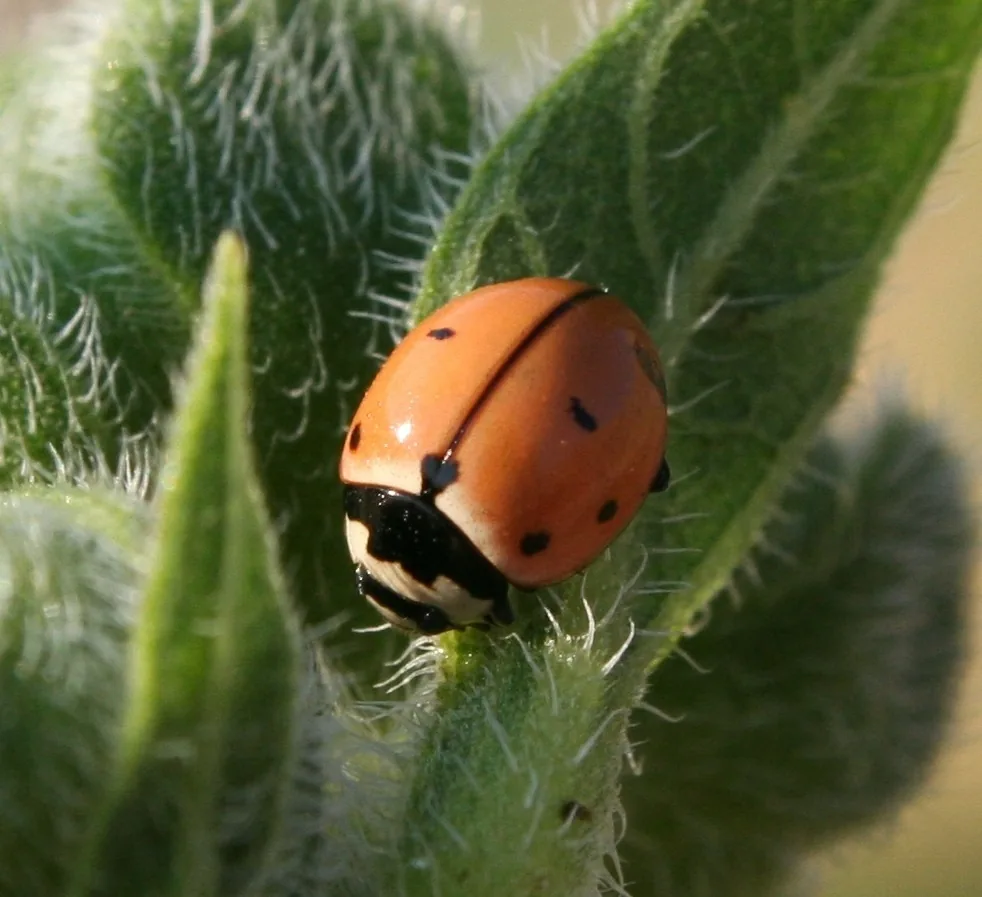
- Count the spots. The nine-spotted lady beetle usually has nine black spots on pale orange to red wing covers, though spot size and number vary, so a photo for an expert is the safest way to confirm a find.[1]
- What should I do if I find one?
- Leave it where it is, take clear photos and record the location. In Ontario, sightings go to the Natural Heritage Information Centre.[1]
Sources
- Government of Ontario, “Nine-spotted Lady Beetle (species at risk in Ontario).” www.ontario.ca/page/nine-spotted-lady-beetle (accessed 2026-11-09)
- Environmental Entomology (Entomological Society of America), “Intraguild interactions of native and introduced coccinellids: the decline of a flagship species (Tumminello, Ugine and Losey 2015, Environmental Entomology 44:64-72), abstract.” pubmed.ncbi.nlm.nih.gov/26308807/ (accessed 2026-11-09)
- Environmental Entomology (Entomological Society of America), “Effect of prey limitation on competitive interactions between Coccinella novemnotata and Coccinella septempunctata (Turnipseed, Ugine and Losey 2014, Environmental Entomology 43:969-976), abstract.” pubmed.ncbi.nlm.nih.gov/24937124/ (accessed 2026-11-09)
- Environmental Entomology (Entomological Society of America), “Interactions of Coccinella novemnotata and Coccinella septempunctata while foraging for aphids (Ugine, Hoki and Losey 2018, Environmental Entomology 47:87-92), abstract.” pubmed.ncbi.nlm.nih.gov/29340591/ (accessed 2026-11-09)
- Ecological Applications (Ecological Society of America), “Landscape change and alien invasions drive shifts in native lady beetle communities over a century (Perry et al. 2024, Ecological Applications 34:e3024), abstract.” pubmed.ncbi.nlm.nih.gov/39192693/ (accessed 2026-11-09)
- PLoS ONE, “Egg predation by the introduced lady beetle Coccinella septempunctata lowered mortality in a native lady beetle (Ugine and Losey 2015, PLoS ONE).” pmc.ncbi.nlm.nih.gov/articles/PMC4474596/ (accessed 2026-11-09)
- iNaturalist, “Coccinella novemnotata taxon page (order and family).” www.inaturalist.org/taxa/136563 (accessed 2026-11-09)