On this page
How to identify it
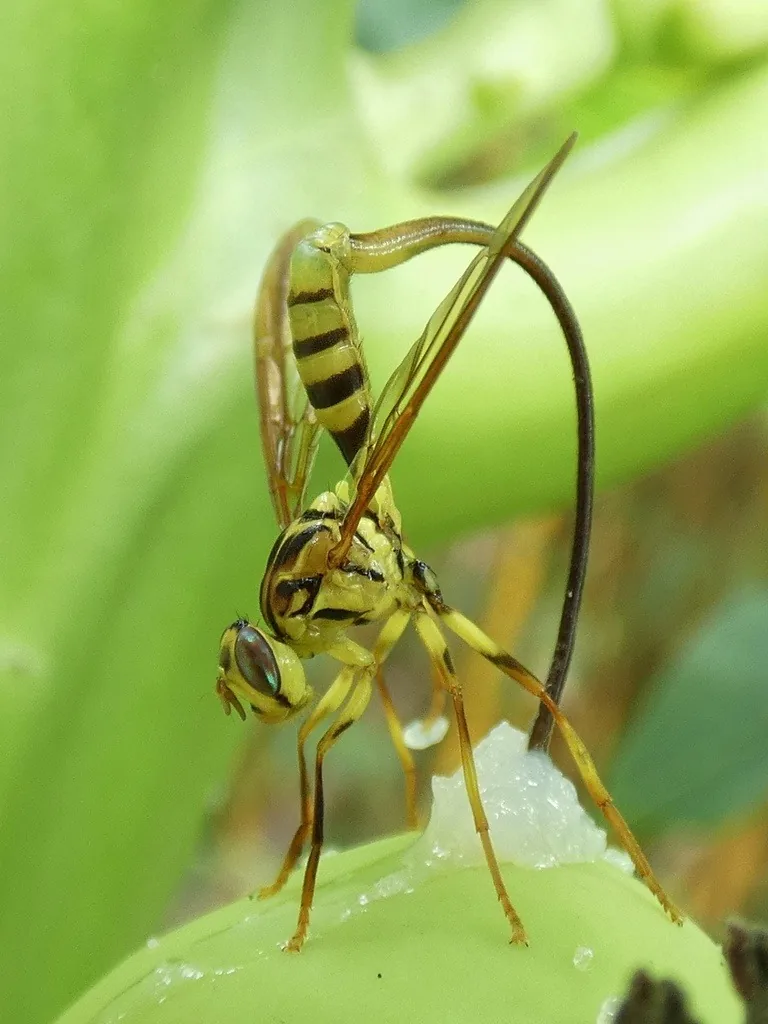
- The adult is commonly mistaken for a wasp (a vespid, the family of paper wasps and yellowjackets) because of its size, shape, coloring and behavior. It is mostly yellow marked with black, with a body about 1/3 to 1/2 inch (8.5 to 13.5 mm) long.[1]
- The female has a long, slender abdomen ending in a curved egg-laying tube (ovipositor) that is longer than her body, 9 to 14 mm. The male looks similar but lacks the ovipositor and has a hairy, less banded abdomen.[1]
- Maggots are white and grow to about 1/2 inch (13 to 15 mm), large for a fruit fly larva. They are found inside the seed cavity of papaya fruit.[1]
- The pupal cases are stout, rounded cylinders about 1/3 to 1/2 inch long, ranging from yellow to dark brown or almost black, found just below the soil surface.[1]
Look-alikes
| Look-alike | How to tell them apart |
|---|---|
| Paper wasps and yellowjackets | The papaya fruit fly is commonly mistaken for a vespid wasp. Look for the female's long, curved tail: it is an egg-laying tube (ovipositor), longer than her body, that she pushes into papaya fruit.[1] |
Where it lives
Found through the Caribbean and in Central and South America. It was introduced into Florida in 1905, probably from the West Indies on papaya shipments, first became established in the Keys and Miami, and spread wherever papayas are grown. In the United States it is found in southern Florida and southern Texas.[1]
Biology and life cycle
Papaya is the main host, wild and cultivated, but in Florida it has also been reported on mango and milkweed.[1]
Males defend a papaya fruit from rival males and release a sex pheromone to draw females, offering them a place to lay eggs. The pheromone has been identified and made synthetically.[4][2]
A female can lay 100 or more eggs. She pierces green fruit, usually about 2 to 3 inches across, and lays a group of 10 or more long, stalked eggs among the seeds in the central cavity. Eggs hatch in about 12 days.[1]
The maggots feed on the developing seeds and inner fruit for about 15 to 16 days. Juice of unripe papaya is fatal to them, so they eat their way out only as the fruit ripens, then drop to the ground and pupate just below the surface. Adults emerge in about 2 to 6 weeks, depending on soil moisture and temperature.[1]
In Florida, larvae and adults can be found in every month of the year.[1]
Damage and signs
- Infested fruit turns yellow and drops from the plant early. In Florida, 2 to 30% of fruit is infested during the spring and summer season.[1]
Health risk
Despite looking like a wasp, it is a fly; the source describes it only as a pest of papaya fruit and mentions no harm to people.[1]
Control
Prevention
The key to control is stopping egg laying, which means killing adult females before they lay eggs in the fruit. Pheromone lures and traps are used to monitor populations, and McPhail traps baited with brown sugar or pineapple juice have caught the flies in Mexico, more females than males.[1][3]
Keep them out
In small plantings (up to about 25 plants), bag each fruit when it is small, soon after the flower falls, in a paper bag or a rolled tube of newspaper tied around the stem. Enlarge the covering as the fruit grows.[1]
Sanitation
Destroy all dropped and prematurely ripe fruit, and any infested young fruit, so the maggots cannot finish developing.[1]
Biological control
Little biological control research has been done. A parasitic wasp from southern Mexico and Costa Rica, Doryctobracon toxotrypanae, may have potential.[1]
Common questions
- Why are my young papayas turning yellow and falling off?
- In southern Florida and southern Texas, papaya fruit fly is a likely cause. Its maggots feed inside the fruit, which yellows and drops early.[1]
- How can I protect papayas in a home planting?
- Bag each fruit while it is small, soon after the flower drops, in a paper bag or a newspaper tube tied around the stem, and destroy any fallen or prematurely ripe fruit.[1]
Sources
- University of Florida/IFAS Extension (Featured Creatures), “Papaya Fruit Fly, Toxotrypana curvicauda Gerstaecker, EENY-021/IN148 (H. L. Selman, J. B. Heppner and T. R. Fasulo; revised January 2012).” journals.flvc.org/edis/article/view/119598 (accessed 2026-11-09)
- Journal of Chemical Ecology (via NCBI PubMed), “Isolation, identification, and synthesis of male-produced sex pheromone of papaya fruit fly, Toxotrypana curvicauda (Journal of Chemical Ecology, 1987; abstract).” pubmed.ncbi.nlm.nih.gov/24302462/ (accessed 2026-11-09)
- Journal of Economic Entomology (via NCBI PubMed), “Two low-cost food attractants for capturing Toxotrypana curvicauda in the field (Journal of Economic Entomology, 2004; abstract).” pubmed.ncbi.nlm.nih.gov/15154449/ (accessed 2026-11-09)
- Scientific Reports (via NCBI PubMed), “The influence of male dominance in female Anastrepha curvicauda mate selection (Scientific Reports, 2021; abstract).” pubmed.ncbi.nlm.nih.gov/33737687/ (accessed 2026-11-09)
- iNaturalist, “Anastrepha curvicauda taxon page (order and family).” www.inaturalist.org/taxa/1505368 (accessed 2026-11-09)