On this page
How to identify it
- Mined needles turn brown and die, typically one needle of each pair. Under magnification the entrance hole on the flat side of the needle is often plugged with resin, and an overwintered larva leaves a round exit hole near the needle base when it moves on in spring.[1]
- The caterpillar is tiny, about 6 mm when mature, with a brown body and a dark brown head and prothoracic shield; the Forest Service's 1972 manual describes full-grown larvae as pinkish. It is found inside the needle, never exposed on the foliage.[1][3][2]
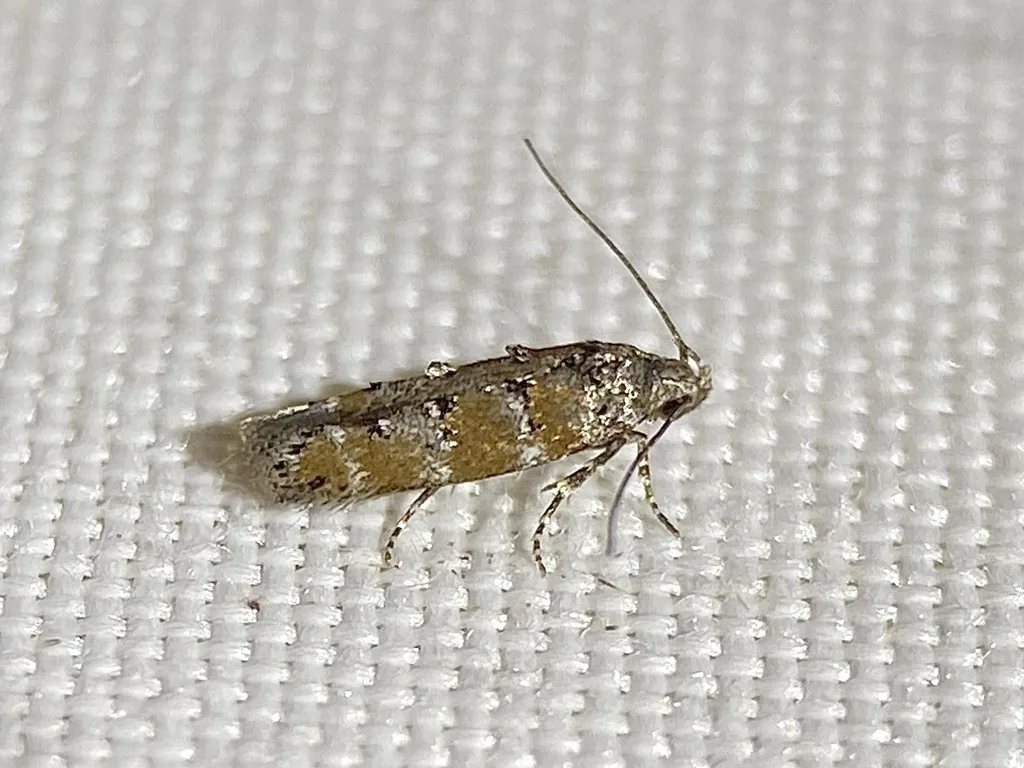
- The adult is a very small moth, wingspread about 9 mm, with reddish to golden brown forewings crossed by four narrow grayish bands and hindwings wider than the forewings.[2]
Look-alikes
| Look-alike | How to tell them apart |
|---|---|
| Spruce needleminer | Hollows out spruce needles and builds nests of dead needles and frass held together with silk; the pine needleminer works on hard pines and stays inside single needles with no web.[2][1] |
| Pine webworm | Its young larvae also mine pine needles briefly, but they soon build an obvious nest of frass and silk on the twig; the needleminer never leaves the needles.[3][1] |
Where it lives
Southeastern Canada south to Georgia and Texas, wherever hard pines grow. Jack, pitch and shortleaf pines are the preferred hosts, with Virginia, Scotch, longleaf, loblolly, red and mugo pines also attacked. UMass notes it may be more common in coastal New England than inland.[2][1]
Biology and life cycle
Eggs are laid in spring, from May to July depending on location, in needles that earlier larvae have already mined and vacated. The newly hatched caterpillar bores into the base of a current-year needle, which dies within two or three weeks.[1][2]
The caterpillar feeds in that first needle until its second instar, then moves to a fresh needle, where it feeds through the summer and spends the winter as a partly grown larva. In spring it mines to the base of the needle, cuts a round exit hole and enters a third needle, where it finishes feeding and pupates inside the mine.[1][3]
Mature caterpillars are present from April to June, and there are at least four larval instars. UMass and the Forest Service's 2004 conifer caterpillar guide give one generation a year; the Forest Service's 1972 manual says there may be two or more.[1][3][2]
At least five other needleminer species attack pines in northeastern North America, including the introduced European pine bud moth (Exoteleia dodecella), so the species is best confirmed from the adult or from the host and mine pattern.[3][1]
Damage and signs
- Each mined needle browns and dies, and the insect typically kills one needle in each pair; older larvae kill the tip of the needle beyond the entrance hole.[1][2]
- Forest-grown trees are occasionally infested heavily but are seldom seriously injured. Heavy infestations on ornamentals or in plantations can be serious, and even light browning matters on nursery stock and Christmas trees grown for sale.[2][1]
Health risk
Neither source mentions any effect on people; this is a plant pest.[1][2]
Control
Prevention
In most landscapes no treatment is needed: UMass calls the pine needleminer a minor pest of ornamental trees whose native parasitoids usually keep it below damaging levels. Check browned needles on pitch and other hard pines in spring and dissect a few under magnification to confirm caterpillars or pupae before acting.[1]
Biological control
Three parasitoid wasps (Achrysocharis, Copidosoma and Dicladocerus species) were recorded killing a share of the larvae in a 1960s Quebec study, and the Forest Service reports the mite Pediculoides ventricosus destroying over 75 percent of late-instar larvae in North Carolina infestations. Strong wind and rain during the adult flight also knock populations down.[1][2]
Pesticides
For nursery or Christmas tree plantings, UMass lists abamectin, acephate, acetamiprid, bifenthrin, cyantraniliprole, emamectin benzoate, horticultural oil, insecticidal soap, malathion, neem oil, pyrethrin plus sulfur and spinosad as active ingredients labeled in Massachusetts, with abamectin, acephate, acetamiprid and emamectin benzoate as trunk injections and chlorantraniliprole or neem oil as soil drenches; apply after bloom to protect pollinators.[1]
Common questions
- Why is one needle in each pair on my pitch pine brown?
- That pattern, with a tiny resin-plugged hole in the needle, is typical of the pine needleminer, a 6 mm caterpillar that feeds inside the needle and kills it.[1]
- Does the pine needleminer kill trees?
- Rarely. Forest trees are seldom seriously injured, though heavy infestations on ornamentals or plantation trees can be serious and the browning is a cosmetic problem on trees grown for sale.[2][1]
- How many generations are there each year?
- The sources disagree: UMass and the Forest Service's 2004 guide report one generation, while the Forest Service's 1972 manual says there may be two or more.[1][3][2]
Sources
- UMass Extension Landscape, Nursery and Urban Forestry Program, University of Massachusetts Amherst, “Exoteleia pinifoliella, Pine Needleminer, Insect & Mite Guide (Professional Guide for IPM in Trees and Shrubs).” www.umass.edu/agriculture-food-environment/landscape/publications-resources/insect-mite-guide/exoteleia-pinifoliella (accessed 2026-11-10)
- USDA Forest Service, “Eastern Forest Insects, Miscellaneous Publication 1175 (W. L. Baker, 1972; scanned copy).” archive.org/details/easternforestins1175bake (accessed 2026-11-10)
- USDA Forest Service, Forest Health Technology Enterprise Team, “Pine Needleminer (Exoteleia pinifoliella), from Caterpillars on the Foliage of Conifers in the Northeastern United States, FHTET-2004-01 (C. T. Maier, C. R. Lemmon, J. M. Fengler, D. F. Schweitzer and R. C. Reardon, 2004), Bugwood wiki archive.” wiki.bugwood.org/Archive:Caterpillars/Exoteleia_pinifoliella (accessed 2026-11-10)
- iNaturalist, “Exoteleia pinifoliella taxon page (order and family).” www.inaturalist.org/taxa/416913 (accessed 2026-11-10)