On this page
How to identify it
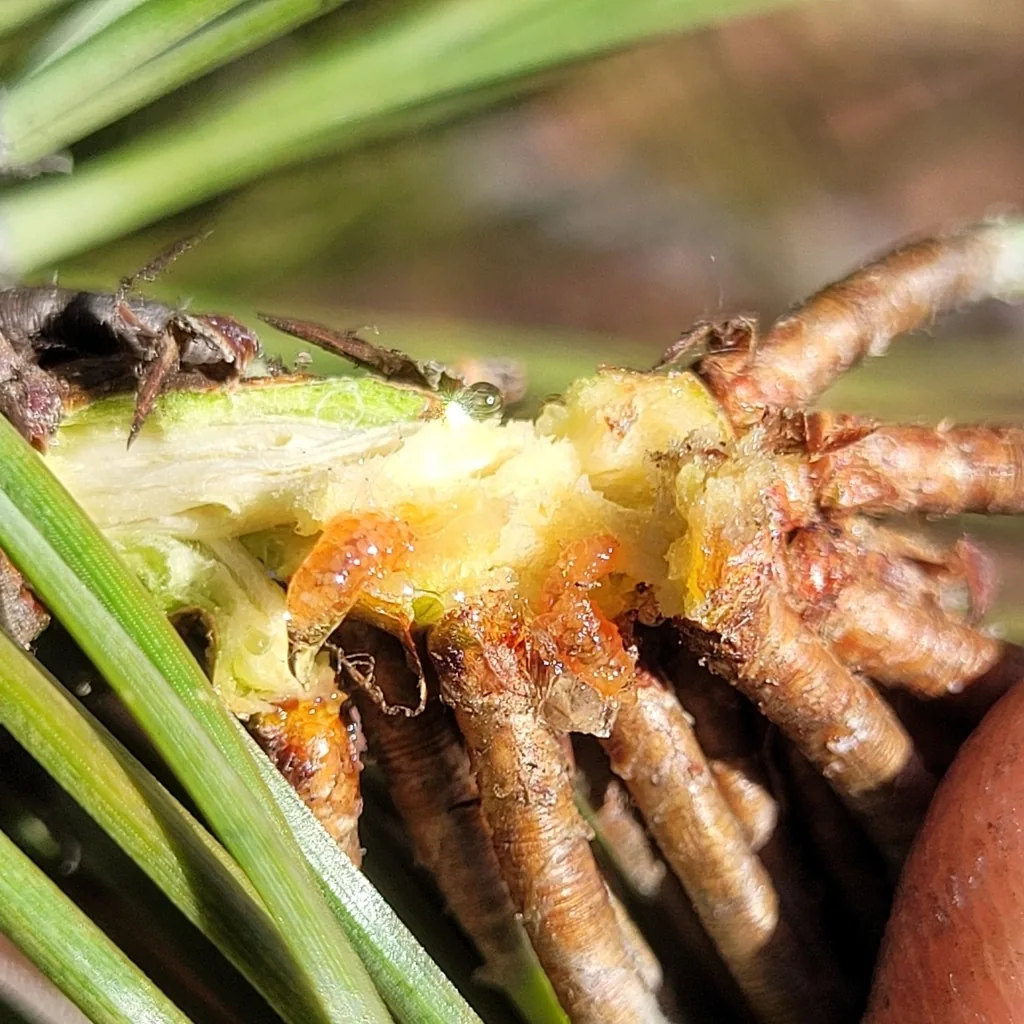
- Pitch galls are usually white masses up to almost 1/2 inch wide on pine twigs, most noticeable in early to mid April in North Carolina. Full-grown maggots inside are slender, orange and 3/16 to 3/8 inch long, keeping their rear spiracles in contact with the air.[1]
- Gouty pitch midge injury shows as slight swellings on the current year's shoot, each enclosing a feeding pit about 4 by 3 mm that holds a larva in fluid resin. Needles around the pits die in tufts, droop, turn yellow and then reddish brown; heavily hit twigs become sprigs of dead foliage, or flags, scattered over the crown.[2]
- The gouty pitch midge adult is a delicate fly about 3.5 mm long with transparent wings and a dark gray to brown body except for a crimson abdomen; the full-grown larva is 4 to 5 mm, bright orange to red, flattened and tapered, with two rows of bilobed tubercles and a shiny coat of resin.[2]
- Twigs often die from the gall to the tip, and after the midges leave, pitch galls sometimes melt and drip from the tree.[1]
Look-alikes
| Look-alike | How to tell them apart |
|---|---|
| Twig beetles and scale insects | The USDA leaflet notes that certain twig beetles and scale insects cause damage that superficially resembles gouty pitch midge work, but midge injury is distinctive: slight swellings on the shoot, each enclosing a resin-filled larval pit.[2] |
Where it lives
The gouty pitch midge is transcontinental, most common in the North Atlantic, Inland Empire and Pacific Coast states, with damage observed in western Montana, northern Idaho, northeastern Washington, southern Oregon and northern and central California and historic outbreaks in northern New York; NC State describes pitch gall midges on pines in North Carolina, and the USDA Forest Service manual records other species on Virginia and jack pine in the East.[2][1][3]
Biology and life cycle
Several Cecidomyia species lay eggs on pine twigs in spring. The maggots bore into the cambium, the pitch that flows out forms the gall, and the maggots develop inside it. Depending on the species, mature maggots either stay in the pitch and pupate in a silken cylinder, pushing through a thin cap so the pupa protrudes from the gall, or leave to pupate nearby. There is one generation a year in North Carolina.[1]
Almost all yellow pines can carry pitch galls; white pine is infested by a single species, Cecidomyia candidipes. The USDA manual records C. resinicola in small patches of resin on Virginia pine wounds, C. reeksi in the same situation on jack pine, and C. cupressi feeding in the seeds and causing a leaf gall on bald cypress.[1][3]
The gouty pitch midge (Cecidomyia piniinopis, called Retinodiplosis inopis in the 1971 leaflet) attacks only living trees and only their current year's shoots. In the East its principal host is pitch pine, with Virginia and jack pine also attacked; in the West the chief host is ponderosa pine, and it also breeds in Jeffrey pine growing near infested ponderosa. Saplings and poles 4 to 16 feet tall are hit hardest, trees under 3 years old usually escape, and older trees are attacked mainly in the lower crown.[2][1][3]
Gouty pitch midge adults fly in spring, from late March to early May in the Sierra Nevada foothills and a month or more later in colder climates. They live 5 to 12 days, mating almost immediately; each female carries 80 to 100 eggs and lays them singly or in groups of up to four behind bud scales or needle bases on expanding shoots. Eggs hatch on the sixth day, and each larva bores into the shoot within four to six days and feeds in its resin-filled pit until the following spring.[2]
In late winter and early spring the mature gouty pitch midge larvae leave their pits amid copious resin, settle mostly on the needles, spin a beaked white cocoon and pupate about a week later; the pupal period lasts 10 to 14 days. There is one generation a year.[2]
Gouty pitch midge numbers fluctuate markedly from year to year. Three tiny parasitic wasps (an egg parasite, Platygaster diplosidis, plus Eurydinota rufiventris and an Amblymerus species) sometimes kill half or more of the midges in natural stands, but parasitism in the plantations studied did not exceed 25 percent.[2]
Damage and signs
- Pitch galls are relatively common on pines and can cause minor dieback on loblolly pine; twigs often die from the gall to the tip, and dripping galls can land on cars parked beneath.[1]
- The gouty pitch midge is not a true gall maker but causes swellings and malformed twig growth. Two or three pits do no noticeable harm, but numerous pits girdle the shoot and kill it, pits along one side twist the shoot, and healed pits leave a rough corky scar. Prolonged severe infestations deform or stunt crowns, sharply reduce growth and occasionally kill trees; on young trees in outbreaks, half of the new shoots often die.[2]
- The gouty pitch midge is more injurious to planted trees than to natural stands: it was a serious enemy of pine plantations at Placerville and Mt. Shasta, California, killed plantation trees in Montana in the late 1930s, and was very abundant in northern New York from 1911 to 1913.[2]
Health risk
The sources treat these midges only as pine pests and mention no effect on people.[1][2]
Control
Prevention
Two or three gouty pitch midge pits have no noticeable effect on a tree, populations swing widely from year to year, and natural controls (parasites, host resistance and weather) usually regulate the midge's abundance; the USDA leaflet's control advice rests on those natural controls and on tree selection, not on spraying.[2][1]
Ponderosa pines with sticky, resinous new shoots are more prone to gouty pitch midge injury than trees whose shoots are dry and smooth or covered with a waxy bloom. Where the midge is a problem, choose planting stock and seed trees with dry or waxy shoots and remove sticky-shooted trees (about a third of a stand) when thinning. Tree vigor has little to do with susceptibility.[2]
Pesticides
On a small specimen tree, NC State says a pesticide would have to be timed to the adult stage: keep a few galls with maggots inside a clear plastic bag in the shade outdoors and spray a contact insecticide when the tiny midges appear in the bag. A systemic insecticide injected into the soil or trunk might give some control.[1]
Common questions
- What are the white blobs of pitch on my pine twigs?
- White pitch masses up to almost half an inch wide on pine twigs in spring, each holding slender orange maggots, are pitch galls made by Cecidomyia midges. They are most noticeable in early to mid April in North Carolina.[1]
- Why do my ponderosa pine shoots have dead needle tufts and twisted tips?
- Tufts of dead needles that droop and turn yellow then reddish brown, flags of dead foliage scattered over the crown, and shoots twisted by pits along one side are the marks of the gouty pitch midge, whose larvae feed in resin-filled pits in the current year's shoots.[2]
- Will pitch gall midges kill my tree?
- Rarely. Pitch galls cause at most minor dieback on loblolly pine, and even the gouty pitch midge seldom kills trees, though prolonged severe infestations stunt crowns and reduce growth, and occasionally kill trees.[1][2]
Sources
- NC State Extension, “Pitch Gall Midges, PDIC factsheet (J. R. Baker; revised February 19, 2024).” content.ces.ncsu.edu/pitch-gall-midges (accessed 2026-11-10)
- USDA Forest Service, “Gouty Pitch Midge, Forest Pest Leaflet 46 (C. B. Eaton and J. S. Yuill, revised October 1971; scanned copy).” www.fs.usda.gov/foresthealth/docs/fidls/FIDL-46-GoutyPitchMidge.pdf (accessed 2026-11-10)
- USDA Forest Service, “Eastern Forest Insects, Miscellaneous Publication 1175 (W. L. Baker, 1972; scanned copy).” archive.org/details/easternforestins1175bake (accessed 2026-11-10)
- iNaturalist, “Cecidomyia taxon page (order and family).” www.inaturalist.org/taxa/334824 (accessed 2026-11-10)