On this page
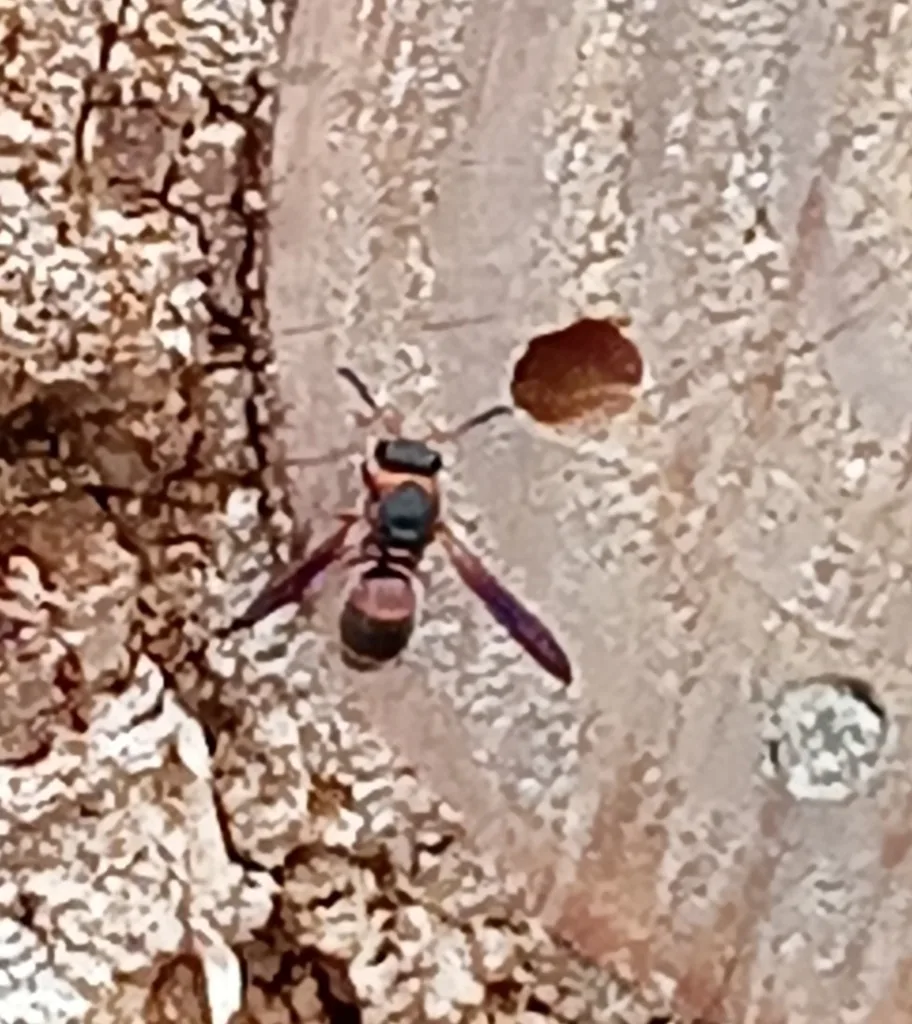
How to identify it
Look-alikes
| Look-alike | How to tell them apart |
|---|---|
| Mud dauber wasps | Mud daubers belong to different families, are usually larger and slenderer, and build exposed mud nests stocked with spiders.[2] |
| Potter wasps | Close relatives in the same subfamily that also seal nest cells with mud.[2] |
Where it lives
Mostly in the southeastern United States, from the coasts of Florida to North Carolina and west to eastern Texas.[1]
Biology and life cycle
Each female builds her own nest in a cavity, separating cells with plugs of sand and grit; each cell gets one egg hung from a thread and seven to ten paralyzed caterpillars.[1]
Nests may contain one to eight cells, with female eggs laid toward the inside and males toward the entrance.[1]
Damage and signs
Health risk
No particular risk is described; these solitary wasps are generally beneficial.[1][2]
Control
Prevention
If they nest in outdoor wooden furniture and you don't want them there, clean the item and seal the holes with wood putty or polyurethane.[2]
Common questions
- Are the small wasps going in and out of holes in my bench eating the wood?
- No; potter and mason wasps only nest in existing holes and hunt caterpillars.[2]
Sources
- University of Florida IFAS Extension (EDIS, Featured Creatures), “Red and Black Mason Wasp, Pachodynerus erynnis (EENY-760).” ask.ifas.ufl.edu/publication/IN1293 (accessed 2026-10-16)
- Clemson Cooperative Extension Home & Garden Information Center, “Potter and Mason Wasps.” hgic.clemson.edu/potter-and-mason-wasps/ (accessed 2026-10-16)
- iNaturalist, “Pachodynerus erynnis taxon page (order and family).” www.inaturalist.org/taxa/338573 (accessed 2026-10-06)