On this page
How to identify it
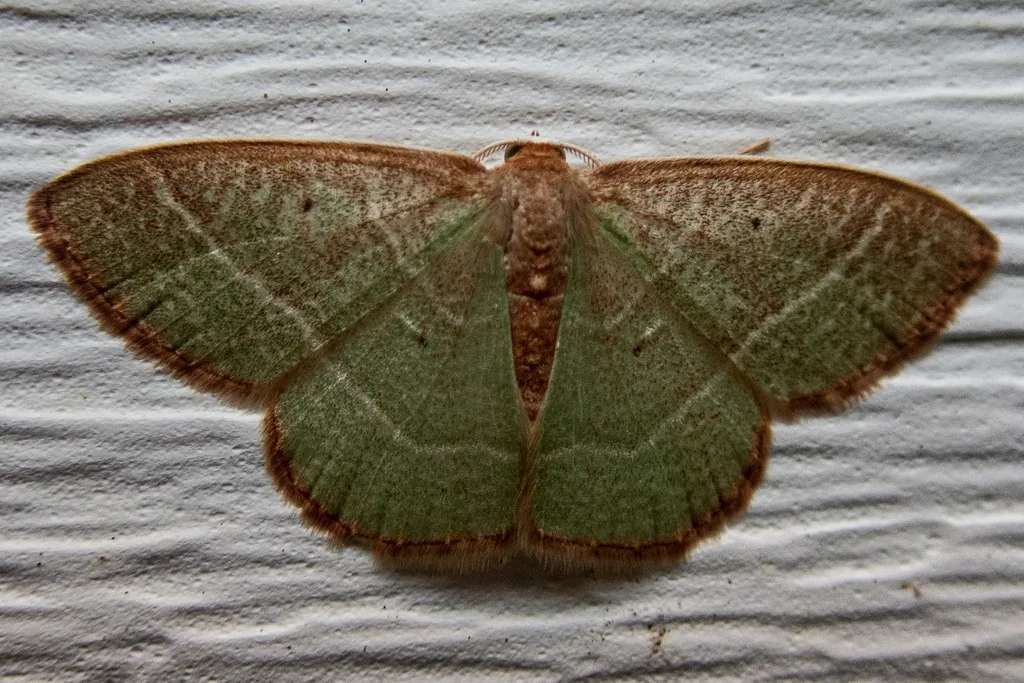
- Both seasonal forms have two thin white lines across the wings, running parallel to the outer edges and flowing unbroken from the forewings onto the hindwings.[1]
- Summer adults are green, and their wing edges can carry a pink or pink-checkered fringe. Spring adults are tan.[1]
- The abdomen has white spots that are usually outlined in red. The wingspan is 3/4 to 1 inch.[1]
- The caterpillar is an inchworm under 2 cm (about 3/4 inch) long, colored anywhere from tan or straw to rust, brick red, brown or nearly black, with a spiny body and paired, winglike flanges on the front abdominal segments. Resting on the edge of a dying leaf, it looks like a scrap of dead leaf.[2][1]
Look-alikes
| Look-alike | How to tell them apart |
|---|---|
| Wavy-lined emerald | Very similar, but its wing fringe is pale green rather than reddish, and it has an unbroken white stripe along the top of the abdomen instead of red-ringed white spots.[1] |
| White-fringed and red-fronted emeralds | Their caterpillars live alongside red-fringed emerald caterpillars over much of the Northeast and are hard to tell apart; the USDA Forest Service advises basing identifications on the adult moths.[2] |
Where it lives
The USDA Forest Service gives its range as extreme southern Canada to Florida and eastern Texas, in forests and woodlands. In Missouri it is found statewide in most wooded areas, because white oaks are common there.[2][1]
Biology and life cycle
The caterpillars eat white oak and other oaks, walnut and birch, and the USDA Forest Service adds gale, sweetfern and other woody plants.[1][2]
Adults fly at night from April into September, with two or more broods a year. In Connecticut there are two generations, with full-grown caterpillars in June and early July and again from late August into October.[1][2]
In this genus, what the caterpillars eat influences their color and pattern. In a related species, caterpillars fed low-tannin diets were pale with enlarged flanges, the form often found on oak catkins in spring, while those fed tannin-rich food such as summer leaves grew into a grayer, more twiglike form with smaller flanges.[2]
Damage and signs
Health risk
Neither the Missouri Department of Conservation nor the USDA Forest Service mentions any bite, sting or other risk to people.[1][2]
Control
Prevention
Neither source recommends any control. Every stage, from egg to adult, is food for predators.[1][2]
Common questions
- Why are some red-fringed emeralds tan instead of green?
- The species has two seasonal forms. Adults that emerge in spring are tan, and those that emerge in summer are green.[1]
- Why do I find little green moths on my house in the morning?
- They may be red-fringed emeralds. Like most moths they are active at night and attracted to lights, and the Missouri Department of Conservation notes you may find them perched on the side of your house near lights in the morning.[1]
- What do the caterpillars look like?
- They are spiny inchworms with winglike flanges along the sides, tan, brown or reddish, and they look like bits of dead leaf when they rest on a leaf edge.[2][1]
Sources
- Missouri Department of Conservation, “Red-Fringed Emerald (Field Guide).” mdc.mo.gov/discover-nature/field-guide/red-fringed-emerald (accessed 2026-11-09)
- USDA Forest Service, Forest Health Technology Enterprise Team, “Geometroid Caterpillars of Northeastern and Appalachian Forests, FHTET-2001-10 (D. L. Wagner, D. C. Ferguson, T. L. McCabe and R. C. Reardon, September 2001; scanned copy).” archive.org/details/geometroidcaterp00wagn (accessed 2026-11-09)
- iNaturalist, “Nemoria bistriaria taxon page (order and family).” www.inaturalist.org/taxa/203831 (accessed 2026-11-09)