On this page
How to identify it
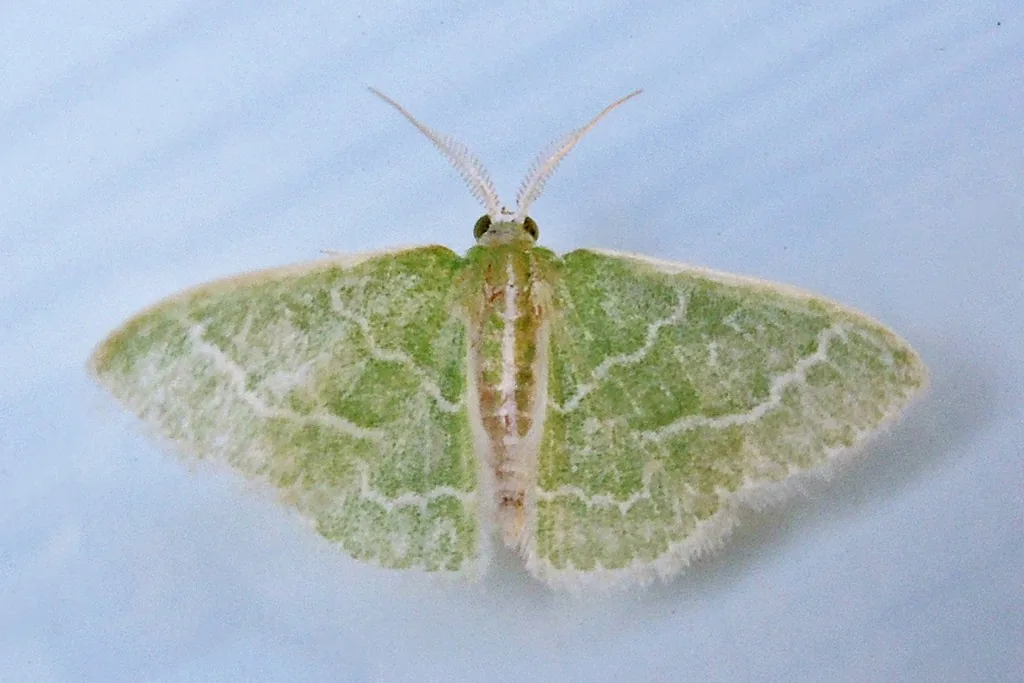
- Like most emeralds, it is a green moth that rests with its wide wings spread out to the sides. Look for mildly wavy white lines across the wings, a pale green fringe along the wing edges, and a long, thin white stripe running the whole length of the abdomen.[1]
- The wingspan is only 1/2 to 1 inch.[1]
- The caterpillar is an inchworm decorated with petal fragments and other plant bits, which it binds with silk to pale projections along its back. Under the costume the body is mottled brown, black and white and densely set with tiny spines, with an oblique white line through each breathing pore.[3]
- Fresh petal clippings can make the caterpillar pink, purple or golden yellow; as they dry, they look like crumbs.[1]
- A full-grown caterpillar is about 1.5 cm (a little over 1/2 inch) long.[3]
Look-alikes
| Look-alike | How to tell them apart |
|---|---|
| Southern emerald | A close relative with similar coloring, but its cross lines are much more scalloped or jagged, forming little points where they cross the wing veins. It is more numerous in the southeastern United States.[1] |
| Red-fringed emerald | Red-fringed emeralds have a reddish fringe on the wing edges and white spots on the abdomen that are usually outlined in red. The wavy-lined emerald's fringe is pale green, and its abdomen has an unbroken white stripe.[2] |
Where it lives
In its guide to eastern forest caterpillars, the USDA Forest Service gives its range as southern Canada to Florida and Texas, in fields and other open habitats. In Missouri it is found statewide and is most abundant in and near prairies, pastures, old fields and roadsides.[3][1]
Biology and life cycle
The caterpillars feed on many plants. They are most often seen on composite flowers such as sunflowers, coreopsis, coneflowers, blazing stars, goldenrods, asters, black-eyed Susans, yarrow, ageratum, boneset and daisies, and they also use blackberry, raspberry, rose, sage, St. John's-wort and other plants.[1][3]
The costume changes with the menu: the caterpillar trims fragments from each new flower it moves to, and because its covering usually includes fresh stamens and petals, it apparently adds new material daily.[3]
Missouri has two or three broods a year. In Connecticut and Maryland there are two generations, with full-grown caterpillars from April into June and again from July into September; northern New England has one.[1][3]
It spends the winter as a partly grown caterpillar, about half developed.[1][3]
Damage and signs
Health risk
Neither the Missouri Department of Conservation nor the USDA Forest Service mentions any bite, sting or other risk to people.[1][3]
Control
Prevention
Neither source recommends any control. The Missouri Department of Conservation treats finding one of the decorated caterpillars as a special treat and notes that insects like this moth are important food for birds and other predators.[1][3]
Common questions
- What is the little inchworm covered in flower petals?
- It is a camouflaged looper, the caterpillar of the wavy-lined emerald moth. It snips pieces of petals and other plant bits and attaches them to its back with silk.[1][3]
- Where can I find camouflaged loopers?
- Scan the flower heads of sunflowers, asters, goldenrods, coneflowers and other composites for something that looks out of place, such as a clump of debris that starts to walk like an inchworm.[3][1]
- Do camouflaged loopers hurt flowers?
- They do eat flowers and foliage, but neither the Missouri Department of Conservation nor the USDA Forest Service treats them as pests or recommends control.[1][3]
Sources
- Missouri Department of Conservation, “Wavy-Lined Emerald (Field Guide).” mdc.mo.gov/discover-nature/field-guide/wavy-lined-emerald (accessed 2026-11-09)
- Missouri Department of Conservation, “Red-Fringed Emerald (Field Guide).” mdc.mo.gov/discover-nature/field-guide/red-fringed-emerald (accessed 2026-11-09)
- USDA Forest Service, Forest Health Technology Enterprise Team, “Geometroid Caterpillars of Northeastern and Appalachian Forests, FHTET-2001-10 (D. L. Wagner, D. C. Ferguson, T. L. McCabe and R. C. Reardon, September 2001; scanned copy).” archive.org/details/geometroidcaterp00wagn (accessed 2026-11-09)
- iNaturalist, “Synchlora aerata taxon page (order and family).” www.inaturalist.org/taxa/126204 (accessed 2026-11-09)