On this page
How to identify it
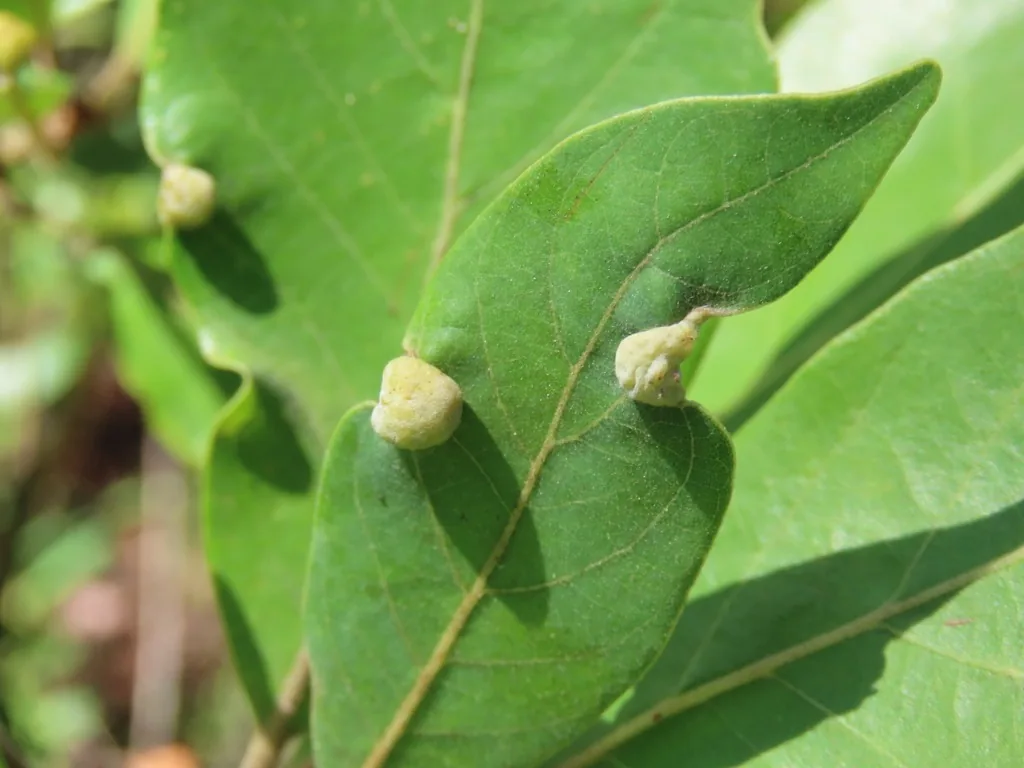
- The usual sign is the gall: the margin of a young leaf curls over into a swollen, elongated pocket that can be more than 1/2 inch long, sometimes several to a leaf.[1][2]
- Adults are about 1/8 inch (3 to 4 mm) long, pale greenish-yellow and elongate-oval with a pointed abdomen, and look like miniature cicadas.[1][2]
- Adult wings are clear and lance-shaped with pale green veins, and the thorax sometimes has brown stripes.[1]
- Young nymphs are yellow and flat. Mature nymphs are green with orange wing pads, red eyes, short black antennae and a few waxy filaments.[1][2]
Where it lives
It occurs throughout the range of its host bays, the southeastern coastal plain from Delaware to Texas, including North Carolina.[1][2]
Biology and life cycle
It lives only on Persea bays: red bay, silk bay and swamp bay. The name magnoliae is a mistake; the insect was first thought to live on sweet bay magnolia, but there are no verified records from magnolias.[1][2]
Its eggs have never been described. They may be laid under the leaf surface, or, as NC State suggests, inside leaf buds the way the related boxwood psyllid does, in which case they would wait out summer, fall and winter in the buds and hatch as growth resumes.[1][2]
As newly hatched nymphs feed, the leaf margin curls and finally wraps them in the gall. When the nymphs are mature, the gall splits along its edge to let them out, and their cast skins can be seen on the undersides of leaves.[1][2]
Galls form only on new leaves. Leaves attacked just as they open may be badly distorted, and up to eight galls per leaf, with galls on as much as 80 percent of the foliage, have been reported.[1][2]
In Florida, adults emerge mostly from April to June, peaking in mid-May. Reports differ on the number of generations, from one a year to at least three overlapping generations in Florida, and NC State expects a new generation on each flush of growth in North Carolina.[1][2]
Living inside a gall does not protect the nymphs. Tiny parasitic wasps attack them (parasitism of 25 to 45 percent was found in one Florida study, and parasitized nymphs turn dark), a predatory midge larva eats them, and small birds open the galls to feed on them.[1][2]
Damage and signs
- The damage is mostly cosmetic. NC State says even heavy infestations cause little real damage to the health of infested bays, and UF calls the main impact aesthetic, for homeowners and park managers.[2][1]
- In one study, galled leaves were smaller and aged faster, and shoots with galls grew less and produced fewer flowers, but seed production was not related to the number of galls.[1]
Health risk
Neither source mentions any risk to people or pets. It is a small sap feeder that lives on bay trees.[1][2]
Control
Prevention
Most trees can be left alone: the galls look bad but do little harm to the tree's health, and parasitic wasps, a predatory midge and birds all attack the nymphs.[2][1]
Where galls would bother you, a Florida landscaping book cited by UF recommends using red bay in background plantings because the galls disfigure the leaves.[1]
Pesticides
Treatment only works before galls form, on the very young nymphs. NC State suggests a neem seed extract or a systemic insecticide such as acephate or imidacloprid sprayed at bud break. Imidacloprid can also go on the soil under the tree, ideally in January or February some weeks before bud break, but not where there is a well or open water nearby.[2]
A bigger threat to red bay
Red bay and other southeastern members of the laurel family are now threatened by a lethal wilt disease caused by a fungus carried by the introduced redbay ambrosia beetle. The psyllid's galls are a cosmetic problem by comparison.[1][2]
UF also notes the bays' value: their aromatic leaves can stand in for commercial bay leaves, bears and birds eat the fruit, deer browse the foliage, and the trees host native insects such as the palamedes swallowtail butterfly.[1]
Common questions
- Will the galls kill my red bay?
- NC State describes the galls as alarming but harmless to the overall health of red bay, and says even heavy infestations cause little real damage.[2]
- Does it attack magnolias or avocado?
- It infests only Persea bays (red bay, silk bay and swamp bay), not sweet bay or other magnolias, and UF says it is not believed to attack avocado.[2][1]
- When should I treat, if at all?
- Usually there is no need. If you do treat, timing matters: galls develop only on new, unfolding leaves, so sprays have to go on at bud break, and a soil treatment with imidacloprid works best in January or February.[2][1]
Sources
- University of Florida IFAS Extension (Featured Creatures), “Red Bay Psyllid, Trioza magnoliae (Ashmead), EENY-438 (D. W. Hall, 2009; archival copy).” journals.flvc.org/edis/article/view/117726 (accessed 2026-11-09)
- NC State Extension, “Red Bay Triozid (PDIC Factsheet; J. Baker, 2020, reviewed 2026).” content.ces.ncsu.edu/red-bay-triozid (accessed 2026-11-09)
- iNaturalist, “Trioza magnoliae taxon page (order and family).” www.inaturalist.org/taxa/482747 (accessed 2026-11-09)