PestControlBasics
Menu

Persimmon Psyllid

Baeoalitriozus diospyri (syn. Trioza diospyri)[3]

The persimmon psyllid is a tiny sap-feeding insect that curls and distorts the new leaves of Japanese, ornamental and native persimmons.[1][2]

Group
Insect
Order
Hemiptera
Family
Triozidae
US records
21 states
Sources
3 cited
Updated
2026-10-16
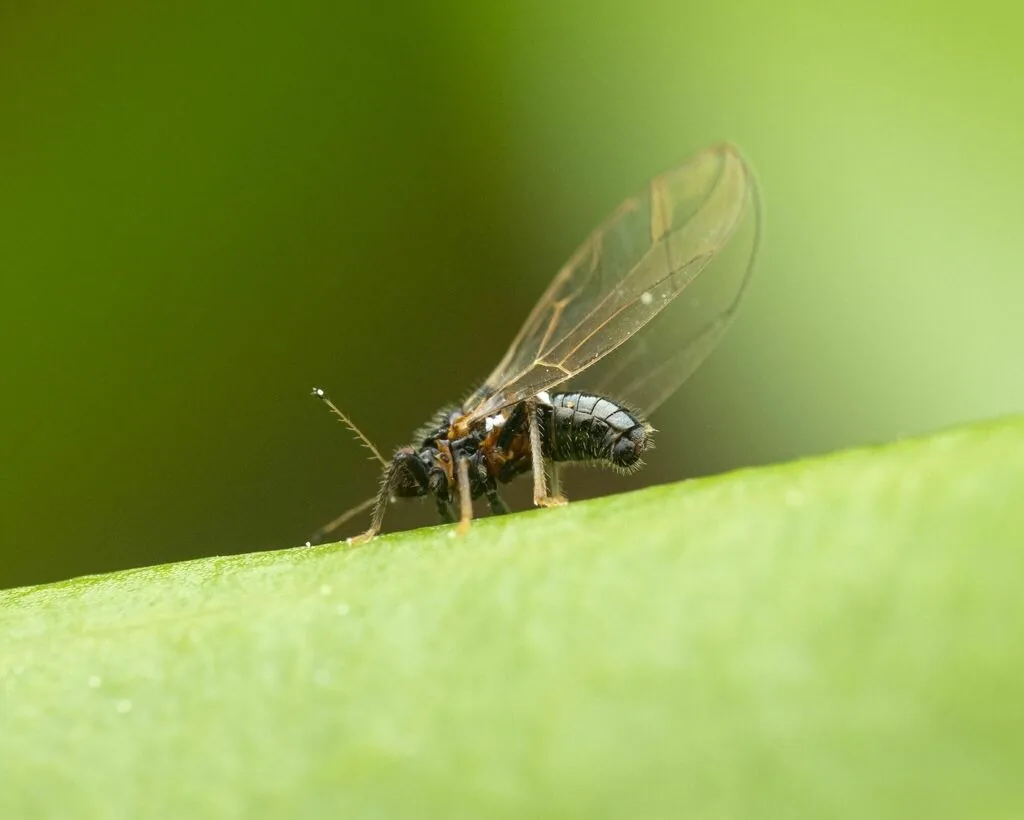
Persimmon psyllid adult with clear wings on a persimmon leaf
Persimmon psyllid adult with clear wings on a persimmon leaf. (c) Zachary Dankowicz, some rights reserved (CC BY) — via iNaturalist, CC BY 4.0
On this page
  1. Identification
  2. Look-alikes
  3. Where it lives
  4. Biology
  5. Damage and signs
  6. Health risk
  7. Control
  8. Related profiles
  9. Common questions
  10. Sources

How to identify it

  • Adults are 1/8 to 3/16 inch (3.5 to 4.5 mm), shining black with whitish legs and antennae; they hold their wings high and jump readily.[1][2]
  • Nymphs are flattened, covered with white powder or fluff, and older ones have a fringe of long hairs around the edge.[1][2]

Look-alikes

Look-alikeHow to tell them apart
AphidsAdults are about the size of a winged aphid.[1]

Where it lives

Common and widespread in Florida and the southeastern United States, and possibly Mexico, apparently throughout the range of native persimmon.[2]

US map: public records from 21 states since 1990 (GBIF).

Biology and life cycle

Females lay tiny, slender eggs along leaf margins; they hatch in five to six days, and the leaf curls over the young nymphs.[1][2]

Nymphs pass through about five stages; psyllids become abundant in spring when new growth appears, and hot weather can suppress them.[1]

Damage and signs

  • Feeding makes leaves pucker, curl and become misshapen, and twists and galls the terminals; damage is occasionally moderate to severe.[1][2]
  • Sticky honeydew grows sooty mold and can mess up plants or property below.[1]

Health risk

None to people or pets.[1][2]

Control

Prevention

Avoid shearing persimmon terminals in the growing season, since new growth attracts psyllids; prune above crotches and nodes instead.[1]

Pesticides

Horticultural oils suppress adults and nymphs without leaving a residue that harms beneficial insects.[1]

Common questions

Why are the new leaves on my persimmon curled and fuzzy white inside?
Persimmon psyllid nymphs feeding under the curled leaves are a likely cause.[1][2]

Sources

  1. NC State Extension, “Persimmon Psyllid (PDIC Factsheet).” content.ces.ncsu.edu/persimmon-psyllid (accessed 2026-10-16)
  2. University of Florida IFAS Extension (EDIS, Featured Creatures; author F. W. Mead, FDACS-DPI), “Persimmon Psylla, Trioza diospyri (EENY-390 / IN700, 2006; archival copy).” journals.flvc.org/edis/article/download/116483/114670/168191 (accessed 2026-10-16)
  3. iNaturalist, “Baeoalitriozus diospyri taxon page (order and family).” www.inaturalist.org/taxa/542517 (accessed 2026-10-06)

Updated 2026-10-16. Built from sourced records. Spot an error? Tell us.