On this page
How to identify it
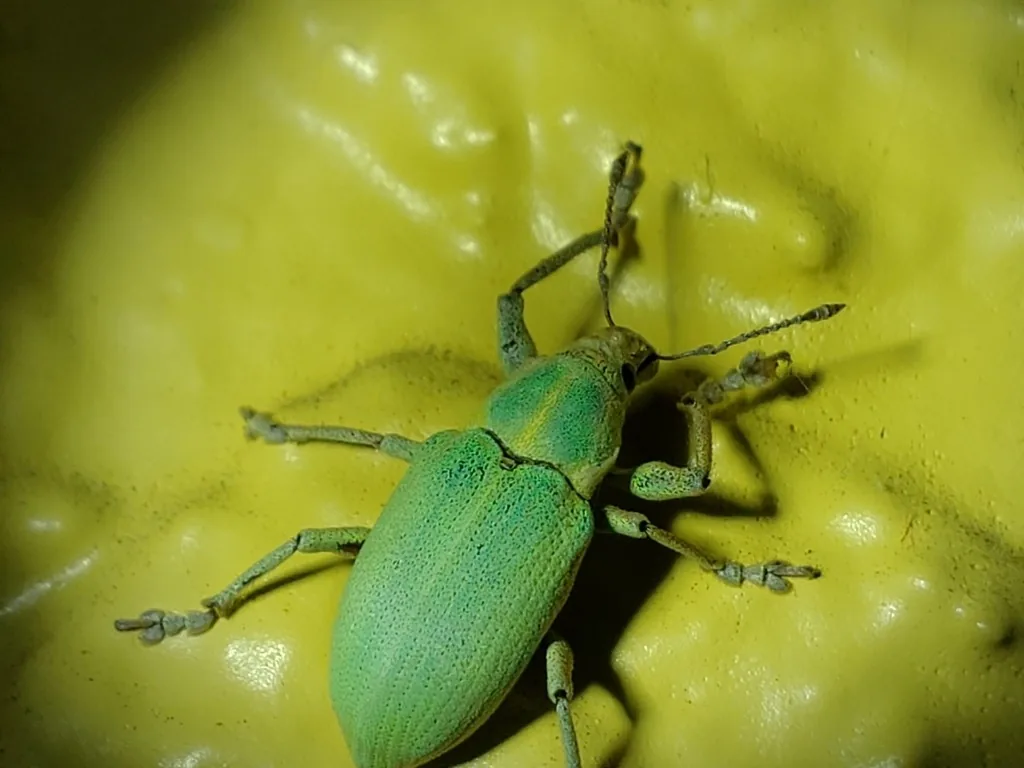
- The adult is a snout beetle about 1/3 to 1/2 inch long, slightly smaller than the Diaprepes root weevil (about 1/3 to 3/4 inch).[2]
- Its feeding sign is notches cut in the margins of young, tender leaves. Notching patterns differ slightly among root weevil species and can be confused with grasshopper damage.[1][2]
Look-alikes
| Look-alike | How to tell them apart |
|---|---|
| Diaprepes root weevil (Diaprepes abbreviatus) | Larger, about 1/3 to 3/4 inch, and the most widespread citrus root weevil in Florida. It is the main target of root weevil management in citrus, and the more severe the root damage, the more likely Diaprepes caused it.[2][1] |
| Fuller rose beetle | Another citrus root weevil, but flightless: it must crawl up the trunk, while blue-green weevils fly to the canopy.[1] |
Where it lives
A Florida citrus pest. Root weevils infest groves throughout the state's citrus-growing regions, and the blue-green citrus root weevils (this species and Pachnaeus opalus) are the most widespread group after the Diaprepes root weevil.[2][1]
Biology and life cycle
Like other citrus root weevils it has three immature stages. Adults come out of the soil and lay eggs on host plants above ground; the young larvae drop to the soil to feed on roots, and the pupae and newly formed adults stay underground.[1]
Adults emerge from the soil throughout the year, but peak emergence of the blue-green root weevils is normally in April and May.[1]
Adults can fly short distances and reach the canopy by flying. They gather on new growth to feed, mate and lay eggs on young or mature leaves, feeding on the outer foliage until midday and then moving into the inner canopy to avoid the heat.[2][1]
All adult citrus root weevils are attracted to the nonreflective outline of a citrus trunk, and as a group these weevils feed on more than 275 kinds of plants.[1][2]
The larvae find roots by smell. In laboratory choice tests, larvae preferred citrus plants infected with Candidatus Liberibacter asiaticus, the bacterium of the huanglongbing (HLB) disease system, over uninfected plants, and they were attracted to pregeijerene, a volatile that citrus roots give off in response to root-feeding insects.[3]
Researchers monitor adults of this species and the Diaprepes root weevil in citrus orchards with Tedders traps, unbaited pyramid-shaped devices that mimic a tree trunk.[4][2]
Damage and signs
- The larvae are the most destructive stage. Feeding on roots over time saps the tree's vigor and productivity and opens the roots to Phytophthora infection; badly damaged trees show yellowing and dropping leaves, twig dieback, off-season bloom and a thinning canopy.[2]
- Adult leaf feeding has no apparent economic effect in mature groves, but it occasionally strips small replanted trees nearly bare.[1]
- Unlike some minor root weevils, the blue-green citrus root weevils are not reliably kept in check on mature trees by good cultural practices alone.[1]
Health risk
It is a plant-feeding weevil, and none of these UF/IFAS guides or research papers describes any risk to people.[2][1]
Control
Prevention
Management starts with a Phytophthora-resistant rootstock certified free of weevils and with good soil drainage, which matters most in the heavier soils of the coastal and interior flatwoods. Weed control probably helps by reducing alternate host plants.[1]
Traps and physical control
To check for adults, inspect young foliage early in the morning or late in the afternoon. The weevils drop when disturbed, so shake the branches over an upside-down umbrella, a drop cloth or plastic sheeting placed under young growth, and repeat at several spots around the tree.[2]
Biological control
Many parasites, predators and pathogens attack citrus root weevils above and below ground, and favoring tree health over chemical controls conserves them. Groves on deep, sandy soils often need no other control.[1]
Pesticides
In commercial groves, foliar sprays of contact insecticides mixed with petroleum oil target adults in the canopy to cut egg laying, and chemical soil barriers target larvae. For citrus root weevils, UF/IFAS cites central Florida research in which two foliar sprays four weeks apart during the peak summer flush, late May through June, lessened root injury.[1]
Common questions
- What is notching the edges of my citrus leaves?
- Notches along the margins of young, tender citrus leaves are the typical sign of adult root weevils such as this one, though the pattern can be confused with grasshopper feeding.[1][2]
- When are blue-green citrus root weevils most active?
- Adults emerge from the soil all year, but their peak emergence is normally in April and May.[1]
- How can I find the weevils on my trees?
- Check young growth early in the morning or late in the afternoon, then shake the branches over an upside-down umbrella or a sheet; the weevils fall when disturbed.[2]
Sources
- University of Florida IFAS Extension, “2026-2029 Florida Citrus Production Guide: Citrus Root Weevils, ENY-611/CG006 (L. W. Duncan, L. Stelinski and L. M. Diepenbrock; rev. 8/2026).” journals.flvc.org/edis/article/view/133500 (accessed 2026-11-09)
- University of Florida IFAS Extension, “Field Diagnosis of Citrus Root Weevil Damage, HS-1014 (S. H. Futch, C. W. McCoy, J. H. Graham, L. W. Duncan and H. N. Nigg; May 2005).” journals.flvc.org/edis/article/view/115063 (accessed 2026-11-09)
- Ecology and Evolution (Wiley), full text in PubMed Central (PMC5496533), “Rivera, Pelz-Stelinski, Martini and Stelinski. Bacterial phytopathogen infection disrupts belowground plant indirect defense mediated by tritrophic cascade. Ecology and Evolution 7 (2017), doi:10.1002/ece3.3052.” doi.org/10.1002/ece3.3052 (accessed 2026-11-09)
- Journal of Nematology (Society of Nematologists), full text in PubMed Central (PMC2620623), “Duncan, Graham, Dunn, Zellers, McCoy and Nguyen. Incidence of Endemic Entomopathogenic Nematodes Following Application of Steinernema riobrave for Control of Diaprepes abbreviatus. Journal of Nematology 35: 178-186 (2003).” pmc.ncbi.nlm.nih.gov/articles/PMC2620623/ (accessed 2026-11-09)
- iNaturalist, “Pachnaeus litus taxon page (order and family).” www.inaturalist.org/taxa/127106 (accessed 2026-11-09)