On this page
How to identify it
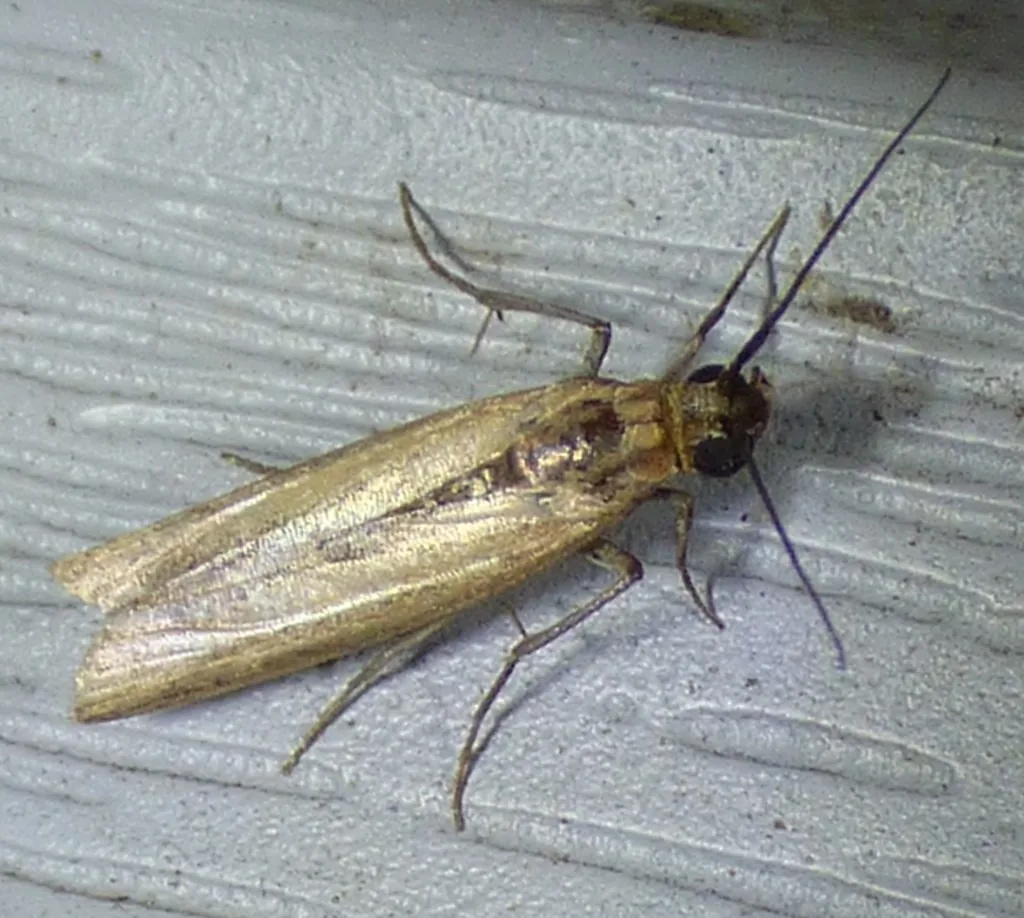
- Adults are small, slender, silver to buff-gray moths about 1/2 to 5/8 inch long, often seen resting on sunflower heads in early morning and evening during bloom.[1][2]
- Newly hatched larvae are pale yellow; older ones turn brown or purplish with light stripes running lengthwise and reach about 3/4 inch.[1][3]
- Infested heads look trashy, with webbing across the face of the head.[1]
Where it lives
It is a pest of field sunflowers from Texas to Nebraska, and UMass Extension describes the same caterpillar damaging garden echinacea and sunflowers.[1][2][3]
Biology and life cycle
Moths are drawn to plants just starting to bloom; nearly 80 percent of eggs are laid within 4 to 7 days after the buds open, and they hatch in 1 to 3 days.[1][2]
Young larvae feed on pollen and florets for about 5 to 6 days, then tunnel into the seeds; a single larva can destroy up to 12 seeds over its 15 to 19 days of feeding.[1][3]
Most full-grown larvae drop to the ground on silk threads and pupate in crevices or under leaf litter, and some larvae spend the winter underground.[3]
In Texas, infestations are heaviest when early-planted fields bloom in May and June, with a smaller flight later in the season.[1]
Damage and signs
Health risk
It feeds only on plants; Texas A&M, Nebraska and UMass Extension mention no risk to people.[1][2][3]
Control
Prevention
In Nebraska, sunflowers planted after June 1 usually escape the main moth flight.[2]
Biological control
On garden flowers, Bacillus thuringiensis subsp. kurstaki can be used on young larvae before they tunnel into the seeds.[3]
Pesticides
For field sunflowers, Texas A&M says insecticides should go on when 15 to 25 percent of plants are blooming and moths are in the field, a narrow window because bloom moves fast; Nebraska notes pyrethroids can help protect the heads.[1][2]
Common questions
- What is eating the centers of my echinacea and sunflowers?
- Possibly sunflower moth caterpillars, which feed on the florets and then tunnel into the developing seeds.[3][1]
- When are sunflower moths active?
- During bloom: moths lay most of their eggs within a week after buds open, so that's the time to watch.[1][2]
Sources
- Texas A&M AgriLife Extension, “Sunflowers, E-579 (insect pests of sunflower).” extensionentomology.tamu.edu/wp-content/uploads/2021/09/E-579-Sunflowers.pdf (accessed 2026-10-19)
- University of Nebraska-Lincoln Extension, “Sunflower Head Moth Outbreak is Coming On Strong (CropWatch, July 26, 2012).” cropwatch.unl.edu/sunflower-head-moth-outbreak-coming-strong-unl-cropwatch-july-26-2012 (accessed 2026-10-19)
- UMass Extension Greenhouse Crops and Floriculture Program, “Sunflower Moth Caterpillar.” www.umass.edu/agriculture-food-environment/greenhouse-floriculture/photos/sunflower-moth-caterpillar (accessed 2026-10-19)
- iNaturalist, “Homoeosoma electella taxon page (order and family).” www.inaturalist.org/taxa/343382 (accessed 2026-10-06)