On this page
How to identify it
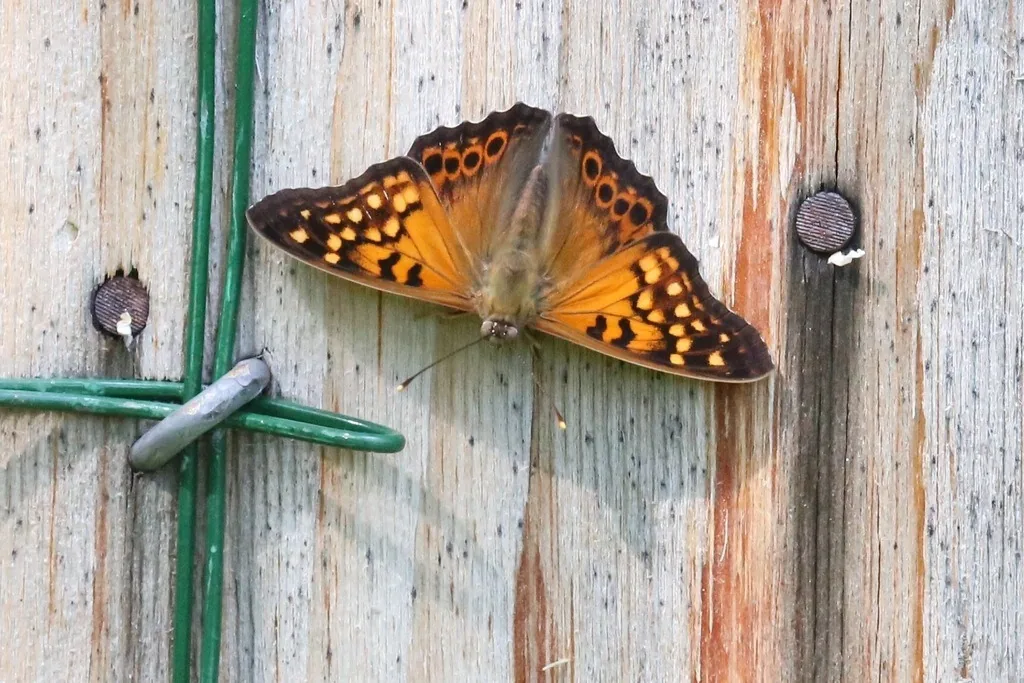
- Wingspan is about 1 1/2 to 2 5/8 inches; wings are brown to orange-brown and females are much larger than males.[1][2]
- It has two complete dark bars in the forewing cell and no dark eyespot near the forewing edge, which separates it from the hackberry emperor.[1][2]
- Caterpillars are green with yellow and white stripes, a forked tail and a pair of short, antler-like horns on the head.[1][2]
Look-alikes
| Look-alike | How to tell them apart |
|---|---|
| Hackberry emperor | More neutral tan with pure white forewing spots (pale yellow in the tawny emperor) and a forewing eyespot.[1][2] |
Where it lives
From southern New England south to Florida and west to North Dakota and southern Arizona; statewide in Missouri wherever hackberries grow.[1][2]
Biology and life cycle
Adults fly from June into October, with two broods in Missouri.[2]
Females lay clusters of 200 to 500 eggs on mature leaves; young caterpillars feed in large groups and thrash together when disturbed.[2]
Caterpillars often feed on older foliage while hackberry emperor caterpillars prefer new leaves.[1]
Fall caterpillars spend the winter inside silk-rolled leaves on the tree.[2]
Damage and signs
Health risk
None. Adults land on people only to sip sweat.[2]
Control
Prevention
No control is needed.[2]
Common questions
- Why does this butterfly keep landing on me?
- Tawny and hackberry emperors are attracted to the salt in human sweat.[2]
- How do I tell it from the hackberry emperor?
- It is more rust-colored, has two unbroken bars in the forewing cell and lacks the forewing eyespot.[1][2]
- Does it hurt hackberry trees?
- Its caterpillars eat hackberry leaves; MDC treats it as a native butterfly, not a pest.[2]
Sources
- University of Florida IFAS Extension (EDIS, Featured Creatures), “Tawny Emperor Butterfly, Asterocampa clyton (EENY-528).” ask.ifas.ufl.edu/publication/IN933 (accessed 2026-10-16)
- Missouri Department of Conservation, “Tawny Emperor (Field Guide).” mdc.mo.gov/discover-nature/field-guide/tawny-emperor (accessed 2026-10-16)
- iNaturalist, “Asterocampa clyton taxon page (order and family).” www.inaturalist.org/taxa/58587 (accessed 2026-10-06)