On this page
How to identify it
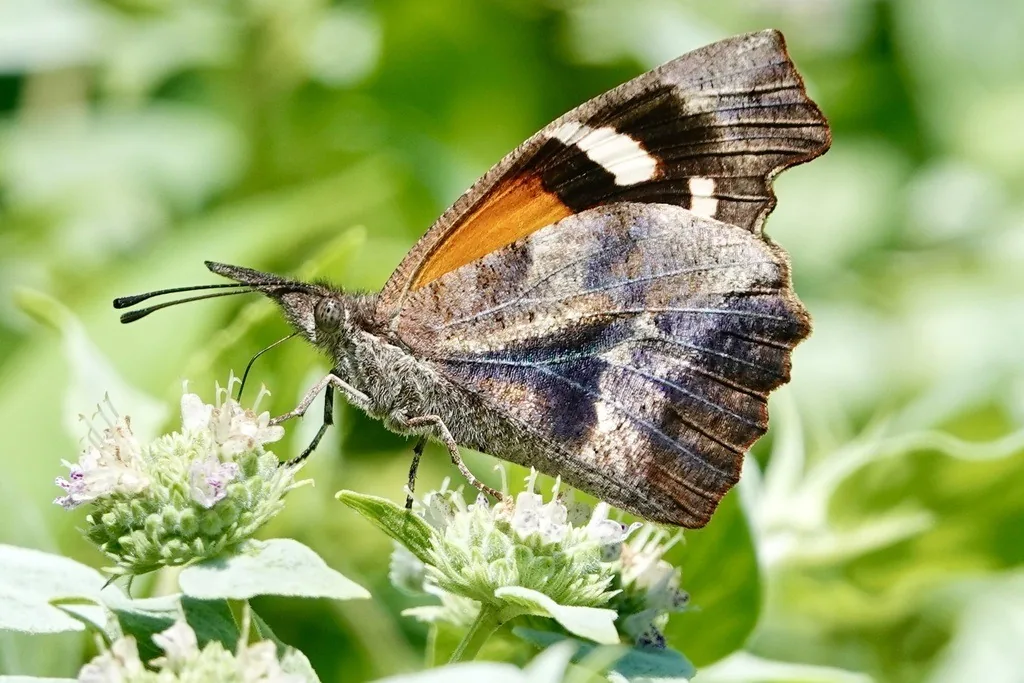
- Wingspan is about 1 to 2 inches; the upper side is orange with wide dark borders and white spots near the squared wingtips.[1][2]
- At rest on a twig with wings closed, it shows mottled brown to violet-gray undersides and looks like a dead leaf, with the snout resembling a leaf stem.[1][2]
- Caterpillars are green with yellow stripes and tiny yellow specks and a humped front end, without the horns of emperor caterpillars.[1][2]
Look-alikes
| Look-alike | How to tell them apart |
|---|---|
| Hackberry emperor caterpillars | Share hackberry as a host, but emperor caterpillars have horns on the head; snout caterpillars do not.[1] |
Where it lives
From central and southern California east to Colorado and Nebraska and through most of the eastern United States, south to Argentina; it migrates into Missouri in May.[1][2]
Biology and life cycle
There are two generations a year over most of the range and three or more in Florida; adults overwinter in the south and repopulate the north each spring.[1][2]
Some years bring immense migrations, numbering in the millions in the West; MDC links booms to early drought that cuts predators followed by heavy summer rain.[1][2]
Eggs are laid in leaf axils of young hackberry shoots, and adults sip nectar, especially from white and yellow flowers, and drink from mud.[1][2]
Damage and signs
Health risk
Control
Prevention
No control is needed.[2]
Common questions
Sources
- University of Florida IFAS Extension (EDIS, Featured Creatures), “American Snout, Libytheana carinenta (Cramer) (EENY-452).” ask.ifas.ufl.edu/publication/IN819 (accessed 2026-10-16)
- Missouri Department of Conservation, “American Snout (Field Guide).” mdc.mo.gov/discover-nature/field-guide/american-snout (accessed 2026-10-16)
- iNaturalist, “Libytheana carinenta taxon page (order and family).” www.inaturalist.org/taxa/58561 (accessed 2026-10-06)