On this page
How to identify it
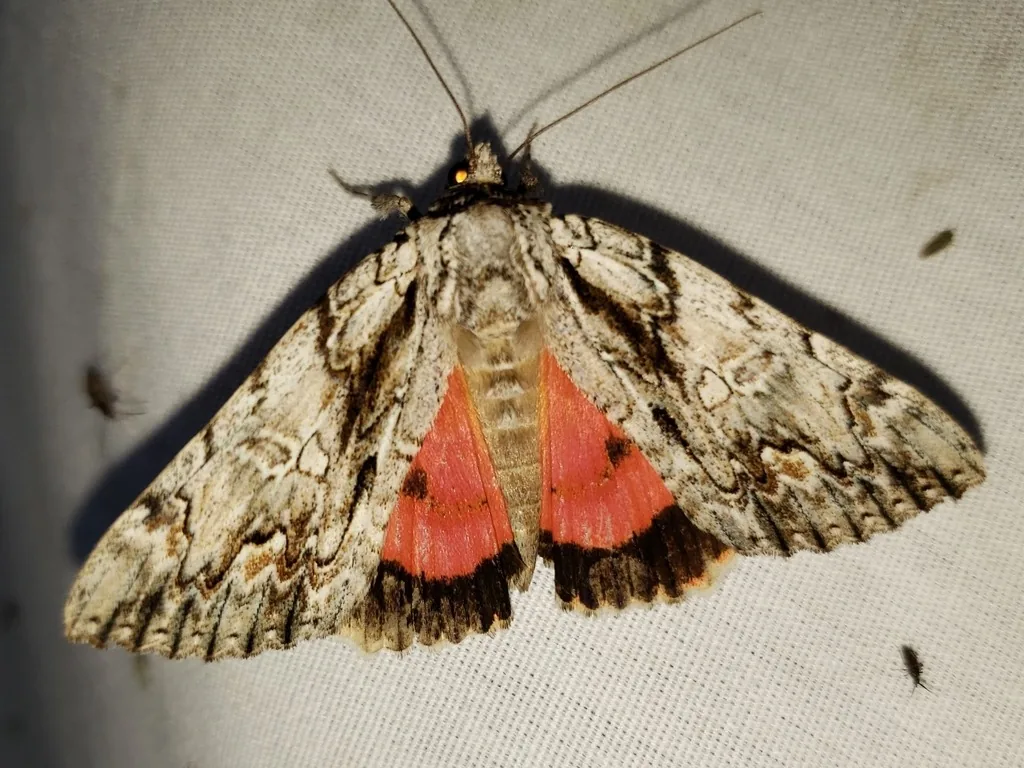
- Forewings dull tan, brown or gray with wavy lines that copy the random patterns of tree bark, so a moth resting on a trunk with its wings folded is very hard to see.[1][2][4]
- Hindwings, normally hidden under the forewings, are usually bright orange, red, yellow or pink with bold dark bands; some species have black hindwings, such as the tearful underwing (Catocala lachrymosa).[1][2]
- Most have a wingspan of 2 to 3 inches. Species and their many named forms vary so much that even experts struggle to separate them; recognizing a moth as an underwing is a good result.[1][2]
- The caterpillars are long, bark-patterned semi-loopers with humps and warts along the back. Unlike true inchworms they have abdominal prolegs, though the pair on the third abdominal segment is reduced, and many have a fringe of short, thickened hairs along the lower sides and dark spots on the underside.[1][3]
Look-alikes
| Look-alike | How to tell them apart |
|---|---|
| Moon-lined moth (Spiloloma lunilinea) | Forewings follow the same general pattern, but each has four dark marks spaced along the leading edge like the tick marks on a ruler, there is a dark collar behind the head, and the hindwings lack the bright colors of most underwings.[1] |
| Locust underwing (Euparthenos nubilis) | Called an underwing and used by Ohio's field guide to illustrate the group, it is one of the largest and most common underwings in Ohio but belongs to a separate genus, Euparthenos.[2] |
Where it lives
More than 100 species occur in North America north of Mexico, with more than 60 in the East, about 60 recorded in Ohio and more than 60 in Missouri. They are found in deciduous forests and forest edges and wherever their food trees grow, including suburbs and cities.[1][3][2]
Biology and life cycle
The Missouri species all have one generation a year and spend the winter as eggs, usually laid on tree bark. The eggs hatch in spring, and for each eastern species the Forest Service describes, caterpillars are present from May to June.[1][3]
Caterpillars feed in the tree canopy at night. During the day they leave the tree and hide in the litter at the base of the trunk, or flatten themselves into bark crevices. They are strong jumpers.[1]
Adults are active at night and come to lights, and many species are drawn to fermented fruit or to a sugar bait painted on tree bark. By day they rest on trunks, and sometimes in caves, under ledges, on rocks or in leaf litter.[1][2]
The bright hindwings work as a flash pattern: a predator follows the color in flight, then loses the moth when it lands and covers its hindwings.[2][1]
Damage and signs
- Each species has its own food plants, mostly deciduous trees and shrubs. Oak and hickory support the most species; the Forest Service notes more than 50 species in New York alone, mostly on those two trees.[2][4][1]
- Examples from the Forest Service caterpillar guide: girlfriend underwing on white oaks, connubial and little nymph underwings on oaks, andromeda underwing on blueberries, and the sweetheart underwing (Catocala ultronia) on apples, cherries and related plants.[3]
- As a group, underwings are of little economic importance.[4]
Health risk
None of the sources describes any harm to people, pets or buildings; the caterpillars feed on tree and shrub leaves, and the adults are night-flying moths often noticed at lights.[1][4]
Control
Prevention
No control is needed. The Forest Service considers underwings of little economic importance, and some species are rare: Missouri lists the marbled underwing (Catocala marmorata) and precious underwing as species of conservation concern, and a few Ohio species are endangered or of special concern.[4][1][2]
Common questions
- What is the gray moth that flashes orange or red when it flies off a tree?
- Most likely an underwing moth. Its bark-colored forewings hide it on the trunk, and the bright hindwings show only in flight.[1][2]
- Do underwing caterpillars damage trees?
- Not in any important way. They eat the leaves of oaks, hickories and other trees and shrubs, but the Forest Service calls the group of little economic importance.[4][2]
- Why do underwings show up at porch lights?
- They are nocturnal and most species are attracted to lights; many also come to fermented fruit.[1][2]
Sources
- Missouri Department of Conservation, “Underwing Moths (Field Guide).” mdc.mo.gov/discover-nature/field-guide/underwing-moths (accessed 2026-11-10)
- Ohio Department of Natural Resources, Division of Wildlife, “Moths of Ohio Field Guide (Publication 5467).” dam.assets.ohio.gov/image/upload/ohiodnr.gov/documents/wildlife/backyard-wildlife/Moths%20of%20Ohio%20Field%20Guide%20pub5467.pdf (accessed 2026-11-10)
- USDA Forest Service, Forest Health Technology Enterprise Team, “Caterpillars of Eastern Forests, FHTET-96-34 (D. L. Wagner, V. Giles, R. C. Reardon and M. L. McManus, November 1997; scanned copy).” archive.org/details/caterpillarsofea001997 (accessed 2026-11-10)
- USDA Forest Service, “Eastern Forest Insects, Miscellaneous Publication 1175 (W. L. Baker, 1972; scanned copy).” archive.org/details/easternforestins1175bake (accessed 2026-11-10)
- iNaturalist, “Catocala taxon page (order and family).” www.inaturalist.org/taxa/83842 (accessed 2026-11-10)