On this page
How to identify it
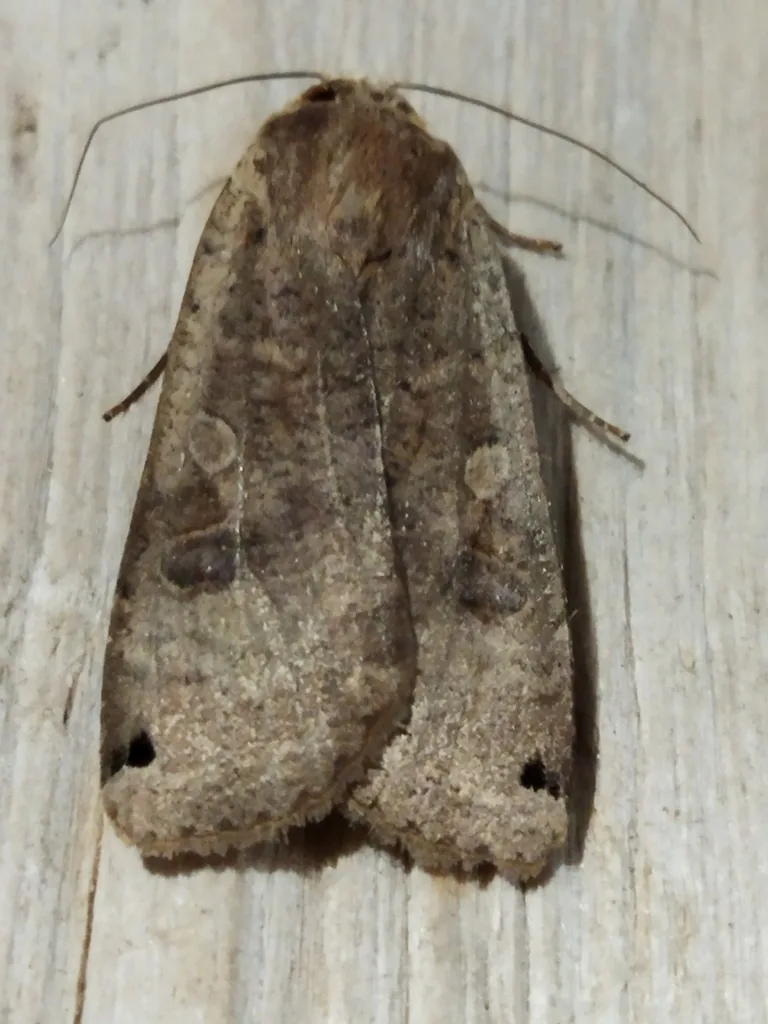
- The moth is large, with a wingspan of about 2 inches. Its forewings vary a lot but are dull gray to dark reddish brown with black markings, which makes the resting moth hard to identify.[1][2]
- In flight, the bright yellow to orange hindwings with a thick dark band along the outer edge make it easy to recognize.[1][2]
- Caterpillars grow from about 1/8 inch to 2 inches long. Young ones are blue-green to greenish gray; older ones turn dark brown, olive or gray.[1][2]
- Grown caterpillars have a row of black dashes along each side of the back, most prominent toward the rear, with a light line below them; pale slanted lines may show on the sides.[1][2]
- The head is light brown to tan with two black, angled lines, described as crescents or an upside-down Y.[1][2]
- Larvae hide in the soil by day and curl into a C shape when disturbed.[1][2]
Look-alikes
| Look-alike | How to tell them apart |
|---|---|
| True armyworm | True armyworm caterpillars have one broad dark band down the back and three contrasting stripes on each side, the lowest with a pinkish tint; winter cutworms have rows of black dashes that are most noticeable near the rear.[1] |
| Variegated cutworm | Variegated cutworms have a row of 4 to 7 small yellow spots down the back and a black W on the last body segment.[1] |
Where it lives
Native to Eurasia and widespread through the Palearctic region and North Africa, it was first found in North America in 1979 at a porch light in Halifax, Nova Scotia. It spread quickly to the northeastern United States, reached Illinois, Wisconsin, Colorado and Wyoming by 2000, and was detected in Oregon in 2001; the adult moth is now considered widespread in the U.S. GBIF holds about 20,000 US records since 1990 from 32 states, most from California, Oregon and New York.[1][2][6]
Biology and life cycle
The moths are strong fliers that can migrate long distances; Oregon State reports outbreaks of adult moths in Oregon with up to 500 caught in a night. In Europe, tethered large yellow underwings flown under a clear night sky headed southwest, consistent with a southward autumn migration.[1][2][5]
In Eurasia there is one generation a year, but trapping in the Pacific Northwest suggests two flights, a smaller one in April to June and a larger one from mid-August through October.[1]
A female can lay up to 2,000 eggs in flat clusters on plants and on non-plant surfaces such as fenceposts and plastic siding. The eggs hatch in 2 to 4 weeks.[1][2]
The caterpillars are in the soil from about September through March and feed whenever temperatures are above freezing, mostly at night, though they will feed by day in mild or overcast weather.[1][2]
They are gregarious: they feed and move across the landscape in large groups, like armyworms.[1][2]
Pupae are reddish brown, about 1 inch long, and rest in earthen cells under soil or debris; the PNW handbook puts them about 2 to 3 inches down.[1][2]
Damage and signs
- Larvae notch and chew leaves, cut stems off at ground level so plants look mowed, and also feed on roots.[1][2]
- The documented host list is long: lawn and pasture grasses, wheat, alfalfa and clover, vegetables such as beets, carrots, cole crops, lettuce, potatoes, Swiss chard and tomatoes, flowers such as hostas, chrysanthemums, irises, primroses and violets, grapes and strawberries, and weeds such as chickweed and dandelion.[1]
- In Oregon, larvae damaged sod and lawns, golf course greens and collars, and herb and flower gardens, and large numbers turned up around homes and in field crops in Oregon and Washington in 2015.[1][2]
- In the United States, larval damage was first reported in 2007, when large numbers appeared around homes and in hayfields across Michigan; there has also been a large outbreak in winter wheat in Idaho.[1]
- Oregon State and USDA researchers call it a serious pest of cool-season turfgrass and grass seed crops in Oregon.[4]
Health risk
Oregon State notes reports from other regions that pets can get an upset stomach from eating winter cutworm larvae, with one case of pet illness confirmed in Oregon. Masses of larvae that die on sidewalks and driveways can make them slippery.[1]
Control
Prevention
Keep lawns dense and healthy: mow regularly, irrigate in summer and fertilize enough to maintain good turf density.[1]
Scout for clipped, mowed-looking or notched foliage and missing plants. By day, dig through the top 2 to 3 inches of soil, under clods, leaf litter or thatch, to find resting larvae; light traps can monitor the moths.[1][2]
No damage thresholds exist for winter cutworm. Oregon State and the PNW handbook point to armyworm thresholds of 1 to 2 larvae per square foot in new seedings and 3 to 4 in mature stands, with hay and pasture tolerating 4 to 6.[1][2]
Grass endophytes don't appear to help: in Oregon greenhouse trials, the level of fungal endophyte infection in tall fescue and perennial ryegrass had little effect on winter cutworm, while grass cultivar affected feeding damage.[4]
Sanitation
In crop fields, remove weeds and plant residue along the edges to cut down on egg-laying sites and food, and till before planting to expose overwintering larvae and pupae.[1][2]
Biological control
Parasitic wasps such as Trichogramma and braconids, tachinid flies, nematodes, bacterial and viral diseases, and predators such as ground beetles, birds and rodents usually keep cutworms below damaging levels, though their effect on winter cutworm in the Pacific Northwest isn't yet clear.[2][1]
Pesticides
If treatment is needed, target small larvae under about 1 inch, apply late in the day so night-feeding larvae are exposed, and consider reduced-risk insecticides to spare natural enemies and pollinators. For grass seed crops, the Pacific Northwest handbook lists spinosad, bifenthrin, lambda-cyhalothrin, zeta-cypermethrin, beta-cyfluthrin and a lambda-cyhalothrin and chlorantraniliprole mix.[1][2]
Where sources disagree
When larvae pupate: Oregon State presumes the more mature larvae pupate during winter and emerge as adults in early spring, while the PNW handbook says mature larvae pupate in early spring; both say younger larvae keep feeding into spring.[1][2]
Generations: published literature gives one generation a year in Eurasia, with moths flying June through October, while Pacific Northwest trap catches suggest two overlapping generations. Oregon State says the life cycle in the region still needs study.[1][2]
Common questions
- What are the masses of caterpillars gathering near my doors in fall or winter?
- They may be winter cutworms. The moths can lay egg masses on fenceposts and siding, and after hatching the larvae disperse in groups and often gather near entryways.[1]
- Why is it called a winter cutworm?
- The larvae tolerate cold and keep feeding through fall and winter, from about September through March, whenever temperatures are above freezing.[1][2]
- Is the moth with yellow hindwings at my porch light a large yellow underwing?
- It may be. At rest its dull gray-brown forewings hide the hindwings, but in flight it shows bright yellow to orange hindwings with a dark outer band, and the moths come to lights at night.[1][2]
Sources
- Oregon State University Extension Service, “Winter Cutworm: A New Pest Threat in Oregon, EM 9139 (J. Green, A. Dreves, B. McDonald and E. Peachey, February 2016).” extension.oregonstate.edu/sites/default/files/documents/em9139.pdf (accessed 2026-11-11)
- Pacific Northwest Pest Management Handbooks (Oregon State, Washington State and University of Idaho Extension), “Grass seed: Winter cutworm (Pacific Northwest Insect Management Handbook).” pnwhandbooks.org/insect/legume-grass-field-seed/grass-seed/grass-seed-winter-cutworm (accessed 2026-11-11)
- University of Idaho Extension, “Large Yellow Underwing: A New Cutworm in Idaho, CIS 1172 (E. J. Bechinski, L. J. Smith, F. W. Merickel and R. Findlay; revised 2021), summary page.” www.uidaho.edu/extension/publications/cis-1172 (accessed 2026-11-11)
- Environmental Entomology, via PubMed, “Evaluation of endophyte-mediated resistance against Noctua pronuba in cool-season grasses in Oregon (Intasin et al. 2026).” pubmed.ncbi.nlm.nih.gov/42418664/ (accessed 2026-11-11). Cited from the PubMed abstract.
- Journal of Experimental Biology, via PubMed, “Evidence for a southward autumn migration of nocturnal noctuid moths in central Europe (Dreyer et al. 2018).” pubmed.ncbi.nlm.nih.gov/30552290/ (accessed 2026-11-11). Cited from the PubMed abstract.
- Global Biodiversity Information Facility (GBIF), “Noctua pronuba: US occurrence records since 1990 by state (GBIF occurrence search API).” api.gbif.org/v1/occurrence/search?taxonKey=1789695&country=US&hasGeospatialIssue=false&occurrenceStatus=PRESENT&year=1990%2C2026&facet=stateProvince&facetLimit=400&limit=0 (accessed 2026-11-11). State counts are records reported (iNaturalist research-grade, museum specimens, surveys), not abundance.
- iNaturalist, “Noctua pronuba taxon page (order and family).” www.inaturalist.org/taxa/81687 (accessed 2026-11-11)