On this page
How to identify it
- The caterpillars vary a great deal in color, from green to brownish black, and most have prominent dark lines running the length of the body along with narrow white, yellow or pink stripes.[1]
- Full-grown caterpillars reach about 48 mm (nearly 2 inches). Just before pupating they shrink to about 25 mm and turn mahogany brown.[1]
- They are lively: disturbed caterpillars spring off the plant and wiggle rapidly. Small ones, under about 1/2 inch, loop as they crawl.[1]
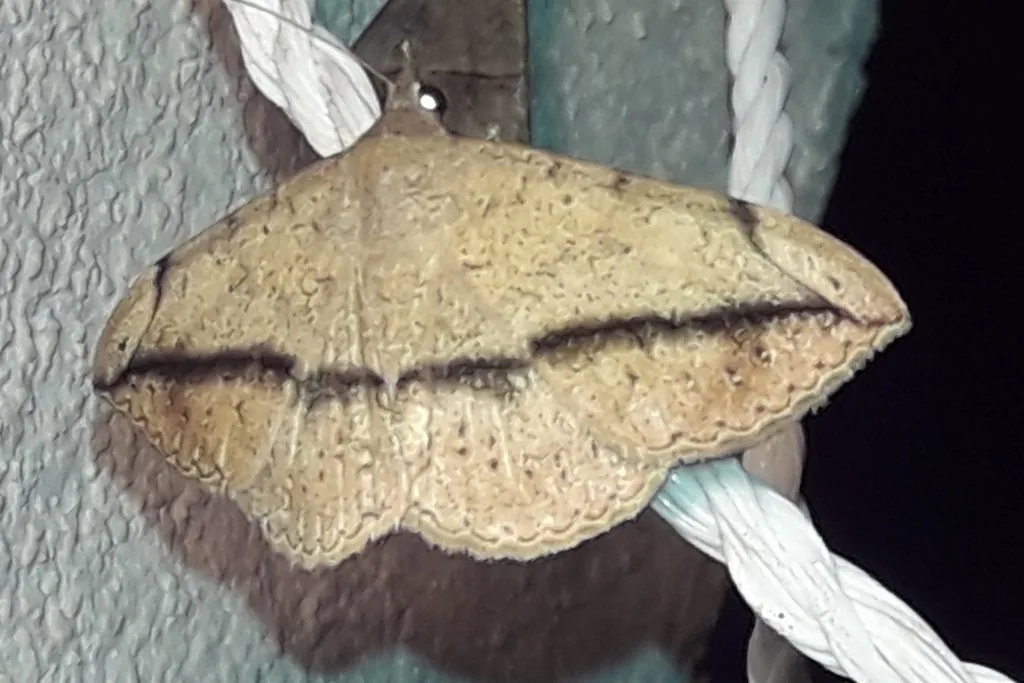
- The moth has a wingspan of 30 to 38 mm and variable forewings, from ash gray to light yellowish brown or dark reddish brown. A dark diagonal line runs across both pairs of wings when they are spread, and the light brown hindwings have a row of pale spots near the edge.[1]
- Eggs are white, slightly oval, 1 to 2 mm across, flattened underneath and prominently ribbed, and they turn pink just before hatching.[1]
Look-alikes
| Look-alike | How to tell them apart |
|---|---|
| Soybean looper | Small velvetbean caterpillars loop as they crawl and are often mistaken for soybean loopers, but the velvetbean caterpillar has four pairs of abdominal prolegs and the soybean looper only two.[1][2] |
Where it lives
Native to the tropics and subtropics of the Western Hemisphere, it lives year-round in tropical America and was first found in Florida in 1903. It overwinters at the southern tip of Florida and migrates into the southeastern United States every year; infestations are less severe in the western United States.[1]
Biology and life cycle
It is a yearly problem from June through September in Florida, Georgia and Alabama. Moths start moving north in early summer, reach north Florida by mid-August and are very abundant by September, and the number of generations depends on when they arrive.[1]
Eggs are laid one at a time, mostly on the undersides of leaves, and hatch in about three days in late summer, taking a week or more later in fall. The newly hatched caterpillars eat their eggshells and usually pass through six stages, and the whole life cycle takes about four weeks in summer, longer in fall.[1]
Pupae form in loose earthen cells on or just under the soil surface, most within about 2 cm of it and never on the plant, and the pupal stage lasts about seven days in late summer and about eleven in early fall.[1]
The moths need to feed after they emerge; they feed at night, with peak feeding from sundown until dusk.[1]
Soybean is the main host and legumes are preferred, but it also feeds on peanut, kudzu, velvetbean, horse beans, cotton, cowpea, coffeeweed, black locust, hairy indigo, lespedeza, sesbania and white sweetclover.[1]
In a mark-release-recapture study, the moths moved an average of about 300 meters from where they were released, and some were recaptured 1,000 meters away.[4]
Damage and signs
- Newly hatched caterpillars strip the lower surface and inner tissue of the leaf; by the end of the second stage they skeletonize leaves down to the veins, and after that they eat whole leaves. Feeding moves on through the middle and lower canopy, and complete defoliation can result.[1]
- The caterpillars also attack tender stems, buds and small pods.[1]
Health risk
Neither UF/IFAS nor the research cited here mentions any risk to people; the caterpillar is treated only as a crop pest.[1][4]
Control
Prevention
Plant early, or use early-maturing soybean varieties, so the crop matures before caterpillar numbers build; in Georgia, late-season caterpillars were more abundant in soybeans planted in early June than in early May. Early-planted soybeans can also act as a trap crop for the moths, while tillage has no significant effect.[1]
Monitor: look at small plants directly in spring, switch to a sweep net as plants grow, and watch for moths with blacklight or pheromone traps set at canopy height, then search for eggs and caterpillars once moths show up.[1]
Biological control
Natural enemies matter: in field plots, predation accounted for 52.5 to 95.2% of velvetbean caterpillar deaths. Predators include ground beetles, tiger beetles, the striped earwig, red imported fire ants, birds, frogs and rodents; the tachinid fly Winthemia rufopicta is the most important parasitoid, and fungi such as Nomurea rileyi add natural control.[1]
Its nucleopolyhedrovirus (AgMNPV), described as the world's most successful viral bioinsecticide, was used extensively against it in soybean through the 1980s and 1990s, and the caterpillars are also susceptible to Bacillus thuringiensis.[3][1]
Pesticides
Insecticides are commonly used against it in the Southeast, and UF/IFAS notes that preventive treatment has given the most promising results; partly resistant soybean varieties slow early growth but don't protect the crop on their own. In South American tests, the caterpillars defoliated a non-Bt soybean variety but not one expressing the Cry1Ac Bt protein.[1][5]
Common questions
- How fast can velvetbean caterpillars defoliate soybeans?
- UF/IFAS reports that they can strip a soybean field's foliage in five to seven days.[1]
- Is it a velvetbean caterpillar or a soybean looper?
- Small velvetbean caterpillars loop when they crawl and are often mistaken for soybean loopers. Count the abdominal prolegs: velvetbean caterpillars have four pairs and soybean loopers only two. Velvetbean caterpillars also spring off the plant and wiggle rapidly when disturbed.[1][2]
- When do velvetbean caterpillars show up?
- In Florida, Georgia and Alabama they are a problem from June through September. The moths reach north Florida by mid-August and are very abundant by September.[1]
Sources
- University of Florida/IFAS Extension (Featured Creatures), “Velvetbean Caterpillar, Anticarsia gemmatalis, EENY-151/IN308 (K. A. Barbara; published September 2000, reviewed August 2006; archival copy).” journals.flvc.org/edis/article/view/139127 (accessed 2026-11-09)
- University of Florida/IFAS Extension (Featured Creatures), “Soybean Looper, Chrysodeixis includens, EENY-695/IN1198 (E. Carter and J. L. Gillett-Kaufman, November 2017).” journals.flvc.org/edis/article/view/105370 (accessed 2026-11-09)
- Genome Biology and Evolution (via NCBI PubMed), “The Pangenome of the Anticarsia gemmatalis Multiple Nucleopolyhedrovirus (AgMNPV) (A. F. Brito et al.; Genome Biology and Evolution 8(1): 94-108, 2015; abstract).” pubmed.ncbi.nlm.nih.gov/26615220/ (accessed 2026-11-09)
- Pest Management Science (via NCBI PubMed), “Oviposition patterns of primary lepidopteran defoliators in soybean and the impact on structured refuge recommendations (J. Gonçalves et al.; Pest Management Science 80(11): 5619-5629, 2024; abstract).” pubmed.ncbi.nlm.nih.gov/38940546/ (accessed 2026-11-09)
- PLoS ONE (via NCBI PubMed), “Feeding injury of major lepidopteran soybean pests in South America (P. D. Carpane et al.; PLoS ONE 17(12): e0271084, 2022; abstract).” pubmed.ncbi.nlm.nih.gov/36520803/ (accessed 2026-11-09)
- iNaturalist, “Anticarsia gemmatalis taxon page (order and family).” www.inaturalist.org/taxa/213809 (accessed 2026-11-09)