On this page
How to identify it
- Caterpillars are light to dark green with white stripes along the back and sides. The body is thicker toward the rear and tapers toward the head, and grown caterpillars reach about 1.3 inches long.[1]
- It has only two pairs of abdominal prolegs and moves with a looping, inchworm-style walk.[1]
- The legs just behind the head may be black or green; on the very similar cabbage looper they are green.[1]
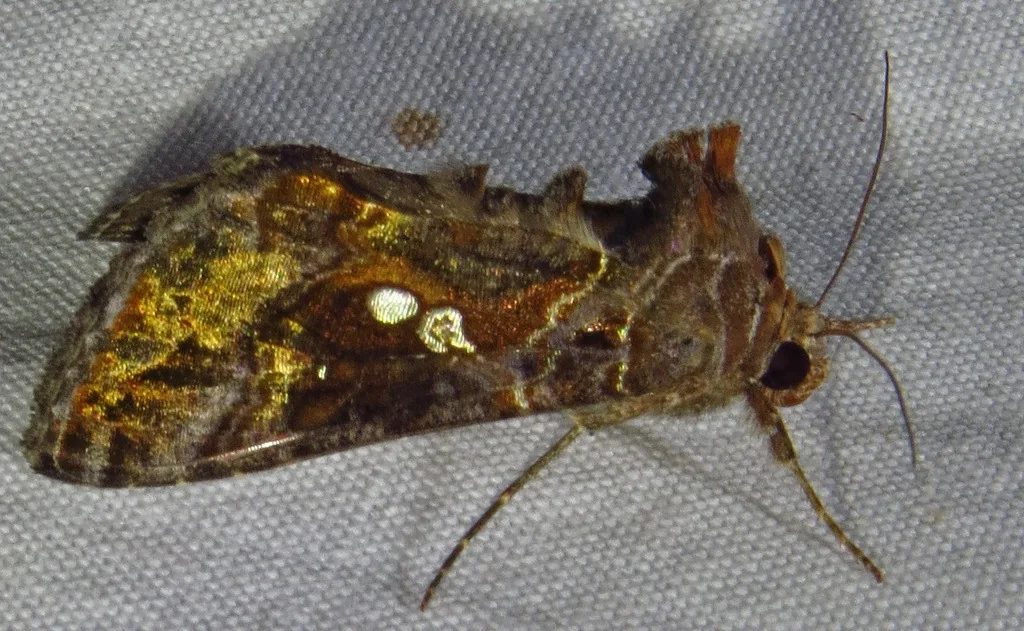
- The moth has a wingspan of 1 to 1 1/2 inches and is mottled brown to black. The forewings are darker than the hindwings and carry silvery white spots, which set it apart from many other crop pests, although the cabbage looper moth has similar marks.[1]
- Pupae are about 1/2 inch long, white to green, and formed on the undersides of leaves.[1]
Look-alikes
| Look-alike | How to tell them apart |
|---|---|
| Cabbage looper | The caterpillars are extremely similar in appearance and size, but cabbage loopers have green legs behind the head, while soybean loopers' may be black or green.[1] |
| Velvetbean caterpillar | Green caterpillars with three or more pairs of abdominal prolegs, such as the velvetbean caterpillar with four, are easy to separate from the soybean looper, which has only two.[1] |
| Other looper moths in pheromone traps | The cabbage looper, Rachiplusia ou, Argyrogramma verruca and Ctenoplusia oxygramma also come to soybean looper pheromone lures and can be mistaken for it. In the Florida Panhandle, C. oxygramma is the most likely to inflate counts, especially early in the season.[5] |
Where it lives
It feeds on soybean across much of North, Central and South America. In the United States it ranges from Maine to Texas and west to California, most heavily in the South and East, but it overwinters only in south Florida and south Texas; each season its infestations spread as far as Canada.[1][3]
Biology and life cycle
Because it isn't known to survive freezing winters, it reinvades most of its range every year, migrating thousands of kilometers during spring and summer. Genetic markers suggest its migration routes differ from the fall armyworm's, apparently because soybeans and corn are planted at different times. Populations may also arrive from Central and South America and the Caribbean.[3][1]
Females lay eggs at night on the undersides of leaves in the lower half of the canopy. The caterpillars usually go through six stages (five to seven have been seen) and feed for 2 to 3 weeks; pupation takes 7 to 9 days, and the moths emerge during the day.[1]
In the southern United States, populations peak in August and September. In Mississippi Delta soybean surveys from 2010 to 2012 it was the most common looper, especially from July through September, while Rachiplusia ou dominated from May to early July. In the Florida Panhandle, trap catches peaked in September and declined through December.[1][4][5]
It has been recorded on 174 plants in 39 families. Besides soybean, it feeds on peanut, cotton and corn; on vegetables such as peas, cabbage-family crops, sweet potatoes, tomatoes, bell peppers, bush beans, cucumber and watermelon; on flowers such as African daisy, begonia, carnation, chrysanthemum, geranium, lantana and sunflower; and on weeds and wild plants such as pigweed (Amaranthus), oxalis, kudzu, groundcherry and cocklebur.[1]
The adult moths feed only on flower nectar.[1]
Damage and signs
- It is mainly a leaf feeder but also eats pods and fruit, including watermelon rinds. Most of the foliage is eaten by the fourth to sixth stages, during the last 4 to 5 days of larval life.[1]
- It defoliates soybean in an unusual pattern, starting in the lower, inner canopy and working up and out, so a field can look undamaged from outside until the tops of the plants are stripped.[1]
- Economically important infestations in soybean usually don't occur north of Texas, Arkansas, Mississippi, Alabama, Georgia and South Carolina. It is one of the most damaging soybean pests in the Mid-South and also causes significant losses in cotton, sunflower, tomato and tobacco.[1][2]
Health risk
None of these sources mentions any risk to people; they treat it only as a crop pest.[1][2]
Control
Prevention
Scout the lower canopy, where early damage is easy to miss. UF/IFAS cites treatment thresholds of 30% defoliation with larvae present before bloom and 15% after bloom in soybean, about five larvae per row foot in cotton while the youngest bolls are immature, and four to eight per row foot in peanut depending on plant age and canopy; flower crops call for lower thresholds because of cosmetic injury.[1]
Biological control
Natural enemies include big-eyed bugs, spined soldier bugs and the parasitic wasp Copidosoma floridanum; a Louisiana study found seven parasitoid species, two fungal diseases and a mermithid nematode attacking it.[1]
Bacillus thuringiensis products are commonly used against leaf-feeding caterpillars and don't threaten beneficial insects in the field.[1]
Pesticides
Resistance has been confirmed to pyrethroid, carbamate and organophosphate insecticides, and it keeps rising. Management still leans heavily on insecticides and transgenic crops, and researchers call for more integrated approaches.[1][2]
Common questions
- How do I tell a soybean looper from a cabbage looper?
- They look almost the same. Check the legs just behind the head: soybean loopers' may be black or green, while cabbage loopers' are green. The moths are similar too, both with silvery white spots on the forewings.[1]
- Why does my soybean field look fine on the outside but have loopers?
- Soybean loopers start feeding in the lower, inner canopy and work up and out, so the outer canopy can look undamaged until the tops are stripped.[1]
- Where do soybean loopers come from each year?
- In the United States they survive winter only in south Florida and south Texas, and more may arrive from Central and South America and the Caribbean; from there they migrate north each season, reaching as far as Canada.[1][3]
Sources
- University of Florida/IFAS Extension (Featured Creatures), “Soybean Looper, Chrysodeixis includens, EENY-695/IN1198 (E. Carter and J. L. Gillett-Kaufman, November 2017).” journals.flvc.org/edis/article/view/105370 (accessed 2026-11-09)
- Frontiers in Insect Science (via NCBI PubMed), “Ecological interactions, host plant defenses, and control strategies in managing soybean looper, Chrysodeixis includens (R. Debnath et al.; Frontiers in Insect Science 4: 1480940, 2024; abstract).” pubmed.ncbi.nlm.nih.gov/39726917/ (accessed 2026-11-09)
- Genes (via NCBI PubMed), “Investigating the Migratory Behavior of Soybean Looper, a Major Pest of Soybean, through Comparisons with the Corn Pest Fall Armyworm (R. N. Nagoshi et al., USDA ARS; Genes 14(7): 1495, 2023; abstract).” pubmed.ncbi.nlm.nih.gov/37510399/ (accessed 2026-11-09)
- Journal of Economic Entomology (via NCBI PubMed), “Temporal Occurrence of Plusiinae on Soybean in the Mississippi River Delta (K. C. Allen, N. S. Little and O. P. Perera, USDA ARS; Journal of Economic Entomology 114(2): 723-727, 2021; abstract).” pubmed.ncbi.nlm.nih.gov/33438020/ (accessed 2026-11-09)
- Journal of Economic Entomology (via NCBI PubMed), “Seasonal Flight Patterns of Chrysodeixis includens in the Florida Panhandle and Inventory of Plusiine Species Cross-Attracted to Synthetic Pheromone (T. J. Shaw et al.; Journal of Economic Entomology 114(6): 2315-2325, 2021; abstract).” pubmed.ncbi.nlm.nih.gov/34595520/ (accessed 2026-11-09)
- iNaturalist, “Chrysodeixis includens taxon page (order and family).” www.inaturalist.org/taxa/148908 (accessed 2026-11-09)