On this page
How to identify it
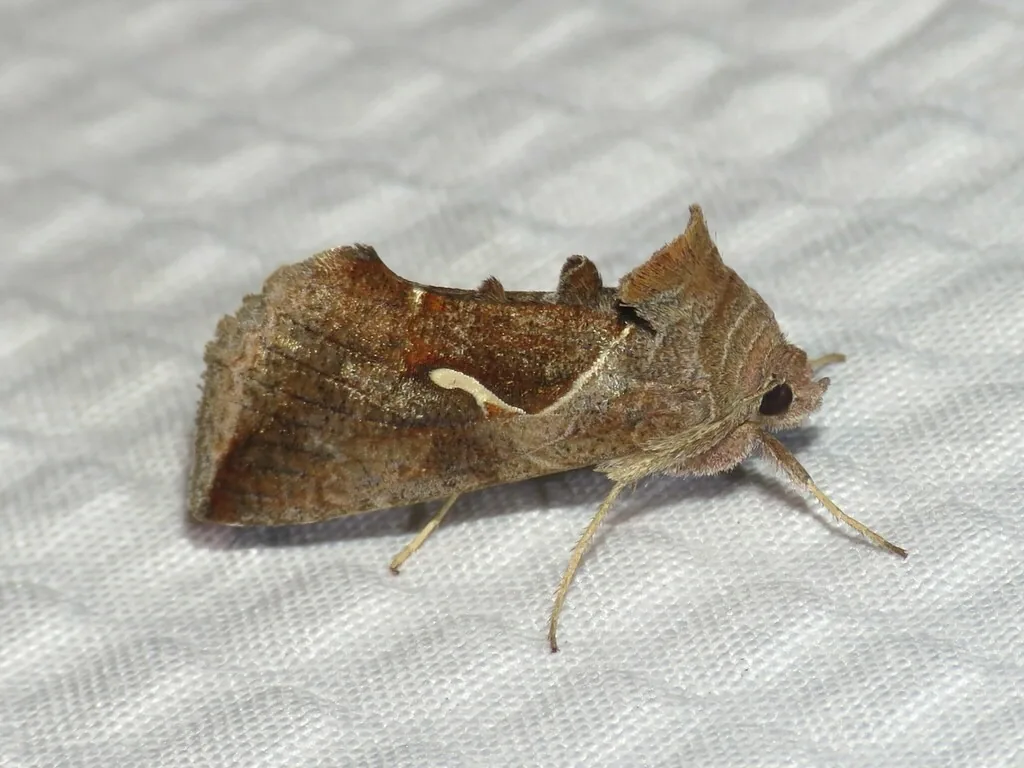
- At rest the moth folds its wings like a roof over its back. The forewing is gray or tan with a rectangular darker brown patch, bordered by a curved silvery white line that often ends in a small reddish spot.[1]
- The wingspan is 1 1/4 to 1 1/2 inches.[1]
- The caterpillars are pale green loopers that hump their backs as they walk. A white or pale line runs down each side, holding a row of small white breathing pores (spiracles) rimmed in black, and the rest of the body has sparse, tiny hairs and small light markings.[1]
Look-alikes
| Look-alike | How to tell them apart |
|---|---|
| Other owlet moths and loopers | Many owlet moths look very much alike. 'Looper' only describes how the caterpillars walk, not how closely the moths are related: geometrid moths are called loopers too, because their caterpillars move the same way.[1] |
Where it lives
It is found statewide in Missouri, flying in open places such as grasslands, old fields, crop fields, gardens and roadsides.[1]
Biology and life cycle
Adults fly from April into October and are active by day as well as at night. They come to lights after dark and drink nectar from many kinds of flowers.[1]
It spends the winter as a pupa, and the moths emerge in spring. There can be several generations a year.[1]
The caterpillars graze on vegetation, the adults help pollinate flowers, and every life stage is food for predators.[1]
A nucleopolyhedrovirus first isolated from the celery looper, known as AfMNPV, infects several other caterpillar pests as well. It turned out to be the same virus as one isolated from another looper, Rachiplusia ou; in tests on European corn borer, corn earworm and tobacco budworm, the two showed no difference in activity.[2][4]
Damage and signs
- The caterpillars eat the leaves of many herbaceous plants. The cultivated ones MDC lists are beet, blueberry, cabbage, carrot, corn, lettuce and celery.[1]
Health risk
The Missouri Department of Conservation mentions no bite, sting or other risk to people.[1]
Control
Prevention
MDC does not describe it as a serious pest or recommend any control; it notes that some other owlet moths are serious crop and garden pests.[1]
Biological control
USDA Agricultural Research Service scientists have worked on turning the celery looper's virus into a sprayable biological insecticide. Spray-dried formulations made with corn flour and lignin held up better against sunlight and rain, and on field-grown cabbage they killed more young cabbage loopers than unformulated virus (67.5% versus 30% three hours after spraying).[3][2]
Common questions
- What do celery looper caterpillars eat?
- A great variety of herbaceous plants: cultivated beet, blueberry, cabbage, carrot, corn, lettuce and celery, and wild plants such as clovers, plantains and viburnums.[1]
- Is a celery looper a kind of inchworm?
- Only in the way it walks. 'Looper' describes the humped, inchworm-style walk; the celery looper is an owlet moth (family Noctuidae), while inchworm-like geometrid moths belong to a different family.[1]
- What is AfMNPV?
- It is a nucleopolyhedrovirus first isolated from the celery looper. Because it infects several economically important caterpillars, USDA researchers have studied it as a microbial insecticide.[2][3]
Sources
- Missouri Department of Conservation, “Celery Looper (Field Guide).” mdc.mo.gov/discover-nature/field-guide/celery-looper (accessed 2026-11-09)
- Journal of Economic Entomology (via NCBI PubMed), “Field activity and storage stability of Anagrapha falcifera nucleopolyhedrovirus (AfMNPV) in spray-dried lignin-based formulations (R. W. Behle, P. Tamez-Guerra and M. R. McGuire, USDA ARS; Journal of Economic Entomology 96(4): 1066-1075, 2003; abstract).” pubmed.ncbi.nlm.nih.gov/14503576/ (accessed 2026-11-09)
- Journal of Economic Entomology (via NCBI PubMed), “Sunlight persistence and rainfastness of spray-dried formulations of baculovirus isolated from Anagrapha falcifera (P. Tamez-Guerra et al., USDA ARS; Journal of Economic Entomology 93(2): 210-218, 2000; abstract).” pubmed.ncbi.nlm.nih.gov/10826164/ (accessed 2026-11-09)
- Journal of General Virology (via NCBI PubMed), “The nucleopolyhedroviruses of Rachiplusia ou and Anagrapha falcifera are isolates of the same virus (R. L. Harrison and B. C. Bonning; Journal of General Virology 80: 2793-2798, 1999; abstract).” pubmed.ncbi.nlm.nih.gov/10573177/ (accessed 2026-11-09)
- iNaturalist, “Anagrapha falcifera taxon page (order and family).” www.inaturalist.org/taxa/59300 (accessed 2026-11-09)