On this page
How to identify it
- Caterpillars are pale green with white lines along the back and sides and grow to about 1 inch long. They move in a looping, inchworm-like way.[1][2]
- They have three pairs of prolegs on the abdomen; cutworms and armyworms have five pairs.[1][2]
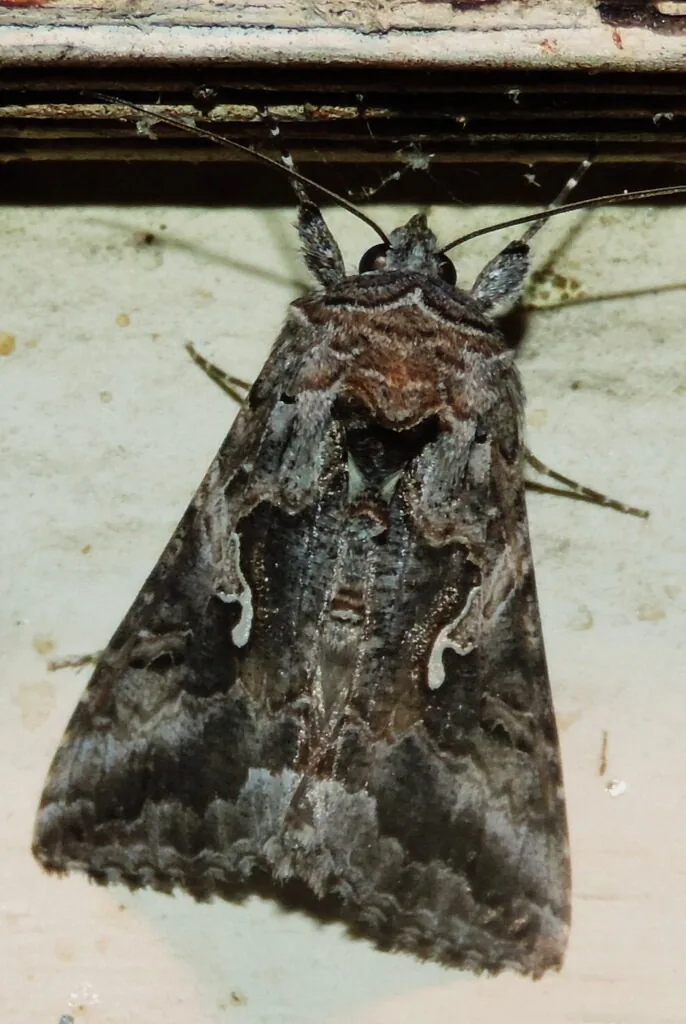
- The moth has silvery-gray to gray-brown forewings, each with an ivory to cream mark shaped like a funnel or a bent U.[2][1]
- The wingspan is 30 to 40 millimeters, or about 1 1/4 to 1 1/2 inches.[2]
- Eggs are round, white to cream colored, and laid one at a time on the undersides of leaves.[2]
Look-alikes
| Look-alike | How to tell them apart |
|---|---|
| Cabbage looper | The caterpillars look much alike, but alfalfa loopers usually have a dark stripe down the back edged with white lines. Alfalfa looper moths are the larger of the two, with a 30 to 40 mm wingspan.[2] |
| Cutworms and armyworms | Cutworm and armyworm caterpillars have five pairs of prolegs on the abdomen; loopers have three pairs.[1] |
Where it lives
The Pacific Northwest handbook and Oregon State University treat it as a crop pest in the Northwest, including in mint in Oregon's Willamette Valley, and a large outbreak was recorded around Kamloops, British Columbia, in 1934.[1][2][3]
Biology and life cycle
It spends the winter as a pupa in the soil or in plant debris near the base of host plants.[2]
Moths begin emerging in late April and May and lay their eggs singly on weeds, mostly wild plants in the mustard family.[2]
Eggs hatch in three to five days, and the caterpillars feed for about two weeks before pupating in cocoons on the host plant or in debris.[2]
A generation takes about 30 days from egg to egg, and there are three or four generations a year. Damage shows most in June and July and again in September and October.[2]
Damage and signs
- Caterpillars chew ragged holes in leaves and along leaf edges and can defoliate potatoes, peas, sugarbeets, alfalfa, beans, mint and spinach.[2][1]
- Larvae and pupae also contaminate the heads of cabbage and other cole crops and end up in processed foods.[2]
- In mint in Oregon's Willamette Valley, early damage in May and early June can look serious, but the plants almost always recover by harvest.[1]
- In the 1934 Kamloops outbreak, caterpillars left freshly mowed alfalfa fields in swarms and crossed into vegetable gardens, chewing lettuce, radishes, beans and beets to the ground within a couple of days.[3]
Health risk
The Pacific Northwest handbook and Oregon State University describe crop damage only and mention no risk to people.[1][2]
Control
Prevention
Check before treating. Count caterpillars on the plants or take sweep-net samples, because natural enemies frequently hold numbers below damaging levels.[1][2]
In mint, spraying just for loopers in May and June is generally not worth it: the damaged early leaves are shaded out and drop before harvest, and the spray can kill the beneficial insects that control loopers.[1]
Biological control
Natural enemies often keep loopers in check. Naturally occurring viruses, parasitic wasps and flies, and predators all kill them; virus-infected caterpillars turn off-color, limp and slow, and parasitized ones often show small black blotches.[1][2][3]
Bacillus thuringiensis (Bt) products control loopers when the caterpillars are small and the leaves are well covered; more than one application may be needed.[1][2]
Pesticides
Insecticides work much better on small caterpillars. For commercial mint, the Pacific Northwest handbook lists active ingredients including azadirachtin, spinosad, spinetoram, chlorantraniliprole, methoxyfenozide and tebufenozide.[1][2]
Common questions
- How do I tell an alfalfa looper from a cabbage looper?
- The caterpillars are very similar, but the alfalfa looper usually has a dark stripe down the back edged in white. The moths look alike too, but the alfalfa looper moth is larger, with a 30 to 40 mm wingspan.[2]
- Do I need to spray for loopers?
- Often not. Viruses, parasitic wasps and flies, and predators frequently keep looper numbers down, so check the plants first. If treatment is needed, Bt works best on small caterpillars.[1][2]
Sources
- Pacific Northwest Pest Management Handbooks (Oregon State, Washington State and University of Idaho Extension), “Mint: Alfalfa looper and cabbage looper (Pacific Northwest Insect Management Handbook).” pnwhandbooks.org/insect/agronomic/mint/mint-alfalfa-looper-cabbage-looper (accessed 2026-11-08)
- Oregon State University, Department of Entomology, “Alfalfa Looper (potato pest fact sheet, modified from R. E. Berry, Insects and Mites of Economic Importance in the Northwest).” hopper.science.oregonstate.edu/potato/alfalfalooper.pdf (accessed 2026-11-08)
- Entomological Society of British Columbia, “An Outbreak of Autographa californica Speyer Around Kamloops, Summer 1934 (G. J. Spencer, Proceedings of the Entomological Society of British Columbia, 1935).” journal.entsocbc.ca/index.php/journal/article/download/619/628/1038 (accessed 2026-11-08)
- iNaturalist, “Autographa californica taxon page (order and family).” www.inaturalist.org/taxa/121823 (accessed 2026-11-08)