On this page
How to identify it
- The caterpillar is pale green with narrow white lines along the back and a whitish line on each side. Its head is green with black dots.[2][1]
- It has four pairs of fleshy prolegs and moves with a looping, inchworm-like motion. Caterpillars feed mostly at night and spend the day on the undersides of leaves, often stretched along a vein or leaf stem, where they are hard to see. When disturbed, small ones drop on a silk thread and larger ones thrash from side to side.[2]
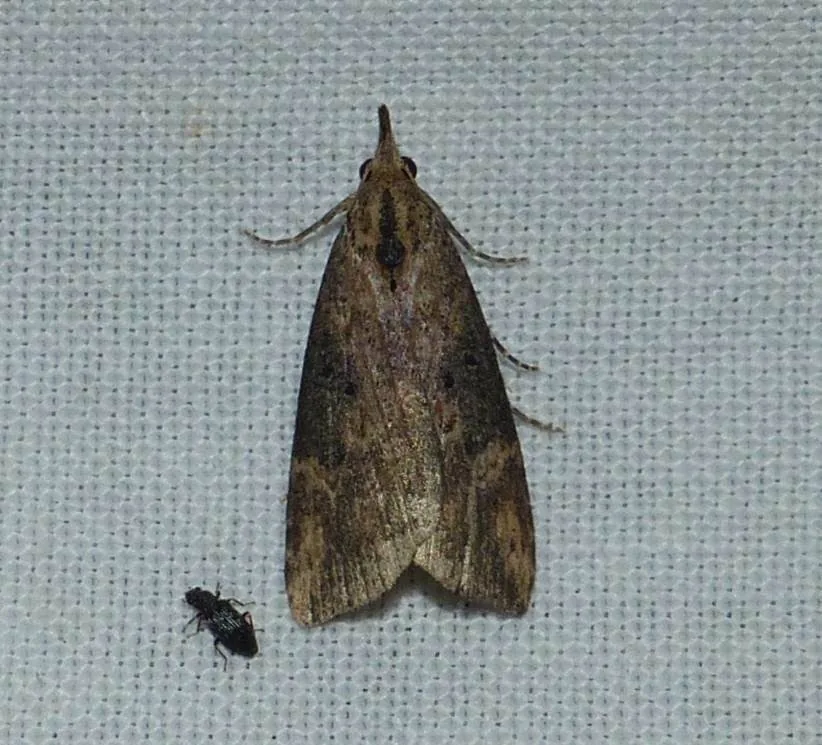
- The adult is a mottled gray to gray-brown moth about an inch long, with a long, snout-like projection at the front of the head. Females have a distinct W-shaped dark patch along the front edge of each forewing; in males the mark is fainter.[2]
- Eggs are tiny (about 1/50 inch), round and slightly flattened, and laid one at a time, usually on the undersides of hop leaves.[2]
Look-alikes
| Look-alike | How to tell them apart |
|---|---|
| Bertha armyworm | Bertha armyworm moths lack the snout and have a large spot on each forewing and a white band near its rear edge. Their caterpillars have a dark back with a yellow to orange stripe on each side; newly hatched ones have black heads, feed in groups and have five pairs of prolegs instead of four.[2] |
Where it lives
It is a pest of hop yards in the Pacific Northwest, studied in Washington and western Oregon. The Pacific Northwest handbook says it is seldom a problem in Washington, while researchers describe it as a reemerging hop pest that often needs treatment.[2][4][1][3]
Biology and life cycle
Adults spend the winter in sheltered spots such as cracks in tree trunks and fallen logs, sometimes a long way from hop yards, and fly back to the hops in April to lay eggs.[2]
Few plants other than hop serve as hosts.[2]
Eggs hatch in about three days. The caterpillars feed for two to three weeks through five or six stages, then pupate, and adults emerge 10 to 12 days later.[2]
There are three generations a year. After the first, all life stages can be in the field at once, which makes it hard to pick the best time to treat.[2]
Damage and signs
Health risk
These hop production sources treat it only as a crop pest and do not describe any harm to people.[2][1]
Control
Prevention
In a four-year western Oregon study, looper numbers and defoliation rose with the rate of nitrogen fertilizer, so avoiding unduly high nitrogen rates may help.[4]
Biological control
Natural enemies are important. At least nine parasitoid species attack the hop looper, and parasitism can reach 70 percent. Two Trichogramma wasps attack the eggs, five tachinid flies attack the caterpillars in Washington, and two ichneumonid wasps attack the pupae and can cut the number of moths that survive the winter. Hop yards also hold predators such as big-eyed bugs and damsel bugs, and whirligig mites (Anystis) eat hop looper eggs.[2]
Pesticides
Choose products that target caterpillars so the natural enemies of loopers, spider mites and hop aphids are spared. Bacillus thuringiensis subsp. aizawai is effective and highly specific to caterpillars, and Bt products work best on young caterpillars. The Pacific Northwest handbook keeps the current list of registered insecticides.[2][1]
In four years of field trials, the powdery mildew fungicide pyraclostrobin, applied in late July to early August, also reduced hop looper numbers and defoliation; two related fungicides did not.[3]
Monitoring in hop yards
No economic threshold has been set. Watch for caterpillars in the foliage before flowering; large caterpillars in the upper canopy after flowering are generally not tolerated.[2]
To check, lay a plastic or cloth tarp along a three-foot stretch of row, grab a bine at or just above head height and shake it hard for 10 to 15 seconds, then count the caterpillars that fall onto the tarp.[2]
Common questions
- What is eating lacy holes in my hop leaves?
- Hop looper caterpillars are a likely cause. They are pale green with thin white lines, feed at night, and hide along the veins on the undersides of leaves by day.[2][1]
- Do I need to spray for hop loopers?
- Not always. Parasitic wasps, tachinid flies and predators often keep them down, and parasitism can reach 70 percent. If treatment is needed, Bt products aimed at caterpillars spare these natural enemies.[2]
Sources
- Pacific Northwest Pest Management Handbooks (Oregon State, Washington State and University of Idaho Extension), “Hop-Hop looper (Pacific Northwest Insect Management Handbook).” pnwhandbooks.org/insect/agronomic/hop/hop-hop-looper (accessed 2026-11-09)
- Oregon State University, University of Idaho, USDA Agricultural Research Service and Washington State University, “Field Guide for Integrated Pest Management in Hops, 2nd edition (D. H. Gent et al., eds., 2010; Hop Looper and Bertha Armyworm section by J. D. Barbour).” hopper.science.oregonstate.edu/hop/HopHandbook2010.pdf (accessed 2026-11-09)
- Journal of Economic Entomology (via NCBI PubMed), “Suppression of hop looper (Lepidoptera: Noctuidae) by the fungicide pyraclostrobin (J. L. Woods and D. H. Gent; Journal of Economic Entomology 107(2): 875-879, 2014; abstract).” pubmed.ncbi.nlm.nih.gov/24772573/ (accessed 2026-11-09)
- Journal of Economic Entomology (via NCBI PubMed), “Influence of Nitrogen Fertilizer Rate on Hop Looper (A. E. Iskra, J. L. Woods and D. H. Gent; Journal of Economic Entomology 111(5): 2499-2502, 2018; abstract).” pubmed.ncbi.nlm.nih.gov/30085208/ (accessed 2026-11-09)
- iNaturalist, “Hypena humuli taxon page (order and family).” www.inaturalist.org/taxa/143126 (accessed 2026-11-09)