On this page
How to identify it
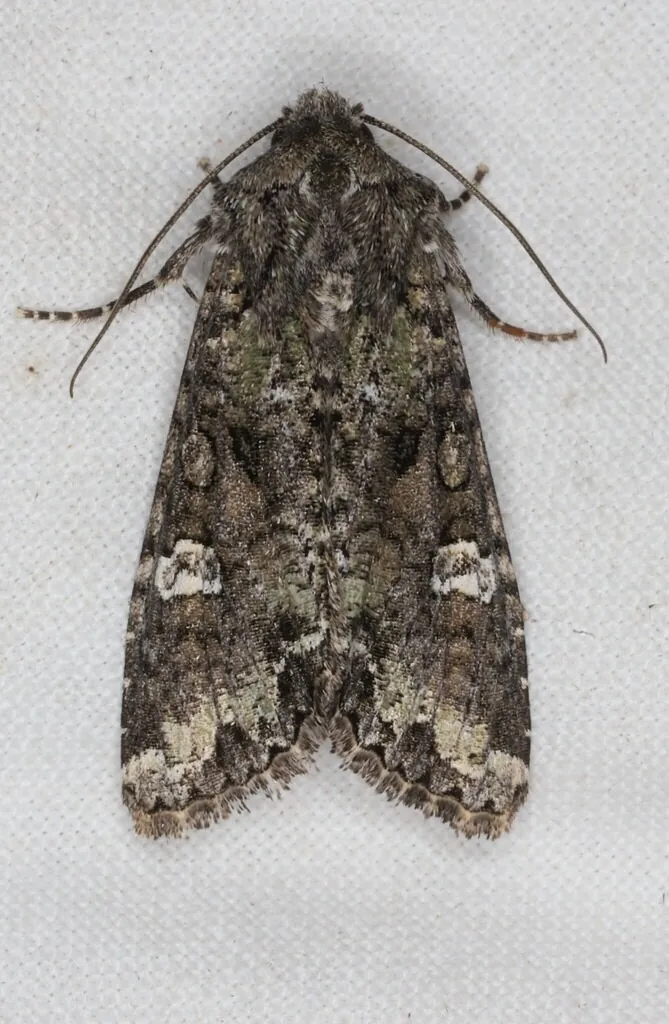
- The moth has a wingspan of about 4 cm (1 1/2 inches) and flies only at night. Its forewings are mostly grey, flecked with black, brown, olive and white scales, and a prominent white, kidney-shaped mark ringed in whitish scales near the middle of the forewing, toward the front edge.[1]
- Near the tip of each forewing there is a conspicuous, irregular white and olive transverse marking that is characteristic of the species.[1]
- Newly hatched caterpillars are about 3 mm long and pale green with a pale yellowish stripe along each side, and they are hard to spot on the undersides of leaves. Older caterpillars may stay green, but many turn brown or velvety black.[1]
- Mature caterpillars are about 4 cm long, with a light brown head and a broad yellowish-orange stripe along each side. The velvety black ones have three narrow, broken white lines down the back.[1]
- Eggs are laid in single-layered clusters of about 50 to 500 on the undersides of leaves. They are pinhead-sized, ridged and sculptured, white at first and darker as they develop.[1]
Look-alikes
| Look-alike | How to tell them apart |
|---|---|
| Diamondback moth caterpillars | Small bertha armyworm caterpillars drop from leaves on a fine silk thread when disturbed, just as diamondback moth caterpillars do, which makes the two hard to tell apart at that size. Large bertha armyworms instead drop off the plant and curl up, like other cutworms and armyworms.[1] |
| Other cutworm pupae | The reddish-brown bertha armyworm pupa, about 0.5 to 1.8 cm long, cannot be told apart from the pupae of other cutworms.[1] |
Where it lives
It is native to North America and a significant pest of canola in western North America. In Canada it occurs throughout Manitoba, Saskatchewan, Alberta and the interior of British Columbia, with severe infestations usually limited to the Parkland area of the Prairies and the Peace River region.[1][2]
Biology and life cycle
It belongs to a group called climbing cutworms, along with the true armyworm and the variegated cutworm. In Canada there is one generation a year.[1]
It spends the winter as a pupa 5 to 16 cm deep in the soil. Moths emerge from early or mid-June until early August and seem strongly drawn to canola fields in bloom. They mate within five days, and each female lays about 2,150 eggs, with up to 3,500 recorded; at average temperatures the eggs hatch within a week.[1]
Caterpillars feed for about six weeks, molting five times. When mature, in late summer or early fall, they burrow into the soil and pupate; all have pupated by early to mid-September.[1]
Canola, rapeseed, mustard, alfalfa, lamb's quarters and related plants are the preferred food, and flax, peas and potato are secondary hosts. In pot experiments, females laid more eggs on canola given moderate or high rates of fertilizer than on poorly fertilized plants, and egg laying also differed among canola varieties.[1][3]
In most years cold winters, cool wet weather, parasites, predators and diseases keep numbers low; when these checks fail, populations can explode. Infestations of 50 to 200 caterpillars per square metre may be common, and more than 1,000 per square metre have been reported.[1]
A genetic study of an outbreak across western North America found little population structure over the moth's whole range and suggested that outbreak may have spread from a single focal point in central Saskatchewan.[2]
Damage and signs
- Only the caterpillars damage crops. Young caterpillars chew irregular holes in the undersides of leaves and do little harm, but the last two larval stages eat 80 to 90% of everything a caterpillar consumes, so damage builds fast. Most serious crop damage happens in about a three-week period between late July and late August.[1]
- If canola drops its leaves before the caterpillars are mature, they feed on the seed pods, chewing holes and eating the seeds; at high numbers whole pods are eaten, and pods stripped of their green outer layer can shatter early. In flax they eat the flowers and developing bolls and sometimes the stems, so bolls drop.[1]
- Twenty caterpillars per square metre in canola can reduce the yield by about 1.16 bushels per acre. In peak outbreak years large sums are spent on insecticides, and losses can still be heavy.[1][2]
Health risk
The Alberta overview and the research papers treat it only as a crop pest; none of them mentions any harm to people. Moth traps baited for it can also catch bumble bees, a concern for pollinators rather than people.[1][2][5]
Control
Prevention
Control lamb's quarters and wild mustard. The caterpillars feed first on these weeds and move into flax, peas, lentils and sugar beets after the weeds are destroyed, so weed control reduces infestations in those crops.[1]
Traps and physical control
Fall cultivation kills many pupae and leaves less stubble to trap snow, exposing the remaining pupae to deep cold. Because the moths fly well, this works best when a whole area does it, and it should not be used on light soils that erode easily.[1]
Biological control
Native parasites, an ichneumonid wasp (Banchus flavescens) and a tachinid fly (Athrycia cinerea), and a nuclear polyhedrosis virus attack the caterpillars. They usually act only after considerable damage, with their greatest effect a year or two after an outbreak peaks, which is probably why severe infestations last only two or three years. Spraying only when thresholds are reached helps preserve them.[1]
Pesticides
Treat only when caterpillar counts exceed the economic threshold. A single, well-timed application of a registered insecticide is usually effective; spray when the caterpillars are at least 1.3 cm long, early in the morning or late in the evening while they are feeding, and use enough water to cover dense canopies.[1]
To avoid killing foraging honey bees, delay spraying until the crop has finished blooming; if that is not possible, choose the product least harmful to bees and apply it in the evening.[1]
Monitoring and thresholds
Across the Canadian Prairies, networks of pheromone-baited traps catch male moths and show the regional risk of caterpillar outbreaks; Alberta's network of about 200 traps has run since 1995. Higher moth catches from mid-June through July point to more risk of caterpillar damage in July and August, but larval counts in one year do not predict the next.[1][5]
Start checking fields for caterpillars about two weeks after the peak trap catches, at the early pod stage. Count the caterpillars in a quarter-square-metre frame at a minimum of 5, and preferably 10 to 15, spots at least 50 metres apart, shaking the plants and searching the soil surface and debris, and multiply the average by four to get the number per square metre.[1]
Adjacent fields can have very different numbers and sizes of caterpillars, depending on how attractive each crop was when the moths laid eggs, so check each field. Under drought, when the caterpillars are feeding on pods after early leaf drop, the threshold may need to be lowered.[1]
Traps baited with a mixture of acetic acid and 3-methyl-1-butanol have also caught bertha armyworm moths, both males and females, in roughly equal numbers.[4]
Common questions
- Why do bertha armyworm outbreaks come and go?
- Outbreaks cycle every six to eight years. Harsh winters in snow-free fields kill most of the overwintering pupae, while accumulated snow protects them. Parasites and a virus have their greatest effect a year or two after an outbreak peaks, which is probably why severe infestations last only two or three years.[2][1]
- Is a field next door a reliable guide to my own field?
- No. Neighboring fields can carry very different numbers of caterpillars, depending on how attractive each crop was to egg-laying moths, so each field needs its own count.[1]
- Do the moth traps for bertha armyworm catch bees?
- Green pheromone-baited bertha armyworm traps in Alberta caught more bumble bees, and more bee species, than unbaited traps. The amount of natural and forested habitat around a trap also affected how many bees it caught.[5]
Sources
- Government of Alberta, “Bertha armyworm: Overview (revised by S. Meers, Alberta Agriculture and Rural Development).” www.alberta.ca/bertha-armyworm-overview (accessed 2026-11-09)
- PLoS ONE (via NCBI PubMed), “Examining population structure of a bertha armyworm, Mamestra configurata, outbreak in western North America: implications for gene flow and dispersal (M. A. Erlandson et al.; PLoS ONE 14(6): e0218993, 2019; abstract).” pubmed.ncbi.nlm.nih.gov/31247053/ (accessed 2026-11-09)
- Journal of Economic Entomology (via NCBI PubMed), “Canola nutrition and variety affect oviposition and offspring performance in the generalist herbivore, Mamestra configurata (C. S. Weeraddana and M. L. Evenden; Journal of Economic Entomology 111(4): 1702-1710, 2018; abstract).” pubmed.ncbi.nlm.nih.gov/29905809/ (accessed 2026-11-09)
- Journal of Economic Entomology (via NCBI PubMed), “New chemical attractants for trapping Lacanobia subjuncta, Mamestra configurata, and Xestia c-nigrum (P. J. Landolt, USDA-ARS; Journal of Economic Entomology 93(1): 101-106, 2000; abstract).” pubmed.ncbi.nlm.nih.gov/14658518/ (accessed 2026-11-09)
- Environmental Entomology (via NCBI PubMed), “Local and landscape-scale features influence bumble bee bycatch in bertha armyworm pheromone-baited monitoring traps (N. L. Grocock and M. L. Evenden; Environmental Entomology 49(5): 1127-1136, 2020; abstract).” pubmed.ncbi.nlm.nih.gov/32815534/ (accessed 2026-11-09)
- iNaturalist, “Mamestra configurata taxon page (order and family).” www.inaturalist.org/taxa/224414 (accessed 2026-11-09)