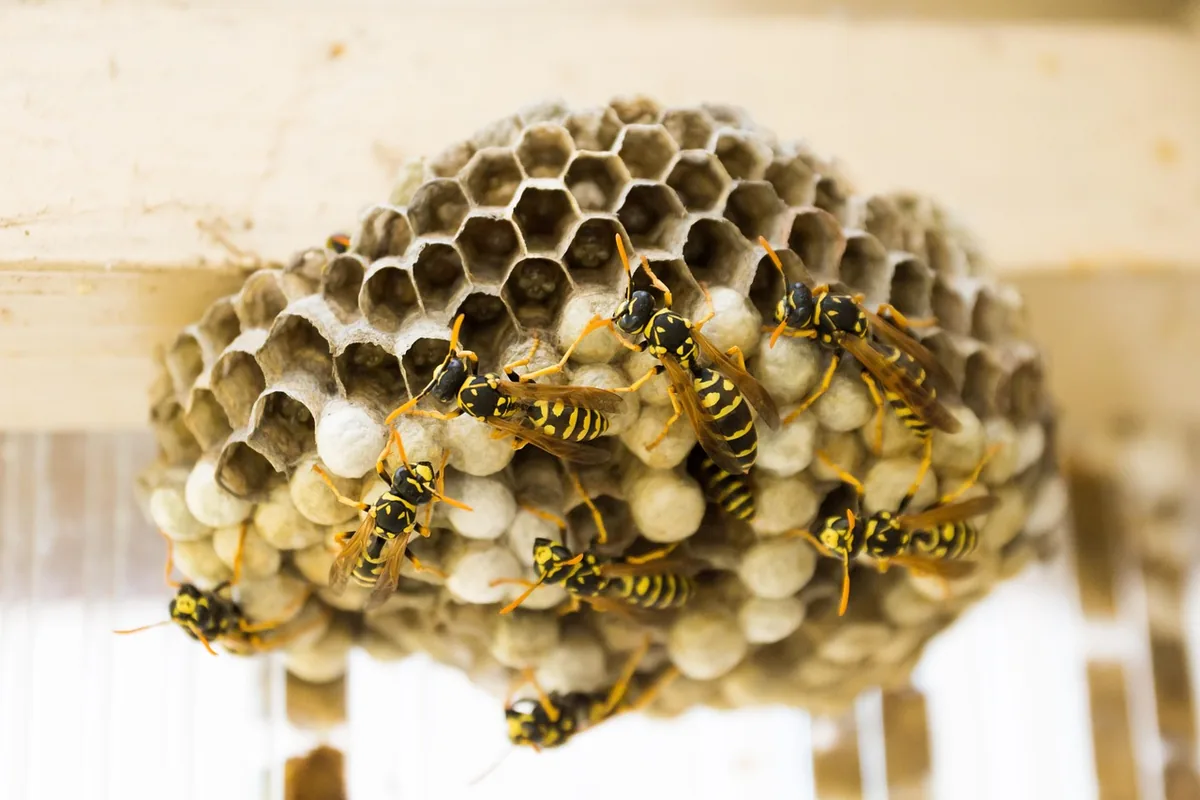
Before reaching for a spray can, ask whether the nest actually needs treatment. Paper wasps, mud daubers, and most solitary wasps are beneficial predators that consume enormous quantities of pest insects — caterpillars, flies, crickets, and spiders. A single paper wasp colony can kill thousands of garden pests per season, providing free biological pest control. The University of Minnesota Extension recommends tolerating wasp nests that don't pose a direct safety risk.
Not every wasp nest requires removal. Paper wasps under a high eave that no one walks near are actively hunting caterpillars and other garden pests — they're free pest control. Mud daubers are solitary, rarely sting, and prey on spiders. Cicada killers look terrifying but males can't sting at all.
The question isn't "is there a wasp nest?" It's "does this nest create a stinging risk where people or pets spend time?"
Treat if: The nest is near a doorway, walkway, play area, or outdoor eating area. Nests inside wall voids, soffits, or the ground near paths. Anyone in the household has a bee/wasp sting allergy. Yellow jacket nests (ground or wall void) — yellow jackets are defensive and aggressive, especially in late summer when colonies are largest.
Leave alone if: The nest is high on a tree branch, under a roofline away from foot traffic, or in an area nobody uses. Paper wasp nests at high elevation cause no problems and will be abandoned after the first hard frost anyway — wasps don't reuse nests.
Timing: Treat at dusk or after dark when all workers have returned to the nest and are least active. Never treat during the day when workers are flying — they will defend the nest aggressively. Use a red-filtered flashlight (wasps can't see red light) to approach the nest at night.
Approach distance: Stand at least 6 feet away for aerial nests. Most wasp sprays (Spectracide, Raid Wasp & Hornet) shoot a stream 15–20 feet — use that distance. For ground nests, approach from the side, not directly over the entrance.
Protective clothing: Long sleeves, pants tucked into socks, closed-toe shoes, and gloves. A hat reduces the chance of a wasp getting tangled in your hair (which triggers defensive stinging). If treating a large nest, a bee veil ($15–20) provides excellent face protection.
Application: Spray directly into the nest entrance for 5–10 seconds. For paper wasp nests, saturate the entire nest surface. Walk away immediately after spraying — don't stand and watch. Return the next day to confirm the nest is dead (no activity) before removing it.
Most wasp stings cause localized pain, swelling, and redness that resolves in hours. Clean the area, apply ice, and take antihistamine (Benadryl) if swelling is uncomfortable. Unlike bees, wasps don't leave a stinger — no need to scrape.
Seek emergency care immediately if: Swelling spreads beyond the sting site, difficulty breathing, throat tightness, dizziness, rapid heartbeat, or nausea/vomiting. These are signs of anaphylaxis — a life-threatening allergic reaction requiring epinephrine. People with known sting allergies should carry an EpiPen outdoors during wasp season. See our complete sting response guide.
Yellowjackets frequently nest in abandoned rodent burrows, landscape timber voids, and other ground-level cavities. Ground nests are more dangerous than aerial nests because they're easily disturbed by foot traffic, mowing, or children playing — and yellowjackets defend far more aggressively than paper wasps.
Treatment: Apply insecticidal dust (CimeXa, deltamethrin dust, or Tempo dust) directly into the nest entrance at dusk when all workers are inside. Puff the dust into the hole using a bellows duster, then quickly walk away. Do not seal the entrance — returning workers must pass through the treated area to die. Sealing traps them outside where they become agitated and aggressive. The colony typically collapses within 24–48 hours.
Liquid spray is less effective for ground nests because it pools near the entrance rather than penetrating the internal chambers. Dust distributes throughout the nest as workers walk through it and transfer particles to nestmates through contact.
Early spring treatment: In March or April, before queens establish new colonies, apply a residual insecticide to eaves, soffits, porch ceilings, pergola beams, and other sheltered horizontal surfaces where paper wasps typically build. Queens scouting for nest sites contact the treated surface and die before establishing. This single preventive application eliminates the majority of nest-building on treated structures.
Seal entry points: Wasps that build inside wall voids or attics enter through gaps in soffits, torn soffit screens, gaps around utility lines, and unsealed weep holes. Sealing these openings in late winter prevents queens from accessing interior spaces. Use steel wool or copper mesh to block gaps — wasps can chew through expanding foam.
Reduce food attractants: Keep outdoor trash cans sealed. Clean up fallen fruit from trees. Cover sugary drinks and food during outdoor dining. Yellowjackets are particularly attracted to protein sources (grilled meat, pet food) in spring and sugar sources (ripe fruit, soda) in late summer.
Only when it poses a direct safety risk — near doorways, walkways, play areas, or if someone has a sting allergy. Out-of-the-way nests are best left alone; wasps consume thousands of pest insects per season.
Dusk or after dark, when all workers have returned and are less active. Use a red-filtered flashlight — wasps can't see red light. Never treat during active daytime flight.
Aerosol sprays with 15–20 foot jet streams for aerial nests. For ground nests, dust products (CimeXa, deltamethrin) applied into the entrance are more effective than liquid because dust transfers through the colony.
Scrape out the stinger, wash, apply ice, take antihistamine. Watch for allergic reaction: difficulty breathing, throat swelling, dizziness, widespread hives. Use EpiPen and call 911 for anaphylaxis.
Yes — significant pest predators. One paper wasp colony kills thousands of caterpillars and flies per season. Eliminating them can increase garden pest populations.
Spray eaves and soffits with residual insecticide in March–April before queens establish. Seal soffit gaps with steel wool. Keep outdoor food and trash covered.
Several pest control claims circulate widely despite minimal supporting evidence and sometimes despite direct contradiction by entomological research. Among the most persistent: cucumber peels do not repel ants in any meaningful way (this myth is robust online despite being repeatedly tested with negative results), peppermint oil does not repel mice in real-world residential conditions (limited effect in lab cages, no measurable effect when deployed against actual rodent populations), ultrasonic pest repellers have been tested repeatedly and show no significant pest reduction across species, dryer sheets do not deter mice or other pests despite folk reputation, copper bracelets and various other historical remedies have no basis. The pattern: anecdotal claims spread faster than the data testing them. The reliable sources for evidence-based pest information are extension services and peer-reviewed entomology publications; consumer media and viral content frequently amplifies myths without checking the underlying data. When in doubt, the question worth asking is whether the claim has actually been tested under realistic conditions — if not, treat the claim as folk belief rather than information.
Generic pest control timelines published nationally are useful starting points but rarely match local conditions. The same pest emerges weeks earlier in the South than the upper Midwest, peaks at different times in coastal versus inland regions, and finishes its season at different points depending on first frost. Local cooperative extension services publish region-specific phenology — degree-day models, first-detection dates, peak activity windows — that align treatment timing with the pest's actual biology in your area. Beekeepers, gardeners, and Master Naturalist programs locally often track these timings informally and publish them on club websites. The benefit of matching local biology is significant: a preventive treatment applied three weeks early loses most of its value, and one applied three weeks late may miss the highest-pressure window entirely. The thirty minutes spent finding accurate local timing repays itself across every treatment that follows.
Lifestyle and home-improvement publications routinely cover pest control topics, but the quality of advice varies dramatically and the most popular tips often perform worse than less-publicized alternatives. Specific examples of commonly-published advice that doesn't hold up: cinnamon, peppermint oil, and other natural deterrents for ants (work briefly in laboratory conditions but don't produce meaningful field control); bleach in drains for fly elimination (doesn't address the biofilm where flies actually breed); ultrasonic pest repellers (extensive peer-reviewed testing shows minimal to no efficacy); diatomaceous earth applied broadly to carpets and floors (works in dry voids but loses efficacy when wet or vacuumed, and creates inhalation concerns when applied broadly); and dryer sheets stuffed in vents as rodent deterrents (no peer-reviewed evidence of efficacy). The pattern: most universal-home-tip pest advice prioritizes appeal and shareability over efficacy. Better sources for residential pest decisions include cooperative extension publications, peer-reviewed entomology literature (often accessible through extension publications that summarize it), and pest management association educational materials, which represent professional consensus on actual evidence.
Most homeowners frame pest control as elimination — zero individuals seen — but professional programs operate on threshold concepts that better match what's actually achievable and economically reasonable. A treatment threshold is the population level at which intervention is justified; below it, the cost and disruption of treatment outweigh the damage prevented. For aesthetic pests like the occasional ant or spider, the threshold is essentially zero only because tolerance is low, not because zero is biologically realistic. For pests with health implications (cockroaches, rodents) or property damage potential (termites, carpenter ants), thresholds are set well below visible damage to allow time for response. The implication for self-evaluation: a program that drops a cockroach population by 95% without reaching zero may be functioning correctly, and pushing for the last 5% may require disproportionate effort or treatment intensity that creates other problems. Reframing 'success' as durable reduction below threshold rather than absolute zero produces saner program design, more reasonable expectations of paid services, and less wasted DIY effort chasing the long tail of a population that's already controlled in any practical sense.
Across pest categories, placement is more important than the specific brand or formulation chosen, and the diagnostic data backs this up. A mediocre bait placed in the correct location outperforms a premium bait placed wrong; a basic snap trap on a runway outperforms a designer electronic trap in the middle of a room. The underlying reason is pest behavior: most pests follow predictable physical patterns — walls, edges, vertical surfaces, harborage-to-food routes — and traps or baits intersecting those patterns get encountered, while traps placed for human convenience often don't. Practical placement principles that apply across pest types: along walls rather than in open spaces, between harborage and food/water sources, near observed activity rather than in 'symmetric' patterns, and in higher density (more units, closer together) than feels intuitively right. Cockroach gels go in corners and crevices, not on open surfaces; rodent traps go perpendicular to walls with trigger toward the wall; pheromone traps for moths go where moth flight has been observed, not centrally; ant baits go on observed trails, not where ants are 'expected.' Spending time observing pest behavior before deploying traps almost always pays back.
Pest control content on the internet has grown dramatically in volume but not in average quality, and the signals that distinguish reliable sources from unreliable ones are worth knowing. Reliable content typically cites specific products by active ingredient rather than only by brand, references regional variation in pest pressure and treatment efficacy, acknowledges treatment failures and the conditions under which they occur, and avoids absolute claims about results. Unreliable content tends to make universal claims, recommend specific brand products without identifying alternatives, omit the conditions under which advice applies or fails, and write in a tone optimized for affiliate conversion rather than reader understanding. The other useful signal is whether the source discusses cost-benefit and threshold thinking — at what point does treatment become worth doing — versus only providing how-to instructions with the assumption that treatment is the right answer. Sources that engage with the decision dimension are usually more reliable than sources that skip past it. None of these signals are perfect, but applied consistently they filter out a meaningful portion of the lower-quality content that dominates search results for many pest topics.
An inspection is the cheapest tool in pest management, and homeowners systematically underspend on it. The economics are unambiguous: an annual or semiannual inspection costs a small fraction of what any moderate treatment costs, and it catches problems while they're still cheap to address. Termite damage detected in its first season requires perimeter treatment; the same damage discovered three years later may require structural repairs running into five figures. Rodent activity detected through droppings before nesting establishes requires sealing and a few traps; the same activity discovered after a multi-generation infestation has set up in wall voids requires removal, exclusion, sanitation, and sometimes drywall work. The pattern repeats across nearly every pest category. Even households that don't engage a regular pest service should treat the annual inspection as a baseline expense — equivalent to the way they probably treat HVAC tune-ups, gutter cleaning, or smoke detector battery changes. The marginal cost of one trained set of eyes on the property each year is one of the most defensible expenses in home maintenance.
The retail pest control aisle is largely undifferentiated by region, but pest pressure is enormously regional, and the disconnect leads to predictable purchasing mistakes. A homeowner in the Gulf Coast facing year-round subterranean termite pressure and large peridomestic cockroach populations has dramatically different needs from a homeowner in the upper Midwest facing rodent invasion in October and bed bugs in apartments. The product mix that makes sense for each is different, the level of investment that's justified is different, and the cadence of application is different. Generic shopping advice and product reviews tend to wash out these regional patterns by averaging across users. The better approach is to identify the two or three pests that actually drive pressure in your specific area, then build a product and treatment plan around those rather than around the broad category. Local cooperative extension publications, state agricultural department pest fact sheets, and regional pest control company blog content tend to be more useful sources of guidance than national review sites, precisely because they're calibrated to the conditions you're actually treating.