Most people watch where ants are going — toward the food source on the kitchen counter. But the useful information is where they are coming from. The ant trail is a two-lane highway: one lane carries workers toward the food, the other carries food-laden workers back to the colony. Follow the trail in reverse — from the food source back along the baseboard, behind the appliance, to the crack, gap, or pipe penetration where they enter the room.
This entry point is the most important location for treatment. According to the UC IPM Program, placing bait at the trail entry point is far more effective than placing it at the food source, because workers carry it directly back to the colony on the established trail route.
Trail-following tips: Ant trails are easiest to spot in the morning and evening when foraging is most active. Use a flashlight along baseboards and cabinet edges. Ants follow chemical pheromone trails that are invisible to us but map precise routes — the trail often follows edges, corners, and seams where the wall meets the floor or where cabinet faces meet the wall.
Each ant species builds a distinctive type of nest. Knowing what to look for helps you locate the colony quickly.
Small sandy mounds pushing up through sidewalk cracks, driveway expansion joints, patio edges, and along foundation walls. The mound is directly above the nest entrance. Pavement ant mounds are typically small — 1–3 inches across — but the colony extends well below the surface. These are the ants most commonly seen trailing on kitchen counters and bathroom floors.
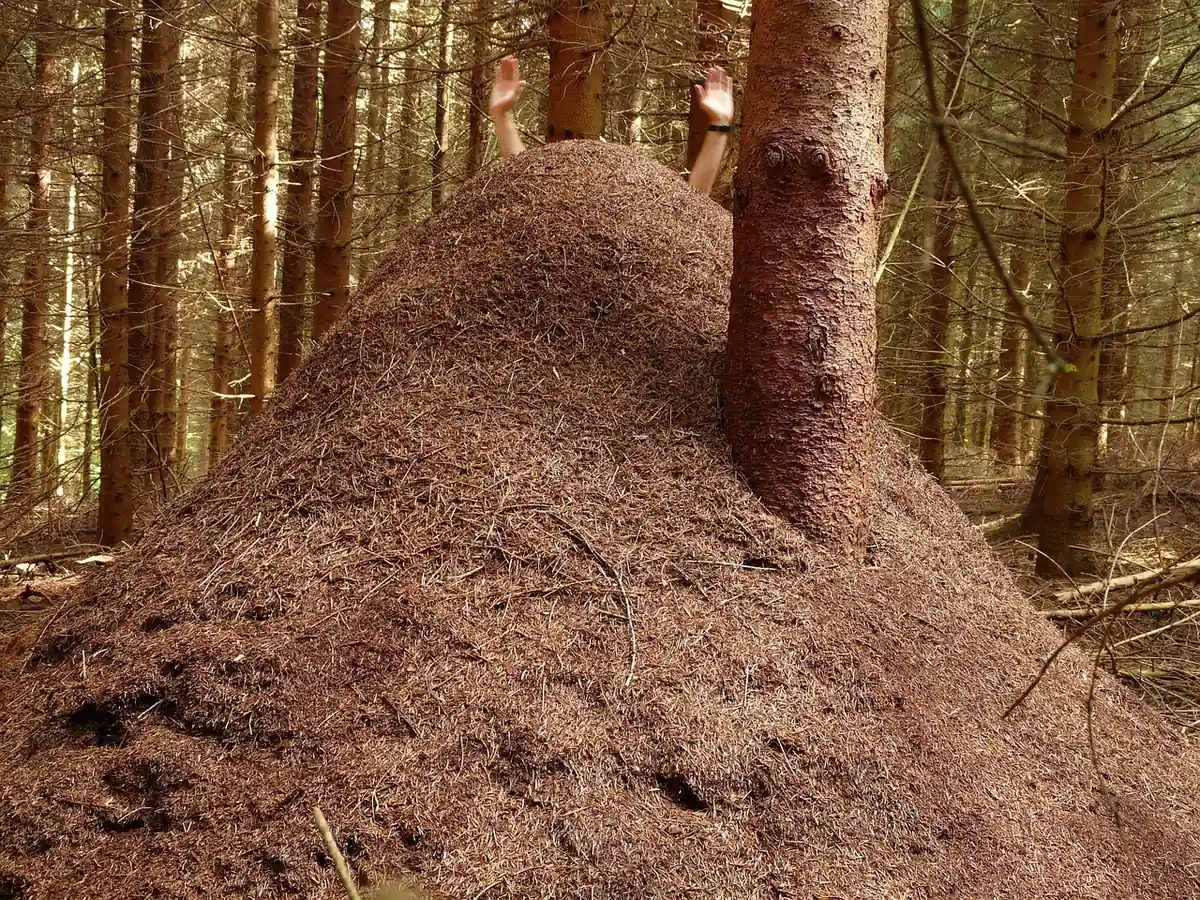
Dome-shaped mounds with no visible entrance hole on top (workers enter and exit from below ground level). Mature fire ant mounds can reach 18 inches tall and 24 inches across, containing 200,000+ workers. Never disturb a fire ant mound by kicking or poking — aggressive workers swarm immediately and deliver painful, venomous stings. Use the Texas Two-Step method for treatment. According to Texas A&M AgriLife Extension, broadcast baiting followed by individual mound treatment is the most cost-effective fire ant management approach.
No visible mound — carpenter ants nest inside wood, excavating galleries for living space. They do not eat wood (unlike termites) but remove it to create smooth, clean tunnels. The telltale sign is frass: fine sawdust mixed with insect body parts, ejected from the nest opening and accumulating in small piles below. Look for frass near tree stumps, fence posts, landscape timbers, deck posts, and — worst case — structural wood in your home. Tap suspected wood with a screwdriver handle and listen for a hollow sound or faint rustling of disturbed workers.
Shallow nests in mulch, under rocks, landscape stones, stepping stones, and under potted plants. Argentine ants form supercolonies — interconnected networks of satellite nests that can stretch across entire properties. There may not be one nest but dozens, connected by foraging trails. Treating individual nests is ineffective; broadcast bait across the property is required to address the supercolony structure.
Odorous house ants: Under mulch, rocks, logs, and landscape fabric. Also nest in wall voids (see indoor section). Named for the rotten-coconut smell when crushed.
Thief ants: Very small (1–1.5mm), nest in soil near other ant colonies and steal their food. Mounds are tiny and easily overlooked in lawns.
| Species | Nest Sign | Where to Look | Nest Size |
| Pavement ant | Small sandy mound in cracks | Sidewalks, driveways, patios | 3,000–5,000 workers |
| Fire ant | Large dome mound, no top hole | Sunny lawn areas, near warm surfaces | 100,000–500,000 workers |
| Carpenter ant | Frass (sawdust + body parts) | Dead wood, stumps, structural timber | 3,000–10,000 workers |
| Argentine ant | No visible mound | Under mulch, rocks, pots | Supercolony (millions) |
| Odorous house ant | No visible mound | Under mulch, rocks, wall voids | 10,000–100,000 workers |
When the ant trail disappears into a wall through a crack, gap around a pipe, or electrical outlet, the nest is either inside the wall void or the ants are traveling through the wall to an exterior colony. Determining which changes your treatment approach.
Place a bait station at the wall entry point and observe traffic for 15–20 minutes. If ants are carrying bait inward (into the wall) and not returning with it outward, the nest is likely inside the wall void. If traffic is bidirectional — ants going in AND coming out carrying bait — the nest is probably outside and ants are using the wall as a highway to reach it.
Odorous house ants: Wall voids near moisture sources — behind dishwashers, under bathroom sinks, inside walls adjacent to shower stalls. They are attracted to condensation on pipes and will establish satellite colonies near any consistent water source.
Carpenter ants: Moisture-damaged wood inside walls, particularly around leaky windows, roof leaks, and failed pipe joints. If you see large black ants (1/4 to 1/2 inch) emerging from a wall, especially at night, you likely have a carpenter ant nest in water-damaged structural wood. This requires professional inspection.
Pharaoh ants: Warm wall voids near hot water pipes, inside electrical junction boxes, and behind baseboards near heating elements. Pharaoh ants are tiny (1.5–2mm), yellow-brown, and notoriously difficult to control because they form multiple satellite colonies when disturbed — never spray pharaoh ants, as this causes colony budding and makes the problem worse. Bait is the only effective treatment.
Carpenter ants deserve special attention because they are the only common ant species that causes structural damage to homes. They excavate galleries in wood for nesting — preferring soft, moisture-damaged wood but capable of tunneling into sound wood as colonies mature.
How to locate a carpenter ant nest:
Follow foraging trails at night (carpenter ants are primarily nocturnal foragers). Tap wood with a screwdriver handle along the trail route — listen for a hollow sound or the faint rustling of disturbed workers inside. Look for frass piles below any suspected nest site. Check window frames, door frames, and any wood that contacts the exterior for soft spots. Inspect where plumbing or roofing has leaked — moisture damage is the primary predictor of carpenter ant nesting.
Carpenter ants frequently maintain a parent colony in an outdoor tree stump or dead tree and establish satellite colonies inside the house. Both must be treated to eliminate the infestation. The parent colony contains the queen and eggs; the satellite colony contains workers and mature larvae. According to the Penn State Extension, locating and treating the parent colony is essential for permanent control.
Ants keep coming back because most treatments target workers — the ants you see on the counter. Workers are expendable; the colony replaces them continuously. The queen (or queens, in multi-queen species) is the reproductive engine, and she stays deep in the nest, protected by workers, never foraging herself.
Killing workers with spray provides temporary relief but does not reduce the colony's population. The queen simply produces more workers. Bait-based treatments work because workers carry the toxicant back to the nest, where it reaches the queen and brood. But bait placed at the food source on the kitchen counter has to travel the entire trail route back to the colony. Bait placed at the entry point — where ants enter the room from the wall void or exterior — is on the direct route home.
This is why finding the nest (or at least the entry point nearest the nest) multiplies bait effectiveness roughly tenfold. You are shortcutting the delivery route.
Sometimes you cannot locate the nest, and that is fine. Bait-based products are designed for exactly this situation — the ants find the bait, carry it home, and the bait finds the nest for you.
Place bait along the trail as close to the entry point as you can determine. Even if the trail disappears behind an appliance or into a wall crack you cannot see behind, placing bait at the last visible point on the trail is effective.
Use the right bait for the species. This is critical — different ant species prefer different bait types. Sweet-feeding ants (odorous house ants, Argentine ants, pharaoh ants) respond to sugar-based liquid bait like TERRO. Protein/grease-feeding ants (pavement ants, fire ants, thief ants) respond to protein-based granular bait. Some species switch preferences seasonally. For species identification, use our 5-step ant ID guide.
Do not spray. Spraying an ant trail kills the visible workers but leaves a repellent residue that forces surviving ants to reroute — they find new entry points and new trails, making the problem appear to spread. Spray also prevents ants from reaching bait. The UC IPM Program recommends bait as the primary ant control method in residential settings.
| Nest Location | Best Treatment | Notes |
| Outdoor soil mound (pavement, fire) | Broadcast bait + mound drench | Bait first, then treat individual mounds |
| Under mulch/rocks (Argentine, odorous) | Liquid bait stations along trails | Multiple stations needed for supercolonies |
| Inside wall void | Bait at entry point + CimeXa dust in void | Puff dust through outlet covers on affected wall |
| Inside structural wood (carpenter) | Professional treatment required | Locate parent colony + satellites; fix moisture source |
| Cannot find nest | Species-appropriate bait along trail | Place as close to entry point as possible |
| Treatment | DIY Cost | Professional Cost |
| Liquid ant bait stations (6-pack) | $6–$10 | — |
| Gel bait (ant-specific) | $8–$15 | — |
| Granular fire ant bait (1 lb) | $8–$15 | — |
| General ant treatment (interior) | $15–$30 | $100–$200 |
| Carpenter ant treatment (locate + treat) | Not recommended DIY | $250–$600 |
| Fire ant yard treatment (broadcast + mound) | $15–$30 | $150–$350 |
Follow the ant trail backward — from the food source toward the wall, crack, or gap where they enter. The trail follows pheromone routes along edges and seams. Place bait at the entry point for maximum effectiveness.
It varies by species. Pavement ants create small sandy mounds in cracks. Fire ants build large dome mounds with no top hole. Carpenter ants leave frass (sawdust + body parts) near wood nests. Argentine ants nest shallowly under mulch and rocks with no visible structure.
Carpenter ants excavate wood but do not eat it — they leave clean galleries and visible frass. Termites eat wood and build mud tubes on foundations. Carpenter ant workers are large and dark; termite workers are pale and soft-bodied. See our detailed comparison.
Yes. Odorous house ants nest near wall moisture sources, carpenter ants nest in moisture-damaged wood, and pharaoh ants nest near hot water pipes. Place bait at the wall entry point and observe traffic direction to determine if the nest is inside or outside.
Not always — bait products let workers carry toxicant back to the colony for you. But placing bait at the trail entry point rather than the food source is roughly 10x more effective because it shortens the delivery route to the queen.
Rain floods tunnels, forcing colonies to excavate and rebuild, pushing soil to the surface. The ants were already there — rain just made them visible. Post-rain is a good time to bait, as displaced ants are actively foraging to rebuild colony reserves.
Pest control content on the internet has grown dramatically in volume but not in average quality, and the signals that distinguish reliable sources from unreliable ones are worth knowing. Reliable content typically cites specific products by active ingredient rather than only by brand, references regional variation in pest pressure and treatment efficacy, acknowledges treatment failures and the conditions under which they occur, and avoids absolute claims about results. Unreliable content tends to make universal claims, recommend specific brand products without identifying alternatives, omit the conditions under which advice applies or fails, and write in a tone optimized for affiliate conversion rather than reader understanding. The other useful signal is whether the source discusses cost-benefit and threshold thinking — at what point does treatment become worth doing — versus only providing how-to instructions with the assumption that treatment is the right answer. Sources that engage with the decision dimension are usually more reliable than sources that skip past it. None of these signals are perfect, but applied consistently they filter out a meaningful portion of the lower-quality content that dominates search results for many pest topics.
An inspection is the cheapest tool in pest management, and homeowners systematically underspend on it. The economics are unambiguous: an annual or semiannual inspection costs a small fraction of what any moderate treatment costs, and it catches problems while they're still cheap to address. Termite damage detected in its first season requires perimeter treatment; the same damage discovered three years later may require structural repairs running into five figures. Rodent activity detected through droppings before nesting establishes requires sealing and a few traps; the same activity discovered after a multi-generation infestation has set up in wall voids requires removal, exclusion, sanitation, and sometimes drywall work. The pattern repeats across nearly every pest category. Even households that don't engage a regular pest service should treat the annual inspection as a baseline expense — equivalent to the way they probably treat HVAC tune-ups, gutter cleaning, or smoke detector battery changes. The marginal cost of one trained set of eyes on the property each year is one of the most defensible expenses in home maintenance.
Pet-safe is a marketing phrase that does specific work, and the work it does is narrower than most pet owners assume. A product labeled pet-safe is generally one that, when used according to label directions and after the specified re-entry interval, presents a low risk of acute toxicity to pets at expected exposure levels. That is not the same thing as zero risk, and it doesn't say anything about chronic exposure, behavioral effects, or exposure to pets with unusual physiology, age, or pre-existing conditions. The other thing it doesn't account for is real-world misuse: pets that lick treated surfaces immediately after application, products applied in higher concentrations than directed, or applications in locations the label didn't anticipate. The practical interpretation is that pet-safe products are a reasonable choice when used carefully, but the safer overall practice with any pet in the home is to keep animals out of treatment areas until products are fully dry or absorbed, choose lower-toxicity formulations like bait stations over surface sprays when feasible, and ask explicitly about ingredients and re-entry intervals rather than relying on the label phrase alone.