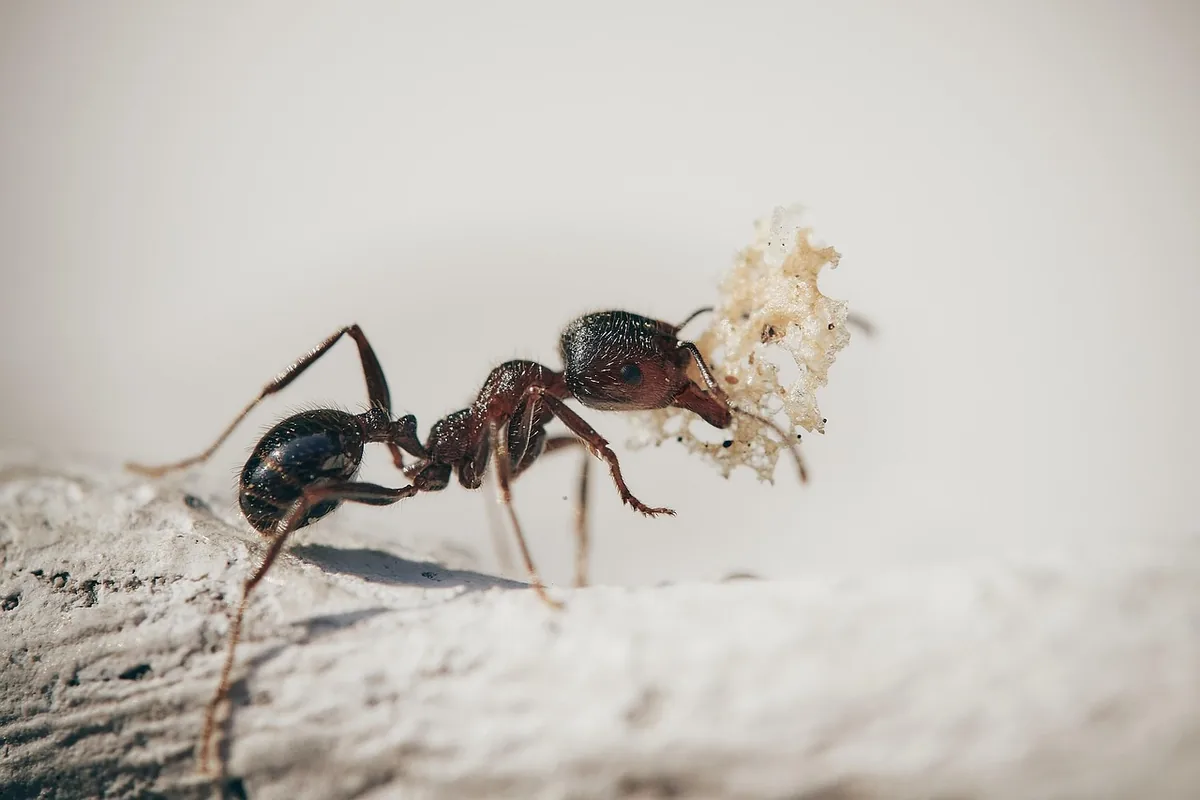
If you've treated for ants and they've returned — same species, same location — it's not random. Ant reinfestations follow predictable patterns, and each pattern has a specific fix. The ant colony didn't come back because it's "persistent." It came back because the treatment didn't reach the queen, the entry point wasn't sealed, or you're treating the wrong species with the wrong strategy.
Spraying kills the workers you see — which represent roughly 10% of the colony. The queen, safely hidden in the nest (often inside a wall void, under the foundation, or in a landscape timber), continues producing hundreds of new workers per day. Within a week, the colony is back to full strength. This is the fundamental reason spray-and-pray doesn't work for ants.
The fix: Use slow-acting bait instead of spray. Ant bait works by exploiting the colony's food-sharing behavior (trophallaxis). Workers consume the bait, carry it back to the nest, and feed it to the queen, larvae, and other workers. The delayed action — 24 to 72 hours — gives workers time to distribute the toxicant throughout the entire colony before the first casualties appear. Gel baits (Advion), liquid baits (TERRO), and granular baits all work on this principle. The key is patience: let the ants feed undisturbed for 3–7 days.
Some ant species — notably Argentine ants, pharaoh ants, and ghost ants — respond to repellent chemicals by budding: the colony splits into multiple satellite colonies, each with their own queen. Spraying with a pyrethroid actually multiplies the number of colonies you're dealing with.
The fix: Never use repellent sprays on budding species. Use only non-repellent baits (borax-based liquid bait, indoxacarb gel). If you've already triggered budding, it takes 2–4 weeks of patient baiting to eliminate all satellite colonies.
Ants follow pheromone trails that persist even after the original colony is eliminated. A new colony from outside — or a different part of the same supercolony — picks up the trail and follows it right back to the same entry point.
The fix: Identify and seal the entry point with caulk. Clean the trail path with soapy water to destroy the pheromone trail. Then bait outside near the sealed entry point to intercept the exterior colony.
Ants switch between carbohydrate (sugar) and protein food preferences based on colony needs. In spring, colonies raising brood need protein. In summer, foraging workers need sugar for energy. A sugar bait offered to ants seeking protein will be ignored — and vice versa.
The fix: If ants aren't taking your bait, switch types. Offer both a sweet liquid bait and a protein gel or granular bait simultaneously. The ants will choose whichever matches their current nutritional need. See our ant species ID guide to match species to preferred bait.
Ants forage where rewards exist. A persistent dripping faucet provides water. Crumbs behind the stove provide food. Pet food left out overnight is a buffet. Honeydew from aphids on foundation plants attracts ants from across the yard. Even if you kill the current colony, the attractant draws the next one.
The fix: Eliminate the attractant. Fix leaks. Deep-clean behind appliances. Store pet food in sealed containers. Treat foundation plants for aphids (which produce the honeydew ants farm). Address the "why" and the "who" becomes irrelevant.
Based on the five failure modes above, here's the protocol that actually works for permanent ant elimination:
Step 1 — Identify the species. Upload a photo to our AI Bug Identifier or check the ant identification guide. Species determines bait type, colony structure, and whether budding is a risk. This step takes 2 minutes and prevents all the downstream mistakes.
Step 2 — Place bait, not spray. Set out slow-acting bait near active ant trails — both sugar-based (TERRO liquid) and protein-based (Advion gel) if you're unsure of preference. Let the ants feed undisturbed for 3–7 days. Increased activity at the bait station is a good sign — it means workers are recruiting nestmates to the food source. Never spray near bait stations. Repellent spray residue prevents ants from reaching the bait.
Step 3 — Seal the entry point. Once ant activity stops (7–14 days), locate and seal the entry point they were using — usually a crack in the foundation, a gap around a pipe, or a window frame joint. Silicone caulk or copper mesh and caulk provide permanent closure. If you seal before the colony is eliminated, the ants will find a new entry point.
Step 4 — Address the attractant. Fix the moisture source (leaking pipe, condensation, poor drainage) or food source (unsealed pet food, crumbs behind appliances, sticky spills) that attracted the colony in the first place. Without addressing the attractant, a new colony will eventually discover the same favorable conditions.
Step 5 — Prevent recolonization. Apply a non-repellent perimeter barrier spray (Termidor, Taurus, or Alpine WSG) around the exterior foundation. Non-repellent formulations are critical — ants walk through the treated zone unknowingly and transfer the product to nestmates, preventing new colonies from establishing along the foundation.
Spray kills visible workers but not the queen. The colony replaces killed workers within days. Repellent sprays can also trigger colony budding, making the problem worse. Use bait instead.
When a colony splits into multiple smaller colonies, each with a queen, in response to stress from repellent chemicals. Common in odorous house ants, Argentine ants, and pharaoh ants. Budding turns one colony into two or three.
Three steps: identify the species (determines bait type), use slow-acting bait (kills the queen), and seal entry points plus address moisture/food attractants. All three are necessary for permanent results.
Sugar-based bait (TERRO liquid) for spring/summer when ants seek carbohydrates. Protein-based bait (Advion gel) for late summer/fall when colonies shift to protein for brood rearing. Offer both if unsure.
Always bait. Spray kills workers but not the colony. Bait is carried back to the queen, eliminating the entire population. Never spray near bait — repellent residue prevents ants from reaching it.
3–14 days depending on colony size. Activity at the bait station should increase first (good sign), then decrease after 3–5 days, and cease by 7–14 days. If untouched after 48 hours, switch bait type.
Several pest control claims circulate widely despite minimal supporting evidence and sometimes despite direct contradiction by entomological research. Among the most persistent: cucumber peels do not repel ants in any meaningful way (this myth is robust online despite being repeatedly tested with negative results), peppermint oil does not repel mice in real-world residential conditions (limited effect in lab cages, no measurable effect when deployed against actual rodent populations), ultrasonic pest repellers have been tested repeatedly and show no significant pest reduction across species, dryer sheets do not deter mice or other pests despite folk reputation, copper bracelets and various other historical remedies have no basis. The pattern: anecdotal claims spread faster than the data testing them. The reliable sources for evidence-based pest information are extension services and peer-reviewed entomology publications; consumer media and viral content frequently amplifies myths without checking the underlying data. When in doubt, the question worth asking is whether the claim has actually been tested under realistic conditions — if not, treat the claim as folk belief rather than information.
Many pest problems are also air quality problems, and treating one without considering the other produces partial results. Cockroach allergens are a documented asthma trigger, with proteins from droppings and shed cuticles persisting in dust for months after the live population is eliminated. Rodent urine and dander carry allergens that contribute to childhood asthma development. Stored-product pests in pantries can contribute to allergic reactions and food contamination. Mold associated with rodent or insect infestations adds a separate respiratory burden. The implication for control programs: post-treatment cleanup of dust, droppings, and contaminated insulation produces measurable indoor air quality gains beyond just removing live pests. HEPA-filtered vacuums (not standard household vacuums, which can re-aerosolize fine particles) are the right tool for cleanup. This matters most in homes with asthma sufferers, young children, or anyone with respiratory sensitivity.
Lifestyle and home-improvement publications routinely cover pest control topics, but the quality of advice varies dramatically and the most popular tips often perform worse than less-publicized alternatives. Specific examples of commonly-published advice that doesn't hold up: cinnamon, peppermint oil, and other natural deterrents for ants (work briefly in laboratory conditions but don't produce meaningful field control); bleach in drains for fly elimination (doesn't address the biofilm where flies actually breed); ultrasonic pest repellers (extensive peer-reviewed testing shows minimal to no efficacy); diatomaceous earth applied broadly to carpets and floors (works in dry voids but loses efficacy when wet or vacuumed, and creates inhalation concerns when applied broadly); and dryer sheets stuffed in vents as rodent deterrents (no peer-reviewed evidence of efficacy). The pattern: most universal-home-tip pest advice prioritizes appeal and shareability over efficacy. Better sources for residential pest decisions include cooperative extension publications, peer-reviewed entomology literature (often accessible through extension publications that summarize it), and pest management association educational materials, which represent professional consensus on actual evidence.
Sealing entry points is the most underrated pest control activity in residential settings, partly because it produces no immediate visible result and partly because it feels like home repair rather than pest control. The yield is substantial: a thoroughly sealed structure with appropriate exterior caulking, intact weatherstripping, sealed utility penetrations, and screen integrity has dramatically lower pest pressure than the same structure without those interventions. Specific high-yield targets include gaps around dryer vents, electrical and plumbing penetrations through exterior walls, gaps where siding meets foundation, mortar joints in older brick, weep holes in newer brick (which should be screened, not sealed), garage door bottom seals (where rodents commonly enter), and the gap above door thresholds where many ants and small insects pass. Materials matter: silicone-based caulk for moisture areas, polyurethane sealant for foundation cracks, copper mesh for rodent exclusion at utility penetrations (steel wool degrades), and 1/4-inch hardware cloth for larger openings. A weekend of methodical sealing in spring or fall — when activity is moderate and weather permits exterior work — produces lasting reduction that no single treatment matches.
Across pest categories, placement is more important than the specific brand or formulation chosen, and the diagnostic data backs this up. A mediocre bait placed in the correct location outperforms a premium bait placed wrong; a basic snap trap on a runway outperforms a designer electronic trap in the middle of a room. The underlying reason is pest behavior: most pests follow predictable physical patterns — walls, edges, vertical surfaces, harborage-to-food routes — and traps or baits intersecting those patterns get encountered, while traps placed for human convenience often don't. Practical placement principles that apply across pest types: along walls rather than in open spaces, between harborage and food/water sources, near observed activity rather than in 'symmetric' patterns, and in higher density (more units, closer together) than feels intuitively right. Cockroach gels go in corners and crevices, not on open surfaces; rodent traps go perpendicular to walls with trigger toward the wall; pheromone traps for moths go where moth flight has been observed, not centrally; ant baits go on observed trails, not where ants are 'expected.' Spending time observing pest behavior before deploying traps almost always pays back.
Pest control content on the internet has grown dramatically in volume but not in average quality, and the signals that distinguish reliable sources from unreliable ones are worth knowing. Reliable content typically cites specific products by active ingredient rather than only by brand, references regional variation in pest pressure and treatment efficacy, acknowledges treatment failures and the conditions under which they occur, and avoids absolute claims about results. Unreliable content tends to make universal claims, recommend specific brand products without identifying alternatives, omit the conditions under which advice applies or fails, and write in a tone optimized for affiliate conversion rather than reader understanding. The other useful signal is whether the source discusses cost-benefit and threshold thinking — at what point does treatment become worth doing — versus only providing how-to instructions with the assumption that treatment is the right answer. Sources that engage with the decision dimension are usually more reliable than sources that skip past it. None of these signals are perfect, but applied consistently they filter out a meaningful portion of the lower-quality content that dominates search results for many pest topics.
Pest control warranties are not standardized, and the differences between contracts that look superficially similar can be enormous. Termite warranties in particular vary across at least three significant dimensions: whether they cover retreatment only or also include damage repair, whether the damage coverage is capped or unlimited, and whether the warranty is transferable to subsequent owners. A retreatment-only warranty on a property with significant termite pressure is much weaker than a damage-inclusive warranty, and the difference matters most precisely in the situations where the warranty is most likely to be needed. General pest control service agreements often have similar gradations — some include unlimited callbacks during the service period, some include a fixed number, and some charge for any visit outside the regular schedule. Before signing, the question to ask is not whether the contract has a warranty, but exactly what the warranty covers, what triggers a callback at no charge, and what the renewal terms are. Companies rarely volunteer this clearly; reading the document carefully and asking specific questions is on the homeowner.
Preventive treatment costs money in a year when nothing is happening, which is precisely why most households avoid it. The decision to spend on prevention requires a willingness to compare what you actually spend against a counterfactual you never directly observe — the infestations you would have had without it. This is a hard mental move, and it's why preventive pest control consistently underconsumed relative to its economic value. The way to think about it more clearly is to compute the expected annual cost of treatment for a property like yours given local pest pressure, then compare that against the cost of a preventive program. In most regions and for most property types, a preventive program comes in lower in expected value, sometimes substantially. The variance is also lower: instead of a year with zero pest spending followed by a year with a large unexpected expense, you have a small consistent line item that smooths out the cash flow. For households where unexpected expenses are particularly painful, that variance reduction is itself worth something even before counting the expected-value benefit.