🔧 HOW-TO GUIDE
How to Eliminate Clothes Moths — Protect Wool, Cashmere, and Silk
Clothes moth larvae eat wool, cashmere, silk, and feathers — but you rarely see them. A systematic protocol targeting the larvae (not the adults) is the only effective approach.
✅ How to Know It's Working
Pest control success is measured in weeks, not days. Here's what to look for:
- Week 1–2: You may see increased activity as pests are flushed from hiding. This is normal.
- Week 2–4: Activity should drop noticeably. Bait traps or sticky monitors should show declining counts.
- Week 4–6: New activity near zero. Any resurgence means a population was missed or re-introduction occurred.
💡 Monitoring tip: Place sticky traps in corners and along walls before you start treatment. Counting catches weekly gives you objective data on whether the population is declining.
👷 When to Call a Professional
DIY is appropriate for small, contained infestations caught early. Call a licensed professional when:
- You've tried DIY twice with no lasting improvement
- The infestation involves a wall void, crawlspace, or area you can't safely access
- There's a health risk involved (hantavirus, anaphylaxis risk, etc.)
- The problem covers more than one room or a large outdoor area
- You have children, elderly, or immunocompromised individuals in the household
⚠️ Rule of thumb: If you've spent more on DIY materials than a professional visit would cost, it's time to call.
❓ Frequently Asked Questions
How do I know if I have clothes moths or carpet beetles?
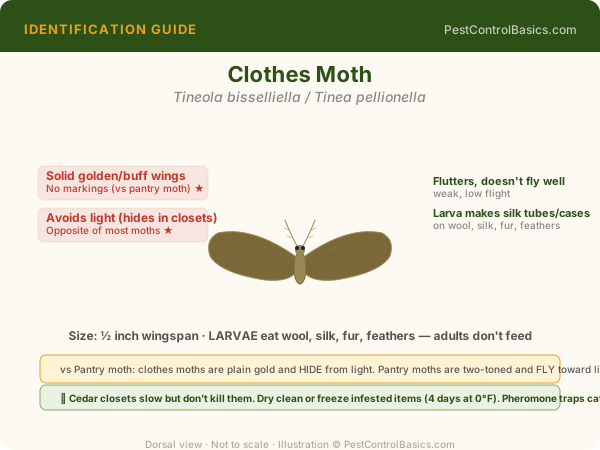
Clothes moths leave irregular holes with silken webbing. Carpet beetles create surface grazing without webbing. Moth adults are small, gold-colored, and avoid light. Carpet beetle adults are round, patterned, and fly toward windows.
Do cedar closets and mothballs work?
Cedar must be fresh and unfinished to emit adequate vapor. Old cedar provides no protection unless sanded. Mothballs work but require near-airtight enclosures and create health concerns. Pheromone traps are a safer monitoring option.
What fabrics do clothes moths damage?
Only animal-based fibers: wool, cashmere, silk, fur, feathers, angora, and mohair. They do not eat synthetics or cotton. Blended fabrics can be damaged as moths eat through synthetic strands to reach wool content.
How do I protect stored wool and cashmere?
Clean all items thoroughly before storage since moths are attracted to body oils and food stains. Store in sealed airtight containers. Cedar blocks or lavender sachets provide supplemental deterrence inside the container.
Clothes moth prevention and treatment
Clothes moth larvae do the damage; adult moths don't eat. Damage appears as small irregular holes in wool, cashmere, or silk items, often in items stored long-term, sometimes with webbing or larval cases nearby. Prevention: store seasonal natural-fiber clothing clean (larvae prefer items with sweat, food, or oil residues), in sealed bags or airtight containers, with cedar or lavender as a deterrent (these are not lethal but help with adult moth avoidance), and inspect stored items at least annually. Treatment for existing infestations: launder washable items in hot water, dry clean items that can't be washed, freeze items that can't be cleaned (sealed bag, several days at freezer temperature kills all life stages), vacuum carpets and upholstery where moth-friendly debris accumulates. Pheromone traps for casemaking and webbing clothes moths confirm presence and track elimination.
When to escalate from DIY to professional
DIY pest control is appropriate for most common household pests when caught early and treated correctly. Escalation to a licensed professional makes sense in specific situations, not just when frustration builds. Wall-void and structural infestations — termites, carpenter ants, rodents nesting inside walls — usually require equipment and access homeowners don't have. Bedbugs at moderate-to-heavy infestation levels almost always require professional treatment; DIY rarely succeeds past the first few isolated bugs. Multi-unit dwellings (apartments, condos) need building-wide coordination that individual unit treatments can't replicate. Health-sensitive households — anaphylaxis risk to stings, immunocompromised individuals, pregnancy, infants — should default to professional because professionals can use the lowest-toxicity option that solves the problem rather than what's available at retail. The financial break-point is roughly when DIY material costs approach one professional visit; below that, DIY is usually fine.
Pantry moths vs. clothes moths — different problems, different solutions
Two common household moths produce very different problems. Indianmeal moths (pantry moths) infest stored grain products — flour, cereal, dry pet food, birdseed, pasta, dried fruit. They enter homes inside infested groceries; the larvae develop in food and the adult moths fly through the home looking for more food sources. Clothes moths (webbing and casemaking species) consume natural fiber — wool, silk, cashmere, hair — and develop in stored clothing, rugs, and upholstery. Confusing the two leads to wrong treatment: pantry moth control requires food source elimination and pantry sanitation; clothes moth control requires textile inspection, cleaning, and storage management. Both respond to pheromone traps for monitoring and detection, but the trap pheromones are species-specific.
Pantry moth elimination protocol
Pantry moth control: empty the pantry completely, inspect every package — flour, grains, cereals, mixes, spices, nuts, dried fruit, pet food. Discard anything with visible larvae (small caterpillars, often in webbing inside packaging), pupae (small cocoons in package folds or pantry corners), or adult moths. Larvae chew through most packaging — paper, thin plastic, even some plastic bags — so visible damage on outside isn't required for contamination. Transfer remaining suspect items to the freezer for at least a week to kill any larvae. Vacuum the pantry thoroughly including all corners and shelving edges, discard the vacuum bag immediately. Wipe shelves with soap and water, then vinegar solution. Store all dry goods in airtight glass or hard plastic containers going forward. Place pheromone monitor traps to verify elimination over weeks following cleanout.
Choosing the right product formulation for the situation
Active ingredient gets most of the attention, but formulation often determines outcome. The same active ingredient in different formulations performs very differently: microencapsulated formulations last longer on porous surfaces and reduce human re-entry exposure, wettable powders give the longest residual on porous substrates but leave visible residue, suspended concentrates give a balance of residual and appearance, dusts are uniquely effective in wall voids and dry harborage but should never be broadcast indoors, baits are appropriate when pests must transport active to the colony or nest, and aerosols are appropriate for direct contact and quick knockdown but rarely give meaningful residual. Choosing formulation by the substrate (porous vs. nonporous), the access (open spray vs. crack-and-crevice vs. void), and the goal (knockdown vs. residual vs. transferable) routinely improves outcomes more than upgrading active ingredient.
Clothes moth treatment and the role of cleaning
Clothes moths — primarily webbing clothes moths and casemaking clothes moths — feed specifically on protein fibers including wool, cashmere, silk, fur, feathers, and pet hair accumulations. Treatment depends on cleaning more than on chemical application because adult moths don't damage textiles; damage is done by larvae feeding on protein fibers, often with the larvae concealed in case-fragments that look like lint. Effective treatment: launder or dry-clean all protein-fiber items in the affected area (heat from drying kills all life stages); vacuum thoroughly including under furniture, in closet corners, along baseboards, and inside storage containers that held affected items; address protein debris that supports populations (pet hair accumulation, dead insect collections in window sills, bird nests in eaves, animal hair carpets); store cleaned wool and protein items in sealed containers (cedar chests, sealed plastic bins) rather than open shelving. Pheromone traps for webbing clothes moths help monitor remaining adult populations and confirm treatment success. Mothballs (naphthalene or paradichlorobenzene) work by sublimation in sealed enclosures but produce indoor air quality concerns and are inappropriate for open storage.
Why most pest 'sightings' aren't what people think they are
Species misidentification is the single most common reason that DIY pest treatment fails or that homeowners describe products as not working. The patterns are consistent: bed bug bites are routinely attributed to mosquitoes, fleas, or unknown causes; carpet beetle larvae are mistaken for bed bug nymphs; small black ants are called 'sugar ants' regardless of actual species; carpenter ants and termites are confused despite very different treatments; bat bugs are treated as bed bugs (the treatment may work, but the actual problem is overhead). Even when identification is correct at the family level, species within a family often require different approaches — German vs. American cockroaches, subterranean vs. drywood termites, or pavement vs. carpenter ants are practical examples. The first hour of any pest problem should go to identification, not treatment: photograph specimens with a coin for scale, send images to a local cooperative extension office (most respond within a day or two), or post to one of the moderated identification forums where entomologists answer. Correct identification narrows treatment options to those that actually work and discards the larger pile that don't.
Pantry moths: source identification before treatment
Indian meal moths and similar pantry pests are nearly impossible to eliminate without identifying and discarding the source product, and most failed pantry moth treatments fail because the source product was missed. The diagnostic approach: empty the entire pantry, inspect every package of dried goods (flour, cereal, rice, grain products, dried fruit, nuts, pet food, birdseed, candy, even spices), and look specifically for webbing in the corners of packages, small caterpillars on or in the food, or the small flat-headed moths themselves. Any package showing evidence is discarded, ideally in a sealed bag taken immediately to outdoor trash. Pheromone traps (which use Plodia interpunctella pheromone) catch male moths and help confirm whether elimination has been achieved; ongoing catches after pantry cleanup indicate a remaining source. After source elimination, vacuum pantry shelves thoroughly (paying particular attention to corners, shelf-track joints, and any seams), wipe with mild soap solution, and store new dried goods in sealed glass or hard plastic containers rather than original packaging. Routine inspection of bulk-bin and warehouse-store purchases at intake (these are common introduction sources) prevents most recurrences.
Pheromone traps: useful for monitoring, weak for control
Pantry moth and clothes moth pheromone traps are sometimes marketed as control devices, but they're substantially more useful for monitoring than for actual population reduction. The traps attract adult males via species-specific pheromone, which makes them useful for detecting the presence of an infestation and for tracking its trajectory over time, but they don't affect females, eggs, or larvae, and they don't reduce the breeding population enough to control an established infestation. Used correctly, pheromone traps are diagnostic tools placed in pantries and closets to detect activity early — when one or two adults appear in a trap, the response is to inspect carefully and find the source product or fabric — rather than treatment tools relied on as the primary intervention. Households that buy pheromone traps and expect them to solve the problem usually experience continued infestation; households that use them as part of a broader program of source identification, disposal of infested materials, and storage practice changes get the diagnostic value the traps actually offer.
When neighborhood-level coordination matters for treatment
Some pests are house-scale problems and some are neighborhood-scale problems, and treating a neighborhood-scale problem as if it were house-scale leads to a familiar frustration: treatment works, then activity returns within weeks because the source was never inside your property. German cockroach problems in multi-unit buildings are the canonical example — treating one unit while the rest of the building is untreated produces temporary relief at best. Rodent infestations frequently span multiple adjacent properties, especially row houses, condo complexes, and dense suburban developments with shared boundary fencing or shared utility easements. Mosquito problems are obviously neighborhood-scale because adult mosquitoes don't respect property lines. The practical implication is that for these pests, isolated treatment is not just incomplete but in some cases economically wasteful. Coordinating with neighbors, talking to HOA or property management about whole-building or whole-block treatment, and identifying the actual sources rather than the symptom locations is what produces durable results. This is uncomfortable work in some neighborhoods, but no amount of treatment intensity in a single unit substitutes for it.
Pantry inventory rotation as preventive practice
Pantry moth infestations begin in specific products and spread from there, and the products responsible are nearly always grain-based items that have been in the pantry longer than they should have been. Flour, rice, cereals, baking mixes, pasta, dried fruit, and pet food are the typical primary sources. Items purchased and consumed within a few months almost never harbor active infestations; items that have been in the pantry for a year or more frequently do, particularly if they're in original packaging that allows moth entry through paper seams or thin plastic. Inventory rotation — first-in-first-out use of dry goods, dating items at purchase, periodic culling of items past their reasonable freshness window — is a preventive practice that addresses the source of most pantry moth problems rather than the symptom. Combined with storage of high-risk items in airtight glass or hard plastic containers, inventory rotation prevents the conditions under which pantry moths establish in the first place. The behavioral commitment is small but consistent, and households that adopt it generally have no further pantry moth issues, while households that rely on reactive treatment cycle through repeated infestations.