On this page
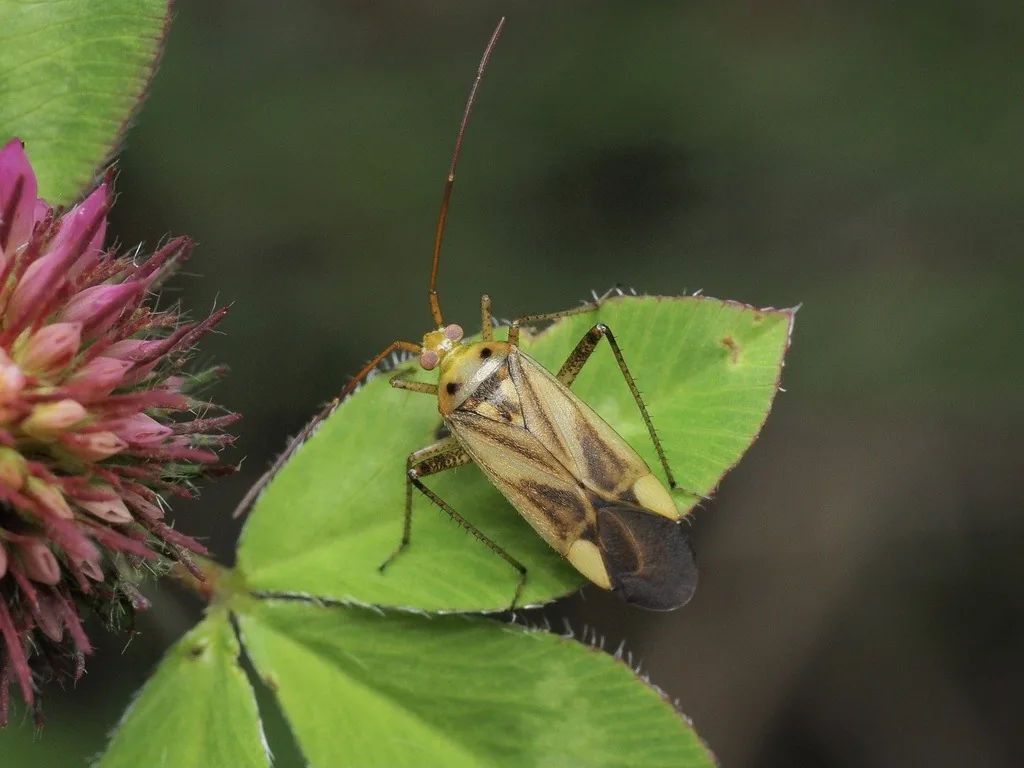
How to identify it
Look-alikes
| Look-alike | How to tell them apart |
|---|---|
| Lygus bugs (tarnished plant bugs) | Lygus bugs reach only about 1/4 inch, are green to brown with a distinct white triangle on the back, and have the tip of the body bent downward.[1] |
| Meadow plant bugs | Meadow plant bugs are long and narrow, about 1/3 inch, and yellow to dark brown, with either long or short wings. They feed mainly on grasses and do little harm to alfalfa.[1] |
Where it lives
SDSU Extension finds it in South Dakota alfalfa, where it turned up in large numbers in the eastern part of the state after a warm, dry spring, and Canadian researchers have measured its effect on alfalfa grown for seed in northern Saskatchewan.[2][1][3]
Biology and life cycle
Alfalfa is a primary host, and the bugs feed on its leaves, buds and flowers.[1][2]
Numbers can surge: SDSU tied large populations in eastern South Dakota to above-average spring temperatures and drought-stressed plants, although alfalfa plant bugs usually stay below the economic threshold.[2]
Damage and signs
Health risk
It feeds on plants; SDSU Extension and the Saskatchewan study mention no risk to people.[1][3]
Control
Pesticides
Scout with a 15-inch sweep net, taking pendulum sweeps through the field. SDSU suggests treatment may be warranted at about 20 to 30 bugs (adults plus nymphs) per 10 sweeps and points growers to the products labeled for lygus bugs in the current South Dakota pest management guide for alfalfa.[1][2]
In seed alfalfa, timing matters: in a 1988 insecticide trial in north central Saskatchewan, plots treated in June, or in June and August, yielded significantly more seed than plots treated only in August.[3]
Common questions
- How do I tell an alfalfa plant bug from a lygus bug?
- By size and markings. The alfalfa plant bug is about 3/8 inch and pale green to brown, nearly twice the size of a lygus bug, which has a white triangle on its back.[1]
- When are alfalfa plant bugs worth treating in hay?
- SDSU's guideline is about 20 to 30 bugs per 10 pendulum sweeps, counting nymphs and adults; populations usually stay below that.[1][2]
- Do alfalfa plant bugs hurt alfalfa grown for seed?
- Yes. In Saskatchewan cage studies, two or four bugs per cage at the green pod stage significantly cut pods, healthy seeds and seed weight.[3]
Sources
- South Dakota State University Extension, “Plant Bugs Showing Up in Alfalfa Fields.” extension.sdstate.edu/plant-bugs-showing-alfalfa-fields (accessed 2026-11-08)
- South Dakota State University Extension, “Alfalfa Plant Bugs Showing Up in Abundance (P. Wagner, A. Varenhorst, P. Rozeboom and B. McManus).” extension.sdstate.edu/alfalfa-plant-bugs-showing-abundance (accessed 2026-11-08)
- The Canadian Entomologist (Cambridge University Press), “The effects of alfalfa plant bug (Hemiptera: Miridae) feeding late in the season on alfalfa seed yield in northern Saskatchewan (J. J. Soroka and D. C. Murrell, vol. 125, issue 5; abstract).” www.cambridge.org/core/journals/canadian-entomologist/article/effects-of-alfalfa-plant-bug-hemiptera-miridae-feeding-late-in-the-season-on-alfalfa-seed-yield-in-northern-saskatchewan1/2CE8F2851BBEEE6A0221E62012F9DA84 (accessed 2026-11-08)
- iNaturalist, “Adelphocoris lineolatus taxon page (order and family).” www.inaturalist.org/taxa/84508 (accessed 2026-11-08)