On this page
How to identify it
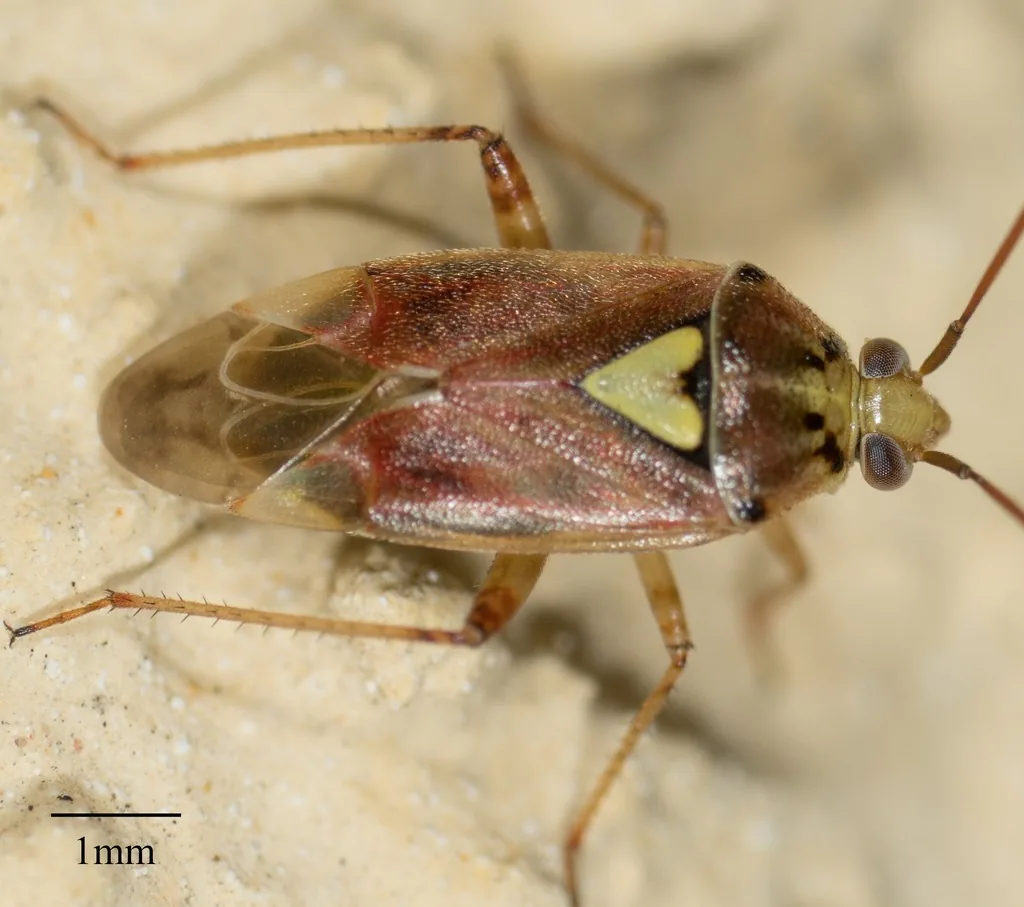
- Adults are about 1/4 inch (6 mm) long, oval and rather flat, greenish or brownish with reddish-brown markings on the wings.[1]
- A small but distinct yellow or pale green triangle sits in the center of the back.[1][4]
- Young nymphs are pale green and look like aphids, but move much faster.[1]
- Nymphs from the third stage on are green with five black dots on the back: two just behind the head, two on the next segment and one in the middle of the abdomen. Adults have no black dots.[1]
Look-alikes
| Look-alike | How to tell them apart |
|---|---|
| Calocoris plant bugs | A similar nonpest plant bug often found on weeds and legumes, longer and narrower, with two prominent black dots just behind the head and dark wing tips.[1] |
| False chinch bug | Smaller (0.1 to 0.2 inch), slender and grayish brown, with silvery gray wings that lack the lygus bug's small triangle near the wing tip.[1] |
| Tarnished plant bug | Lygus lineolaris, a separate species in the same genus; Utah State University lists both, along with the pale legume bug, as lygus bugs found in Utah hemp.[4] |
Where it lives
Found across western North America. Research on it has been done in California strawberry fields and Arizona cotton fields, and it occurs in Utah hemp fields.[2][3][4]
Biology and life cycle
Adults spend the winter in plant debris. In coastal California, overwintered adults lay eggs in weeds in January, and the nymphs hatch in March.[4][1]
When the weeds dry up or are removed, the adults migrate into nearby crops. In strawberries, the first migration by overwintered adults usually happens in April, and a second wave follows later in the season.[1]
It feeds on many hosts. In laboratory tests females were most attracted to alfalfa and preferred it over strawberry and several common weeds, which suggests alfalfa might be used as a trap crop.[2]
Natural enemies include the parasitic wasp Anaphes iole, the nymphal parasitoid Peristenus relictus, and predators such as bigeyed bugs, damsel bugs, minute pirate bugs and spiders.[1]
Damage and signs
- In strawberries, lygus bugs puncture individual seeds, which stops the berry from developing around the feeding site. Straw-colored seeds that are large and hollow are a good sign of lygus damage.[1]
- It is a serious strawberry pest on California's Central Coast and around Oxnard, where berries are picked through the summer, but it rarely becomes one in Southern California and the Central Valley, where fresh-market harvest usually ends by late June.[1]
- On hemp grown for seed, lygus feeding shrivels seeds and heavy feeding on flowers can cause bud drop, though Utah State reports no documented economic damage in Utah hemp.[4]
Health risk
A plant-feeding bug; the sources describe it only as a crop pest and mention no risk to people or pets.[1][4]
Control
Prevention
Check weeds around fields for nymphs from February and strawberry plants for adults from mid-April. UC IPM's beat-tray threshold for strawberries is one nymph per 20 plants sampled. Pheromone-baited sticky traps for males are being developed, and red cylindrical traps caught more than white delta traps.[1][3]
Sanitation
Control weeds along roadsides, ditches and field borders in March and early April, while lygus are still nymphs. Once adults are present, removing weeds only drives them into the crop. Mow or disc cover crops, especially legumes, before they flower.[1]
Traps and physical control
Suction machines (bug-vacs) used once or twice a week can manage low to moderate numbers, but not heavy infestations, and they may spread powdery mildew and gray mold and remove predators.[1]
Biological control
Conserve bigeyed bugs, damsel bugs, minute pirate bugs and spiders, which eat the nymphs. Limit insecticide treatments, because most products that work on lygus also kill the natural enemies of spider mites.[1]
Pesticides
Registered insecticides work best on first- and second-stage nymphs and are not very effective on older nymphs and adults, so timing matters. Insecticidal soap is an option on organic strawberries.[1]
Common questions
- Why are my strawberries lumpy and misshapen?
- Lygus bugs are one cause: they puncture seeds, which stops the fruit from developing around them. Poor pollination can also misshape berries, and leaves small undeveloped seeds rather than the large, hollow, straw-colored seeds typical of lygus damage.[1]
- Are the little green bugs in my strawberries aphids?
- They may be young lygus nymphs, which are pale green and aphid-like but move much faster.[1]
- Is the western tarnished plant bug the same as the tarnished plant bug?
- They are separate species in the same genus: Lygus hesperus, a pest across western North America, and Lygus lineolaris, the tarnished plant bug.[4][2]
Sources
- University of California Statewide IPM Program, “Lygus Bug (Western Tarnished Plant Bug), UC IPM Pest Management Guidelines: Strawberry.” ipm.ucanr.edu/agriculture/strawberry/lygus-bug/ (accessed 2026-11-09)
- Entomological Society of America (Journal of Insect Science), “Hetherington MC, Guédot C, Brunet J. Differential attraction of Lygus hesperus (Hemiptera: Miridae) to host plants in the laboratory. Journal of Insect Science 26(5):ieag117 (2026) (abstract).” doi.org/10.1093/jisesa/ieag117 (accessed 2026-11-09)
- Cambridge University Press (Bulletin of Entomological Research), “Nieto D, Hagler J, Machtley S, Zilnik G, Hall D. Field evaluation of a pheromone lure and trap designs for monitoring Lygus hesperus Knight (Hemiptera: Miridae). Bulletin of Entomological Research 116(3):283-290 (2026) (abstract).” doi.org/10.1017/S0007485325100679 (accessed 2026-11-09)
- Utah State University Extension, “Lygus Bug (Hemp IPM pest notes).” extension.usu.edu/planthealth/ipm/notes_ag/hemp-lygus-bug.php (accessed 2026-11-09)
- iNaturalist, “Lygus hesperus taxon page (order and family).” www.inaturalist.org/taxa/243755 (accessed 2026-11-09)