On this page
How to identify it
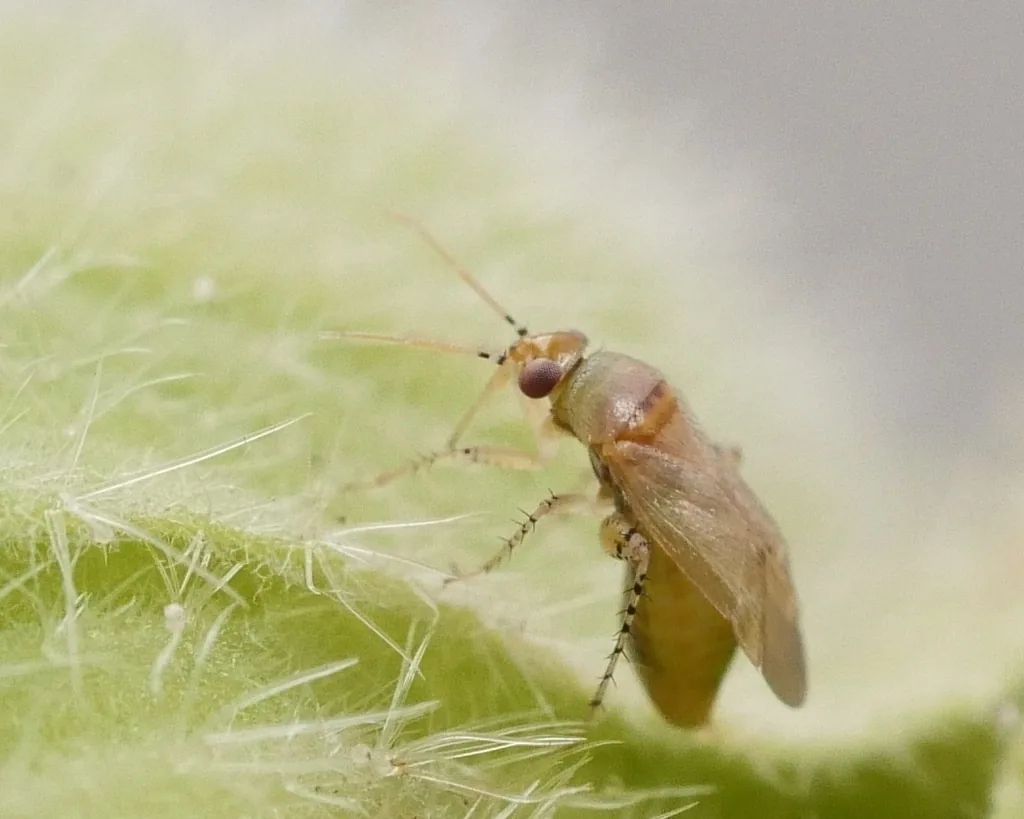
- Adults are only about 1/10 inch long, an elongated oval, greenish brown to grayish brown or brownish yellow, and very mobile and active.[1][2]
- Nymphs are the same size or smaller, oval, pale (described as translucent white by Utah State and as green by the PNW handbook) and fast moving. Mature nymphs can pass for aphids, but they run instead of sitting still.[1][2]
- Eggs are about 1/28 inch long and sac shaped, inserted into bark or under bud scales with only the lid exposed, so they are almost impossible to find.[1]
- The damage is easier to spot than the insect: small corky areas, alone or in a shallow depression, that appear on young apples shortly after petal fall, sometimes with dimpling or distortion of the fruit.[1][2]
Look-alikes
| Look-alike | How to tell them apart |
|---|---|
| Aphids | Mature campylomma nymphs resemble aphids in some ways but are far more active, scurrying away when the leaf is disturbed.[2] |
| Lygus bugs (tarnished plant bugs) | Lygus bugs are larger plant bugs that also cause dimpled, distorted fruit; the campylomma bug is about 1/10 inch long and its fruit injury is limited to the bloom-to-petal-fall window.[1][2] |
| Pear psylla | Pear psylla is one of the pests the campylomma bug eats; on pear the campylomma bug itself rarely damages fruit.[1][3] |
Where it lives
Not native to the United States, present since the late 1800s and of Asian or European origin. Utah State University reports it in Utah apple orchards, and the PNW handbook treats it as an apple and pear pest in Oregon, Washington and Idaho.[2][3][1]
Biology and life cycle
Tree hosts are apple, pear and other rosaceous plants, plus oak; the herbaceous hosts include common mullein (Verbascum thapsus), the weed the insect is named for, as well as potato, sugar beet, corn and small grains.[1][3][2]
The bug overwinters as eggs laid in young twigs and bark crevices of apple, pear and related trees. Eggs begin hatching before bloom, at about the pink stage of apple bud development.[1][2]
The nymphs feed on the tree through bloom. In late spring part of the first-generation adults leave for herbaceous plants, especially mullein, where they feed on the plant and prey on aphids and thrips, although campylomma bugs can be found in orchards all season. From late summer into fall adults move back into orchards to mate and lay the overwintering eggs. There are about three to four generations a year.[1][2]
Late nymphs and adults are predators of aphids, mites and pear psylla, which makes the insect a net benefit in pear orchards and in apples outside the bloom window.[1][2]
Damage and signs
- Only the young nymphs damage fruit, by feeding on blossom calyxes and developing fruitlets. The injury shows shortly after petal fall as small corky areas, alone or surrounded by a depression, with dimpling and deformity; severe injury can cat-face the fruit. Apples become less susceptible as they grow and are safe once they reach about half an inch in diameter.[1][2]
- Golden Delicious is more susceptible than Red Delicious and other dark-skinned cultivars, and early-blooming varieties tend to be hit hardest. Pear fruit is rarely damaged even when populations are high.[1][2][3]
Health risk
None of the sources mentions any effect on people or pets; this is a fruit-quality pest and, for most of the year, a beneficial predator in the orchard.[1][2]
Control
Prevention
Decide whether to treat by monitoring early: tap limbs over a tray from the pink stage through petal fall to count nymphs and adults. After petal fall the bug can no longer damage fruit, and the PNW handbook calls it overwhelmingly beneficial for the rest of the season. Utah State's advice is blunt: the adult is a beneficial predator, so do not control unless necessary.[2][1]
Traps and physical control
Damaged fruit can simply be thinned off; growers may find hand-thinning the scarred fruitlets more cost-effective than spraying.[2]
Biological control
No effective natural enemies of the campylomma bug have been found, and no cultural tactics are known to work, which is why control in orchards with a history of damage relies on timing. Remember that the insect itself is a natural enemy of aphids, mites, thrips and psylla.[1][2]
Pesticides
The window is narrow: between egg hatch and the time nymphs scar the fruit, with bloom through petal fall the most vulnerable period, so any spray should go on by late bloom and must protect pollinators. Utah State lists acetamiprid (homeowner products available) and, for commercial orchards, formetanate hydrochloride applied at night during bloom and not after petal fall because it is toxic to bees and predatory mites. For home gardeners in the Pacific Northwest there are no products specifically registered against this pest on apple or pear, and commercial pear orchards generally do not need treatment.[1][2][3]
When to call a professional
Commercial options such as esfenvalerate and thiamethoxam at the pink stage carry bee cautions and seasonal limits; a commercial grower or orchard consultant is the right person to time them.[2]
Common questions
- My young apples have little corky dimples. Is it too late to spray?
- Yes. The scars are made by nymphs feeding from bloom through petal fall, and once the fruit passes about half an inch in diameter the bug cannot damage it. Thin the worst fruit and note the problem for next spring's monitoring.[1][2]
- Should I kill the campylomma bugs I see in summer?
- No. Outside the bloom window the nymphs and adults eat aphids, mites, thrips and pear psylla. Utah State's fact sheet says not to control unless necessary because the adult is a beneficial predator.[1][2]
- Why is it called the mullein plant bug?
- Common mullein is one of its preferred herbaceous hosts. Part of the first generation leaves the orchard for mullein and other weeds in late spring and comes back in late summer and fall to lay eggs.[1][3]
Sources
- Utah State University Extension, Integrated Pest Management Program, “Campylomma Bug (Utah Pests fact sheet).” extension.usu.edu/planthealth/ipm/notes_ag/fruit-campylomma-bug.php (accessed 2026-11-10)
- Pacific Northwest Pest Management Handbooks (Oregon State University, Washington State University and University of Idaho), “Apple: Campylomma bug, Pacific Northwest Insect Management Handbook.” pnwhandbooks.org/insect/tree-fruit/apple/apple-campylomma-bug (accessed 2026-11-10)
- Pacific Northwest Pest Management Handbooks (Oregon State University, Washington State University and University of Idaho), “Pear: Campylomma bug, Pacific Northwest Insect Management Handbook.” pnwhandbooks.org/insect/tree-fruit/pear/pear-campylomma-bug (accessed 2026-11-10)
- iNaturalist, “Campylomma verbasci taxon page (order and family).” www.inaturalist.org/taxa/748452 (accessed 2026-11-10)