On this page
How to identify it
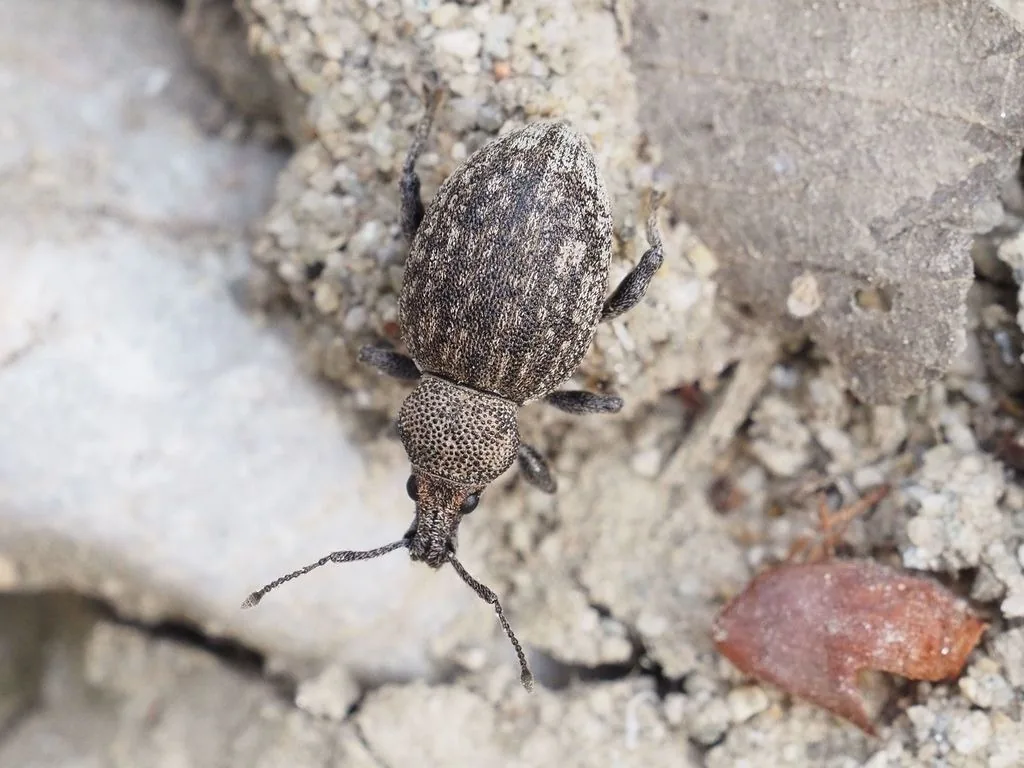
- Adults are mottled gray and humpbacked, about half an inch long, about the length of a thumbnail, with a tough gray shell. They do not fly; the beetle is wingless and gets around by walking, sometimes in large, dark moving masses along rural roadsides.[1][2]
- Every adult is a female. New infestations arrive in gravel, hay, water, trucks and farm equipment, and there is circumstantial evidence that adults ride along with moved beehives.[1][2]
- The sign in the field is an alfalfa stand with an uncharacteristic amount of winter kill, which Cornell says should be investigated for the beetle; the larvae feed on the roots and sever the root system.[1]
Where it lives
An adventive Palaearctic species. In North America it occurs only in Oswego, Jefferson, Cayuga, Wayne, Lewis, St. Lawrence, Clinton, Essex and Franklin Counties of New York, where it infests about 13 percent of the state's agricultural land, including all six northern New York counties, and in Ontario along the St. Lawrence River; a 2012 specimen from Salaberry-de-Valleyfield was the first record for Quebec. It has spread to additional counties over time, and Cornell considers further spread a serious threat to alfalfa growers.[1][2][4]
Biology and life cycle
The adults are all females, wingless and spread by walking or by being carried. Larvae feed on alfalfa roots, and the major plant injury and death come late in the season, from late August through November, usually after the final harvest.[1][2]
Damage and signs
- Larval feeding kills alfalfa by severing the root system. Because the plants die so late in the year, many producers do not notice the lost stand until spring and blame winter kill. The beetle makes growing alfalfa very difficult and expensive, and some growers have been forced to grow only grass hay because of the damage to alfalfa and clover. ZooKeys calls it a major pest of alfalfa.[1][4]
- Cornell's news service reports it lowers the production and profitability of dairy and livestock farms across northern New York.[2]
Health risk
A root-feeding weevil of alfalfa; none of the sources describes any risk to people.[1][2]
Control
Prevention
Cornell says insecticide has not been shown to be effective and is not recommended. Populations can be reduced and held down with a strict three-year alfalfa rotation: the seeding year plus two production years.[1]
Snout-beetle-resistant alfalfa, bred at Cornell for more than a decade, holds great promise, but research strongly suggests the population must be knocked down with nematodes before resistant varieties are planted, or the beetles may be numerous enough to overrun the resistance. Suspected new infestations should be reported to the local Cornell Cooperative Extension educator, and gravel, hay and equipment from infested ground can carry the beetle.[1][2]
Biological control
Insect-killing nematodes are the center of an ongoing area-wide Cornell Extension program in which producers rear and apply their own; in field trials the nematodes maintained themselves in the field while reducing larval populations and reducing or eliminating feeding injury, and one inoculation per field with persistent farm-grown strains is expected to be enough. In the 2008 Cornell trial, Steinernema carpocapsae, S. feltiae and Heterorhabditis bacteriophora all persisted a full year after application; S. feltiae protected plants better than H. bacteriophora and controlled larvae better than S. carpocapsae, and the S. carpocapsae plus H. bacteriophora combination protected plants significantly better than untreated plots.[1][2][3]
Common questions
- Why does Cornell say not to spray for it?
- Because insecticide use for this insect has not been shown to be effective; the larvae do their killing underground late in the season, and the recommended tools are rotation, nematodes and resistant varieties.[1]
- How does a wingless beetle spread between farms?
- By walking, and by riding in gravel, hay, water, trucks and farm equipment; circumstantial evidence also points to beehive movement.[1][2]
- Is it in other states?
- No. Cornell says it occurs nowhere else in the northwestern hemisphere except nine northern New York counties and the Ontario side of the St. Lawrence, and a 2013 ZooKeys paper added a Quebec record from 2012.[1][4]
Sources
- Cornell University College of Agriculture and Life Sciences, “Alfalfa Snout Beetle (Insects of Forage Crops).” cals.cornell.edu/field-crops/forages/insects-forage-crops/alfalfa-snout-beetle (accessed 2026-11-10)
- Cornell University, “Alfalfa snout beetle, an expensive pest on N.Y. farms, is now under attack itself (Cornell Chronicle).” news.cornell.edu/node/273056 (accessed 2026-11-10)
- Journal of Economic Entomology (Entomological Society of America), “Neumann and Shields (Cornell University). Multiple-species natural enemy approach for biological control of alfalfa snout beetle (Coleoptera: Curculionidae) using entomopathogenic nematodes. Journal of Economic Entomology 101: 1533-1539 (2008), PMID 18950034.” pubmed.ncbi.nlm.nih.gov/18950034/ (accessed 2026-11-10)
- ZooKeys (Pensoft), “Douglas, Bouchard, Anderson, de Tonnancour, Vigneault and Webster. New Curculionoidea (Coleoptera) records for Canada. ZooKeys 309: 13-48 (2013), PMC3689125.” pmc.ncbi.nlm.nih.gov/articles/PMC3689125/ (accessed 2026-11-10)
- iNaturalist, “Otiorhynchus ligustici taxon page (order and family).” www.inaturalist.org/taxa/226714 (accessed 2026-11-10)