On this page
How to identify it
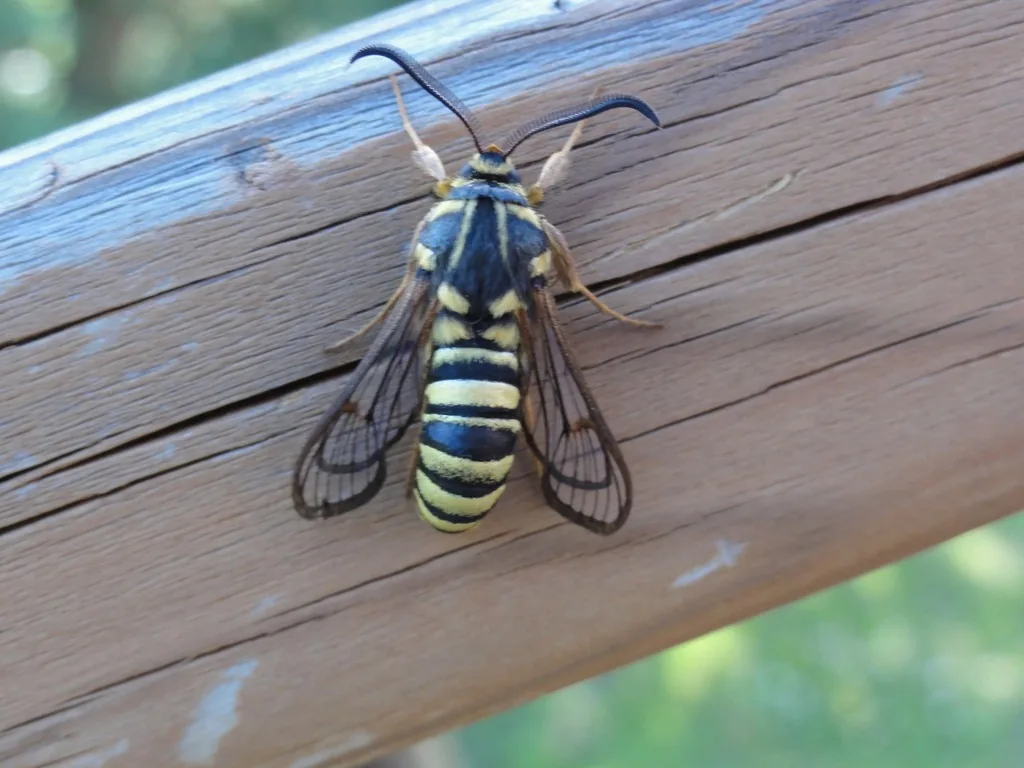
- Adults are about 1 inch long and look like wasps or hornets: black with yellow stripes and accents and clear wings. The antennae are moth-like.[1][2]
- Larvae are off-white and grow to about 1 1/2 inches (40 mm). Arizona describes the head as black, and the Canadian Forest Service as dark red-brown with a tan shield behind it.[1][2]
- The larvae look like roundheaded (longhorned beetle) borer larvae, but like other clearwing borers they have prolegs on the underside of the abdomen.[1][3]
- A telltale sign is an empty brown, papery pupal case sticking out of a hole about 1/4 inch across near the base of the tree, left when the adult emerged.[1][3]
- More general borer signs listed by the Canadian Forest Service: small entry holes in the bark, often around old wounds, pushing out frass; sap bleeding from them; and frass piling up at the base of a badly attacked tree.[2]
Look-alikes
| Look-alike | How to tell them apart |
|---|---|
| Hornets and other wasps | Clearwing moths resemble bees or wasps, which deters predators, but they do not sting. Look for the moth-like antennae.[3][1] |
| Poplar borer and other roundheaded borers | Clearwing borer larvae look much like roundheaded borer larvae but have short prolegs on the underside of the abdomen.[3][1] |
Where it lives
Found through much of southern Canada and the northern United States, including the southern Rocky Mountain states and California. In Arizona it is a pest of the urban forests of the north at higher elevations, above about 6,000 feet.[1]
Biology and life cycle
Hosts are poplars, including cottonwoods and aspen, and willows. Aspen is a favorite host in Arizona, and in Canada the borer commonly feeds in hybrid poplar stool beds.[1][2]
Adults emerge from late spring through early summer in Arizona and in late June or early July in Canada. They live only four to ten days.[1][2]
Arizona reports that after mating each female lays 200 to 600 oval, light to medium brown eggs with a net-like surface in bark cracks and crevices; the Canadian Forest Service says it is not known where on the tree the eggs are laid.[1][2]
Newly hatched larvae, about 1/20 inch long, crawl down to the soil line and bore in. They feed on live wood in the lower trunk, root crown and exposed roots, cutting tunnels about 3/8 inch wide and 3 to 5 inches long.[1][2]
The life cycle takes two years, and the larvae spend two winters in the tree.[1][2]
Mature larvae make a cocoon of wood chips about 2 inches long and 1/2 inch wide. Larvae that fed in roots pupate in silk-lined chambers in the soil, and those in the stem pupate just under the bark; the pupae move to the surface of the soil or bark before the moths emerge.[1][2]
For hardwood borers in general, the Canadian Forest Service names woodpeckers as probably the most effective natural control, with parasitic wasps also feeding on them.[2]
Damage and signs
- Tunnels in the root crown and lower trunk weaken trees, which can break or blow over in wind and snowstorms, especially after repeated attacks. Trees can be killed.[1][2]
- A tree can be attacked many times; Arizona Extension reports fifty larvae in one aspen in Flagstaff. Trees of all sizes are attacked, and the smaller the tree, the greater the potential damage.[1]
- Borer attacks stress trees and make them more susceptible to drought and disease. In hybrid poplar stool beds the borer reduces the production of cuttings.[2]
Health risk
Despite the hornet-like look, clearwing moths do not sting, and the sources describe this species only as a pest of trees.[3][1][2]
Control
Prevention
A healthy tree is the best defense. Water aspen with a good soaking around the drip line about every two weeks during the growing season, control scale insects on the trunk and limbs, and avoid wounding the bark.[1]
Borers favor wounds and scars, so avoid injuring trees during cultivation, pruning or mowing, and water during drought to prevent stress.[2]
Traps and physical control
For a few infested trees, dig around the base to expose the tunnels in the root crown, cut away dead bark and wood to find more, and push a stiff wire into the tunnels to kill the larvae and pupae. Several attempts may be needed.[1][2]
On small trees where every emergence hole can be covered, wrapping the trunk tightly in burlap traps emerging moths in their tunnels. Badly infested trees should be removed and destroyed before the next generation emerges and attacks neighboring trees.[2]
Biological control
The insect-parasitic nematode Steinernema carpocapsae, mixed in water, can be squirted into the tunnels with a squeeze bottle. The nematodes find the larvae and release bacteria that kill them within 48 hours.[1]
Pesticides
To protect a tree from new attacks, Arizona Extension notes that an insecticide sprayed on the lower 3 feet of the trunk before the adults emerge can kill the newly hatched larvae.[1]
Common questions
- What is the papery brown shell sticking out of the base of my aspen?
- It is often the empty pupal case of a clearwing borer such as the American hornet moth, left in a hole about 1/4 inch across when the adult emerged.[1][3]
- Will the black-and-yellow 'hornet' on my poplar sting me?
- If it has moth-like antennae and clear wings, it is probably a clearwing moth such as the American hornet moth. Clearwing moths look like wasps to deter predators but do not sting.[1][3]
- How do I get the larvae out of my tree?
- Expose the tunnels at the root crown, cut away dead bark, and push a stiff wire into the tunnels; injecting the nematode Steinernema carpocapsae into them is another option.[1][2]
Sources
- University of Arizona Cooperative Extension, “The American Hornet Moth in the Urban Forests of Northern Arizona Above 6000 Foot Elevations (AZ1284, revised 10/14).” extension.arizona.edu/sites/extension.arizona.edu/files/pubs/az1284-2014.pdf (accessed 2026-11-08)
- Natural Resources Canada, Canadian Forest Service, “Cottonwood crown borer (Trees, insects and diseases of Canada's forests).” tidcf.nrcan.gc.ca/en/insects/factsheet/11759 (accessed 2026-11-08)
- Colorado State University, Department of Agricultural Biology, “Shade tree borers.” agsci.colostate.edu/agbio/ipm-pests/shade-tree-borers/ (accessed 2026-11-08)
- iNaturalist, “Sesia tibiale taxon page (order and family).” www.inaturalist.org/taxa/358321 (accessed 2026-11-08)