On this page
How to identify it
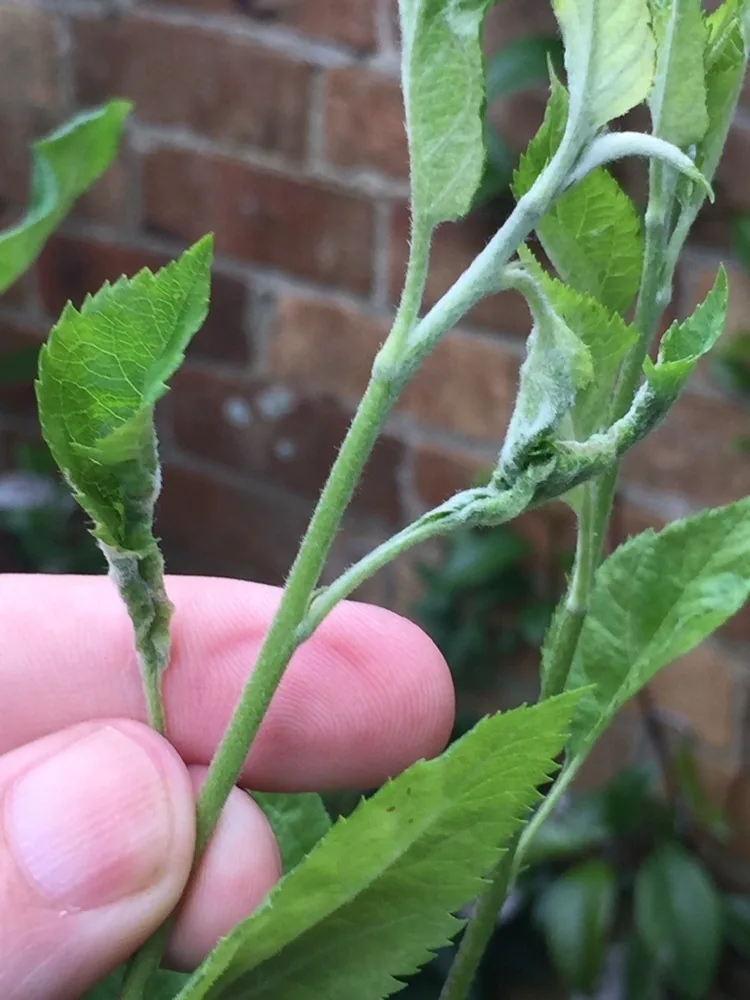
- Young leaves at the tips of apple shoots have their edges tightly curled, rolling into distorted tubes. Infested leaves may turn red to brown and brittle before they fall.[1]
- Unroll a curled leaf to find the larvae: tiny, pinkish orange maggots.[1]
- The adult is a small fly. Females lay their eggs in the folds of young, immature apple leaves.[1][2]
Look-alikes
Where it lives
Native to Europe and spread to New Zealand, Argentina and Canada. In the United States it has been present in New York and Massachusetts since the 1960s, and it was found in northern Whatcom County, Washington, in 1994, then spread through much of western Washington. It has never been found in California's environment, though inspectors there have intercepted it many times on apples from New Zealand and the Pacific Northwest.[2][1]
Biology and life cycle
Some larvae pupate inside the rolled leaves; others drop to the ground to pupate and overwinter, emerging as adults the next spring.[1]
There are two to four generations a year. Each female lays many eggs. The adults are weak fliers but can be carried by wind.[1][2]
Larvae sometimes pupate in the calyx (blossom end) of apples, so the midge can travel long distances in fruit, nursery trees and other apple material.[2]
Females release a sex pheromone that attracts males. In a New Zealand study, egg-laying females spreading from an infested orchard mostly settled within the first 30 meters of a neighboring young block.[5]
Damage and signs
- Heavy infestations stunt shoot tips and cut leaf area, which can slow the growth of nursery stock and newly planted trees. In mature trees, fruit yield is usually not reduced, though fruit size and fruit bud formation are sometimes affected.[1][2]
- Even when the midge is abundant, it does not significantly affect fruit production, but it can disfigure ornamental apple trees.[1][2]
Health risk
It feeds only on apple trees; the sources describe it only as a plant pest.[2]
Control
Prevention
Watch new plantings and young trees, since some apple varieties are more susceptible than others and young trees suffer most.[1][2][4]
Traps and physical control
Removing infested shoot tips and rolled leaves is probably the most effective control if the midge becomes a problem.[1]
Biological control
A tiny parasitic wasp, Platygaster demades, attacks the eggs and young larvae. In New Zealand orchards, parasitism rose from about half in the first generation to 87% by the fourth. Generalist predators such as predatory mites and pirate bugs may also feed on the midge, though little is known about biological control in North America.[3][4][1]
Pesticides
No insecticides are specifically registered for this midge, and contact sprays work poorly because the larvae are protected inside the curled leaves.[1][2]
Common questions
- Why are the new leaves on my apple tree rolled up tight?
- If the rolled leaves at the shoot tips hold tiny pinkish orange maggots, apple leaf curling midge is the likely cause. The larvae feed inside and curl the leaf edges into tubes.[1]
- Will it hurt my apple crop?
- Usually not. Even heavy populations do not significantly reduce fruit production on mature trees; the main concern is stunted growth on young trees.[1][2]
Sources
- Washington State University Puyallup Plant & Insect Diagnostic Laboratory, “Apple Leaf Curling Midge, PLS 18 (A. Antonelli and J. Glass; October 2005).” wpcdn.web.wsu.edu/wp-puyallup/uploads/sites/408/2015/02/PLS-18-Apple-Leaf-Curling-Midge.pdf (accessed 2026-11-09)
- California Department of Food and Agriculture, “California Pest Rating for Dasineura mali (Kieffer): Apple Leaf Gall Midge.” blogs.cdfa.ca.gov/Section3162/?p=618 (accessed 2026-11-09)
- Journal of Economic Entomology (via NCBI PubMed), “Phenological dynamics of Dasineura mali and its parasitoid Platygaster demades in apple orchards (Journal of Economic Entomology, 2011; abstract).” pubmed.ncbi.nlm.nih.gov/22066194/ (accessed 2026-11-09)
- Journal of Economic Entomology (via NCBI PubMed), “Ability of Platygaster demades to parasitize both eggs and larvae makes it an effective natural enemy of Dasineura mali (Journal of Economic Entomology, 2015; abstract).” pubmed.ncbi.nlm.nih.gov/26470331/ (accessed 2026-11-09)
- Journal of Economic Entomology (via NCBI PubMed), “Trapping Dasineura mali in apples (Journal of Economic Entomology, 2007; abstract).” pubmed.ncbi.nlm.nih.gov/17598534/ (accessed 2026-11-09)
- iNaturalist, “Dasineura mali taxon page (order and family).” www.inaturalist.org/taxa/388390 (accessed 2026-11-09)