On this page
How to identify it
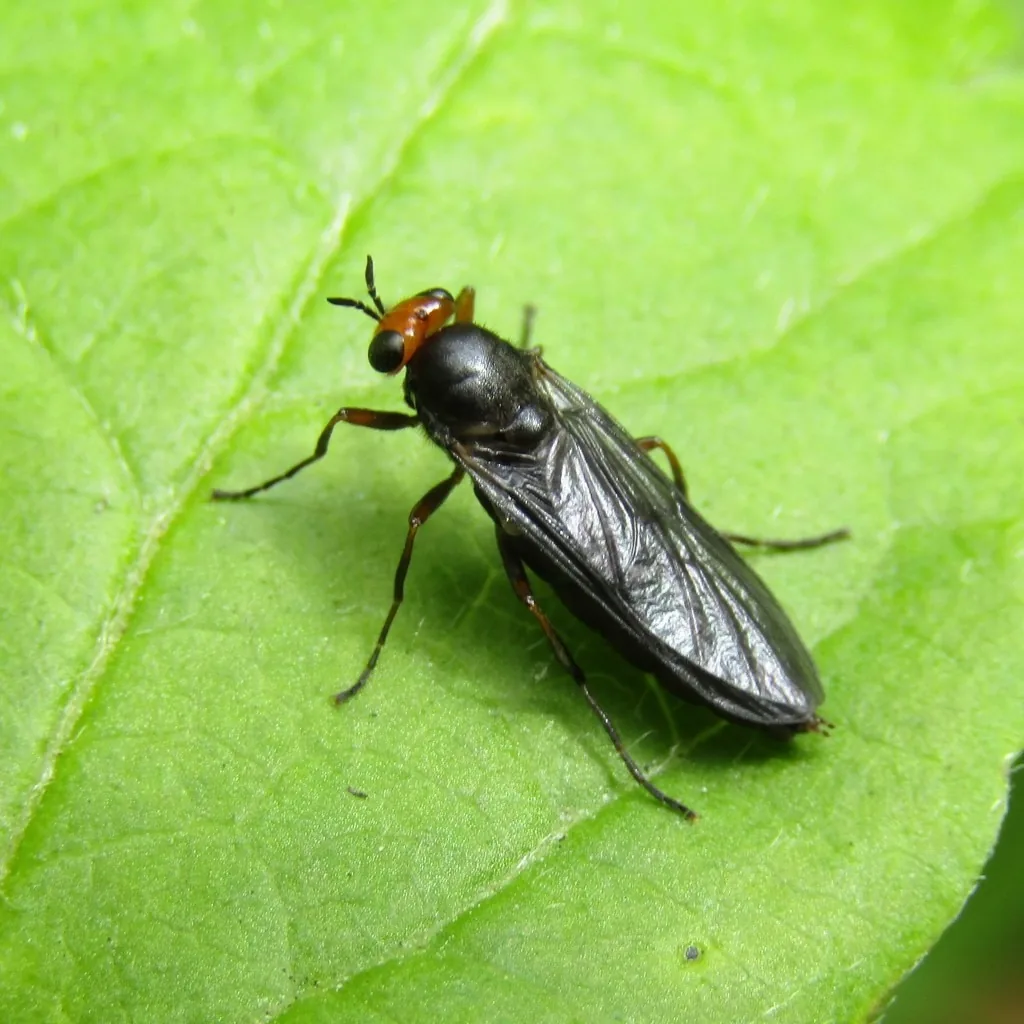
- Adult males are black with yellowish legs and about 1/4 inch (6 millimeters) long. Females are larger, about 0.4 inch (9.5 millimeters), black with reddish legs and a red head.[1]
- Full-grown larvae are legless maggots about 1/2 inch (1.3 centimeters) long with a flattened, distinctly segmented, light tan body with a coarsely granular surface, six long stiff bristles on each segment and a distinct, cone-shaped black head.[1]
Look-alikes
| Look-alike | How to tell them apart |
|---|---|
| March fly larvae | March fly maggots also live in turf but mostly feed on decaying organic matter. Sod fly larvae are told apart by their flattened, distinctly segmented bodies.[1] |
Where it lives
In California it is found only occasionally, and only in the San Francisco Bay Area. In Queensland, Australia, sugarcane researchers have studied the damage its root-feeding larvae do to cane.[1][2]
Biology and life cycle
Adults may fly in May, but their main period of activity is September through November.[1]
Eggs are laid in the soil, and after hatching the larvae may take two years to complete development.[1]
All turfgrass species are susceptible. In sugarcane trials the larvae fed on roots, slowing shoot growth and sharply reducing the regrowth (ratoon) shoots after harvest.[1][2]
Damage and signs
- Larvae feed on sap from grass roots. The grass gradually declines and is replaced over time by broadleaf weeds.[1]
Health risk
UC IPM treats it only as a turf pest and describes no harm to people.[1]
Control
Prevention
Keep turf well maintained, adequately watered and vigorously growing; such a lawn can normally withstand a moderate sod fly infestation.[1]
Pesticides
No insecticides are registered for it, and there are no known biological or cultural controls.[1]
Common questions
- What are the flat, bristly maggots in my Bay Area lawn?
- They could be Australian sod fly larvae: legless, flattened, light tan maggots about 1/2 inch long with stiff bristles on each segment and a black, cone-shaped head. They feed on grass roots.[1]
- How do I control Australian sod fly?
- There are no registered insecticides or known biological controls. The best defense is healthy, well-watered turf, which can tolerate a moderate infestation.[1]
Sources
- University of California Statewide IPM Program, “Australian Sod Fly (Pest Management Guidelines: Turfgrass).” ipm.ucanr.edu/agriculture/turfgrass/australian-sod-fly (accessed 2026-11-09)
- Journal of Economic Entomology (via NCBI PubMed), “Effect of feeding by larvae of Inopus rubriceps on development and growth of sugarcane (P. R. Samson; Journal of Economic Entomology 94(5), 2001; abstract).” pubmed.ncbi.nlm.nih.gov/11681671/ (accessed 2026-11-09)
- iNaturalist, “Inopus rubriceps taxon page (order and family).” www.inaturalist.org/taxa/357883 (accessed 2026-11-09)