On this page
How to identify it
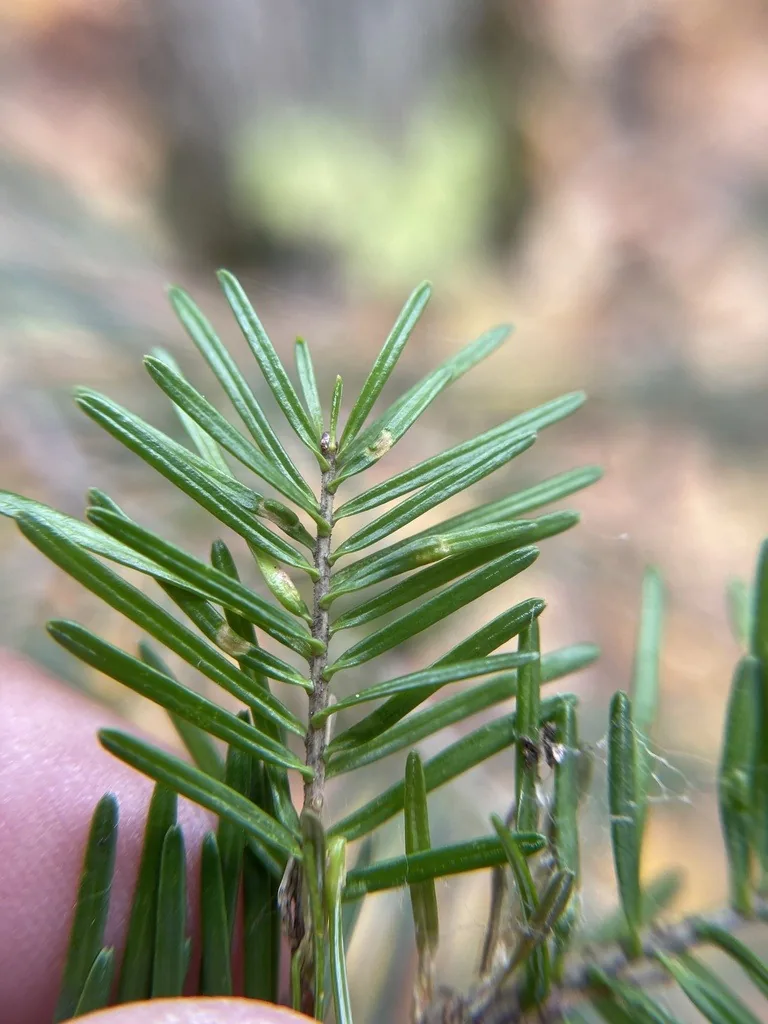
- Look for swellings (galls) near the base of the current year's needles. They are green at first and turn yellow by midsummer; in heavy infestations one needle can carry three or more galls.[2][1]
- Inside each gall is a tiny larva, whitish at first and then orange, with a broad head end and a body that tapers toward the rear.[1][2]
- Adults are tiny orange, mosquito-like flies about 1/8 inch long, often seen on new fir shoots on calm, sunny days in May.[1][2]
- In late autumn the galled needles die and drop, leaving bare spots along that season's twigs.[2][1]
Where it lives
It occurs in many areas of the northern United States and southern Canada, closely following the range of its hosts, balsam fir and Fraser fir.[1]
Biology and life cycle
Adults emerge in May over about two weeks, males first. They are weak fliers. Shortly after budbreak, in mid- to late May, females lay eggs beneath bud scales and on the needles of newly opened buds.[1][2]
Larvae feed at the bases of the developing needles, and the needle tissue grows around them to form the gall. Trees whose buds open late are less likely to be attacked, because their buds are still tight while the midges are laying eggs.[2][1]
From mid-September to late November the mature larvae leave the galls and drop to the ground, where they spend the winter in the litter. They pupate in May. There is one generation a year.[2][1]
Populations are cyclical: midges are abundant for three or four years and then scarce for several years.[1]
Damage and signs
- Up to 50 to 60 percent of the current year's foliage is commonly galled, and the galled needles fall in autumn, thinning the tree.[1][2]
- On Christmas tree farms, severely infested trees may be unmarketable for two to four years, until the damage is sheared off or hidden by new growth. Heavy infestations strip most of the current needles and make the branches useless for wreaths.[2]
Health risk
The sources describe it only as a pest of fir needles; they mention no bites or other harm to people.[1][2]
Control
Prevention
Check trees from June to October for galls. To catch adults, place emergence traps (bottomless boxes with a clear vial or window facing the light) under previously infested trees in early May, or hang yellow sticky cards in them.[1]
Sanitation
Remove and burn heavily infested branches or trees before the galled needles drop in late summer or early autumn.[1]
Biological control
Small parasitic wasps (Platygaster species) can help end an outbreak. If only a few galls are present, leave them in place to conserve these natural enemies, and be cautious about spraying.[1]
Pesticides
Consider spraying only when more than 10 percent of current shoots have galled needles, and skip it in years when populations collapse. Time sprays after egg hatch, once the new needles have lengthened and flared out (late May to early June in central and southern Maine). Some concentrated spray formulations have injured tender new foliage when applied with mist blowers, so ask your county Extension office for current products and follow the label.[1][2]
Common questions
- Why are there little bumps at the base of my fir tree's new needles?
- These are likely balsam gall midge galls. A tiny orange larva inside each needle makes it swell near the base; the galled needles drop in autumn.[1][2]
- Will balsam gall midge kill my fir tree?
- Not usually. Forest trees suffer little permanent damage; the main harm is to the appearance of Christmas trees and wreath tips.[2]
Sources
- University of New Hampshire Cooperative Extension, “Balsam Gall Midge [fact sheet].” extension.unh.edu/resource/balsam-gall-midge-fact-sheet (accessed 2026-11-09)
- Maine Forest Service, Maine Department of Agriculture, Conservation and Forestry, “Balsam Gall Midge, Insect & Disease Fact Sheets (April 2000).” www.maine.gov/dacf/mfs/forest_health/insects/balsam_gall_midge.htm (accessed 2026-11-09)
- iNaturalist, “Paradiplosis tumifex taxon page (order and family).” www.inaturalist.org/taxa/209023 (accessed 2026-11-09)