On this page
How to identify it
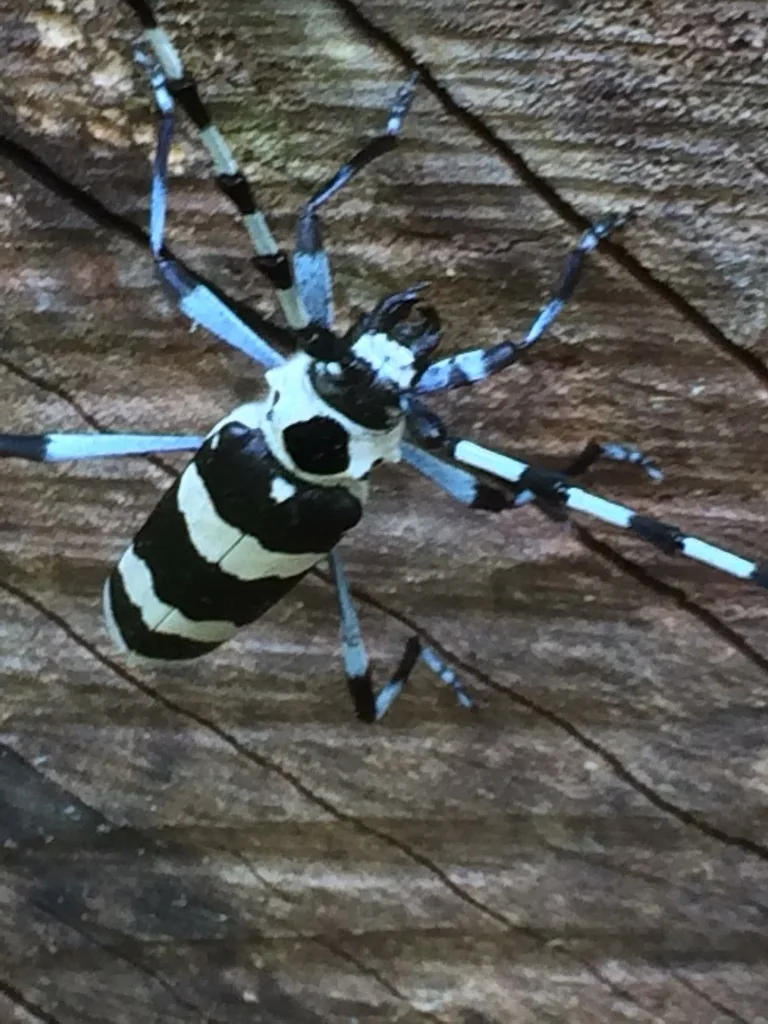
- Adults are elongate, flattened, parallel-sided longhorned beetles, about 25 to 35 mm long according to WSU; the OSU Plant Clinic sheet gives 23 to 40 mm.[1][2]
- The body and the long antennae are conspicuously banded in black and white; OSU describes the coloring as a striking white-blue and black.[1][2]
- The segment directly behind the head is white with a single large black spot that covers 60 percent or more of it.[2]
- It is the only species of its genus in North America.[1]
Look-alikes
| Look-alike | How to tell them apart |
|---|---|
| Asian longhorned beetle | The Asian longhorned beetle has white spots on a shiny black background rather than bands, and the segment directly behind its head is entirely shiny black. On the banded alder borer that segment is white with one large black spot.[1][2] |
Where it lives
It occurs from Alaska to southern California and in the Rocky Mountains from Idaho to New Mexico. In the Pacific Northwest, adults may be encountered from March to August.[1][2]
Biology and life cycle
Its hosts are hardwoods. WSU lists dead maple (Acer), alder (Alnus), ash (Fraxinus), sycamore (Platanus), oak (Quercus), willow (Salix) and California laurel (Umbellularia californica); OSU names alder, ash and California laurel, and occasionally other hardwoods.[1][2]
Females lay their eggs one at a time on small to medium-sized dead branches, and the eggs hatch in 7 to 14 days.[2]
The larvae feed under the bark for 6 to 7 months, then bore into the center of the twig, where they spend the winter as pupae. In spring the pupae finish developing and the adults chew their way out of the branch.[2]
WSU describes the larvae as boring in the trunks of dead host trees.[1]
Adults are usually found singly in summer, but they are occasionally attracted in numbers to fresh or drying paint, presumably by the odor.[1][2]
Damage and signs
Health risk
WSU calls the banded alder borer not a pest, and neither fact sheet describes any risk to people.[1][2]
Control
Prevention
No control is needed. WSU states that the banded alder borer is not a pest and there is no need for control, and OSU notes that its larvae feed only in dead branches.[1][2]
Common questions
- Is this an Asian longhorned beetle?
- Probably not, if it is banded. The Asian longhorned beetle has white spots on a shiny black background and a shiny black segment behind the head, while the banded alder borer has black and white bands and a white segment behind the head marked with one big black spot. OSU notes that the Asian longhorned beetle is a damaging exotic pest not known to be established in Oregon.[1][2]
- Why did banded alder borers show up when I painted my house?
- Adults are occasionally attracted in numbers to fresh paint. OSU reports a few accounts of them coming to drying paint, presumably drawn by the odor.[1][2]
- Do banded alder borers damage trees?
- Their larvae develop only in dead wood, in dead branches and the trunks of dead trees, so the damage is rarely noticed, and WSU says the species is not recorded as economically damaging.[1][2]
Sources
- Washington State University Extension, Puyallup Research and Extension Center, “Banded Alder Borer, PLS-55 (A. L. Antonelli, updated July 2013).” s3.wp.wsu.edu/uploads/sites/408/2015/02/PLS-55-Banded-Alder-Borer.pdf (accessed 2026-11-08)
- Oregon State University Plant Clinic, “The Banded Alder Borer, Rosalia funebris.” entomology.oregonstate.edu/sites/agscid7/files/entomology/Banded_Alder%20Borer_13.pdf (accessed 2026-11-08)
- iNaturalist, “Rosalia funebris taxon page (order and family).” www.inaturalist.org/taxa/51866 (accessed 2026-11-08)