On this page
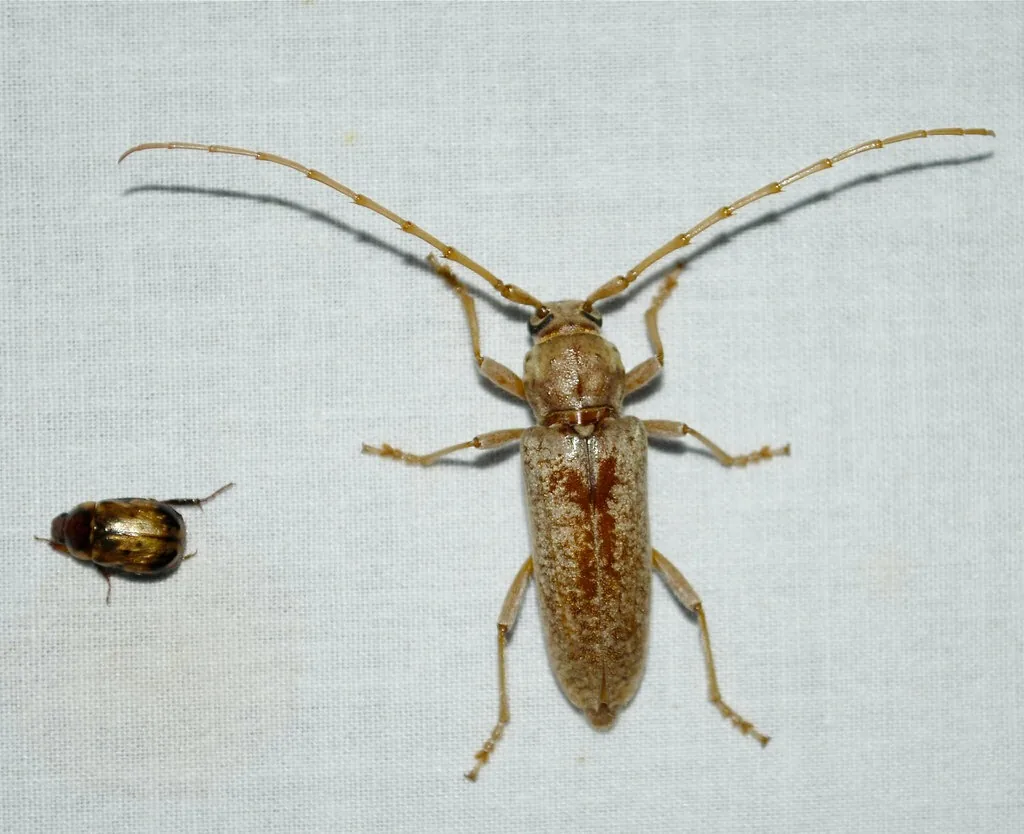
How to identify it
- It attacks living oaks, especially trees in the red oak group such as northern red, southern red and black oak; white oaks are sometimes attacked.[1][2]
- Young larvae bore in through the bark and later chew back out, leaving small, oblong holes in the bark through which they push out frass.[1]
- In the wood, larval feeding leaves wounds with holes in the bark and shredded wood fibers (excelsior), along with tunnels and stain traces left by the tunnels.[2]
- Adults emerge in early summer: in the central United States the main emergence starts around mid-June, lasts about three weeks and comes in odd-numbered years.[1]
Where it lives
It occurs throughout a wide range of North American deciduous forests, from southeastern Canada and Maine south to Florida and west to Minnesota, Iowa, Oklahoma and Texas.[1][2]
Biology and life cycle
In the central United States it has a synchronized two-year life cycle, with adults emerging together in odd-numbered years.[1][2]
Adults live about three weeks. Females start laying eggs right after mating, about 120 each, singly or in small groups in bark crevices or under lichens, and the eggs hatch in less than two weeks.[1]
Young larvae chew through the bark and begin galleries in the phloem, the inner bark. The next spring they keep feeding there, and in summer they move into the sapwood.[1]
Late in the following spring the larvae pupate, and adults emerge soon after.[1]
It is normally present at low levels; populations climbed from the 1980s, peaked around 2001 to 2003, possibly in connection with extreme droughts and trees weakened by age, and then fell back to historically low levels.[1]
Damage and signs
- Borer tunnels degrade logs and lower wood quality, reducing the economic value of oak trees, and the wounds open entryways for other insects and decay organisms.[1][2][3]
- It is not considered a primary cause of tree death, but very high borer populations have coincided with oak decline, and its damage is abundant in oak forests with high tree mortality.[2]
- Severe decline and death of red oaks was detected in 1999 in the Ozark National Forest in Arkansas, during an unprecedented red oak borer outbreak in the Ozark Mountains of Arkansas and Missouri. Borer densities often topped 100 per tree, the highest ever recorded, and the Forest Service estimated that more than a million acres of Ozark forest would be affected by the end of 2001.[1]
- Red oak deaths more than doubled between 2000 and 2009. By the end of that decade, scientists concluded the outbreak was a stress event of the kind that occurs when oaks of about the same age near the end of their life span and are stressed by extreme heat, drought, insects or disease.[1]
- In a tree-ring study of a declining oak stand in southeastern Missouri, researchers dated 743 borer wounds on 31 trees. Borer activity rose over 70 years, jumping in the late 1970s when the stand was about 50 years old, and wound numbers were related to tree age, ring width and annual mean and minimum temperatures.[2]
- MDC lists red oak borers, present in high numbers since 1999, among the contributing factors in the decline of northern red, southern red, black and scarlet oaks in southern Missouri and northern Arkansas, along with two-lined chestnut borers, Armillaria root rot and other stresses.[3]
Health risk
It is a wood-boring beetle of oaks; none of these sources describes any risk to people.[1][2][3]
Control
Prevention
For the long term, MDC recommends increasing the diversity of forest stands, thinning out weakened and diseased trees to favor the younger, most vigorous ones, and encouraging long-lived, drought-tolerant species such as shortleaf pine and white oak in multi-aged stands.[3]
When to call a professional
MDC treats red oak borer damage as part of oak decline. In the short term it advises removing hazardous trees from yards, roads and rights-of-way, surveying your land to judge how severe the problem is, and contacting a professional forester to develop a plan for the most heavily damaged areas.[3]
Common questions
- Do red oak borers kill oak trees?
- Not usually by themselves. Forest Service researchers describe the red oak borer as not a primary mortality agent, but its damage is heavy in declining oak forests with high mortality, and MDC lists it among the contributing factors in oak decline.[2][3]
- Why do red oak borer adults show up in some years and not others?
- In the central United States the beetle has a synchronized two-year life cycle, so adults emerge together in odd-numbered years, starting around mid-June.[1][2]
- What should I do about red oak borers in my oaks?
- MDC's advice for oak decline is to remove hazardous trees from yards, roads and rights-of-way, survey the land to judge the damage, and contact a professional forester. Its long-term strategy includes thinning out weakened trees and favoring drought-tolerant species such as white oak and shortleaf pine.[3]
Sources
- University of Arkansas Arthropod Museum, “Red oak borer.” arthropod.uark.edu/red-oak-borer/ (accessed 2026-11-09)
- USDA Forest Service, Southern Research Station, “A Dendrochronological Analysis of Red Oak Borer Abundance (R.-M. Muzika and R. P. Guyette), Upland Oak Ecology Symposium, Gen. Tech. Rep. SRS-73, pp. 102-105 (2004).” research.fs.usda.gov/treesearch/6505 (accessed 2026-11-09)
- Missouri Department of Conservation, “Oak Decline in Missouri.” mdc.mo.gov/trees-plants/diseases-pests/oak-decline-missouri (accessed 2026-11-09)
- iNaturalist, “Enaphalodes rufulus taxon page (order and family).” www.inaturalist.org/taxa/49004 (accessed 2026-11-09)