On this page
How to identify it
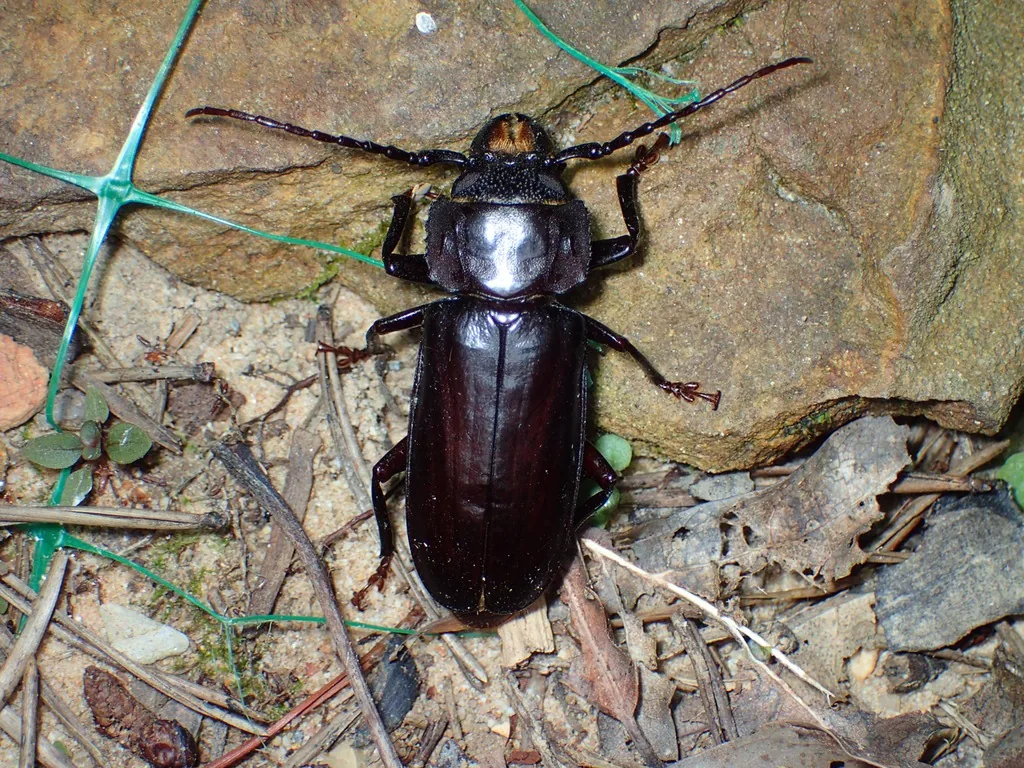
- Adults are large, elongate, somewhat flattened longhorn beetles, reddish brown to dark brown and 23 to 47 mm long (about 7/8 inch to nearly 2 inches).[1]
- The head is large and coarsely pitted, the prothorax is wide with many small flattened teeth along its sides, and the antennae are fairly short, reaching only about the first third of the wing covers in males and a little less in females.[1]
- Larvae are robust, cylindrical, smooth, shiny and sparsely hairy, with small legs, and grow up to 64 mm (about 2 1/2 inches) long.[1]
Where it lives
It is native to the southern United States and Mexico. The Forest Service gives its range as Virginia south to Florida and west to Arizona, and into eastern and northern Mexico.[2][3][1]
Biology and life cycle
Recorded hosts include oak, hackberry and sugarberry, willow, sycamore, boxelder, hickory, sweetgum, elm and maple, and it has been reported from Australian pine in south Florida. It probably attacks many other broadleaf trees.[1][2]
Most adults emerge from May to July, though a few appear as early as April in south Florida and some have been collected as late as October.[1]
Females lay eggs near the base of stressed and dying trees, around wounds where wood is exposed, and in spots that were infested before.[2][1]
The larvae feed briefly under the bark, then bore into the sapwood and heartwood, where they feed close together for 3 to 4 years, cutting large, meandering tunnels that eventually honeycomb the heartwood. They can also complete development in dying or recently dead trees.[2][1]
Mature larvae pupate deep in the tree in galleries plugged with fibrous frass, and the adults chew their way out directly through the wood and bark.[1]
Males recognize females by touch. In laboratory tests, males tried to mate only after touching a female with their antennae, and two hydrocarbons on the female's body surface, 2-methylhexacosane and 2-methyloctacosane, together set off the full mating sequence.[3]
Damage and signs
- Infestations often go unnoticed until weakened trees break, usually near the base. At the break, the heartwood may be completely honeycombed with flattened oval tunnels up to 8 by 22 mm, packed with coarse, fibrous frass.[1]
- Little frass is pushed to the outside, but after a few years large oval emergence holes, about 8 by 18 mm, appear in the bark of standing trees.[1]
- Shade trees that stand without the support of a surrounding forest canopy are especially prone to breaking. Lumber sawn from infested trees is degraded, and crossties and other wood in contact with the ground can also be attacked.[1]
- In Miami-Dade County, Florida, it has recently been found attacking avocado trees. Infestations start in lower cut branches or in the main trunk, especially where there is sunscald injury, and the larvae tunnel down toward the base of the tree, where their tunnels could cause considerable hidden structural damage.[2]
Health risk
None of these sources describes any risk to people; the harm is to trees and wood.[1][2]
Control
Prevention
Keep shade trees healthy and vigorous and avoid wounds at the base of the trunk. Fresh wounds should be treated or filled promptly to keep the borers out.[1]
Traps and physical control
As of 2018, no attractants for trapping the adults had been commercialized.[2]
Biological control
Woodpecker holes have been found in infested trees, but little is known about woodpeckers or other natural enemies as controls.[1]
When to call a professional
Within its range, trees with wounds at the base should be inspected regularly. In Florida avocado groves, researchers found that acoustic sensors could pick up the feeding sounds of larvae hidden in branch stumps, which may help survey infestations.[1][2]
Common questions
- What are the signs of hardwood stump borer?
- Look for large oval emergence holes, about 8 by 18 mm, in the bark near the base of a wounded tree. Trees that snap near the base may show heartwood honeycombed with frass-packed tunnels.[1]
- Does the hardwood stump borer attack avocado trees?
- Yes. It has recently been found in avocado trees in Miami-Dade County, Florida, where larvae enter at lower cut branches or sunscalded trunks and tunnel down toward the base.[2]
- How can I prevent hardwood stump borer damage?
- Keep trees vigorous, avoid wounding the base of the trunk, and treat or fill fresh wounds promptly. Inspect trees with basal wounds regularly.[1]
Sources
- USDA Forest Service, “Guide to Insect Borers in North American Broadleaf Trees and Shrubs, Agriculture Handbook AH-706 (J. D. Solomon, 1995), hardwood stump borer account (as Stenodontes dasytomus dasytomus), pp. 399-401.” research.fs.usda.gov/treesearch/22150 (accessed 2026-11-09)
- Florida Entomologist (Florida Entomological Society), “Mankin, Burman, Menocal and Carrillo. Acoustic Detection of Mallodon dasystomus (Coleoptera: Cerambycidae) in Persea americana (Laurales: Lauraceae) Branch Stumps. Florida Entomologist 101(2): 321-323 (2018).” journals.flvc.org/flaent/article/view/105260 (accessed 2026-11-09)
- Journal of Chemical Ecology (Springer), indexed in PubMed (PMID 20697784), “Spikes, Paschen, Millar, Moreira et al. First Contact Pheromone Identified for a Longhorned Beetle (Coleoptera: Cerambycidae) in the Subfamily Prioninae. Journal of Chemical Ecology 36: 943-954 (2010), doi:10.1007/s10886-010-9837-8 (abstract).” doi.org/10.1007/s10886-010-9837-8 (accessed 2026-11-09)
- iNaturalist, “Mallodon dasystomus taxon page (order and family).” www.inaturalist.org/taxa/269875 (accessed 2026-11-09)