On this page
How to identify it
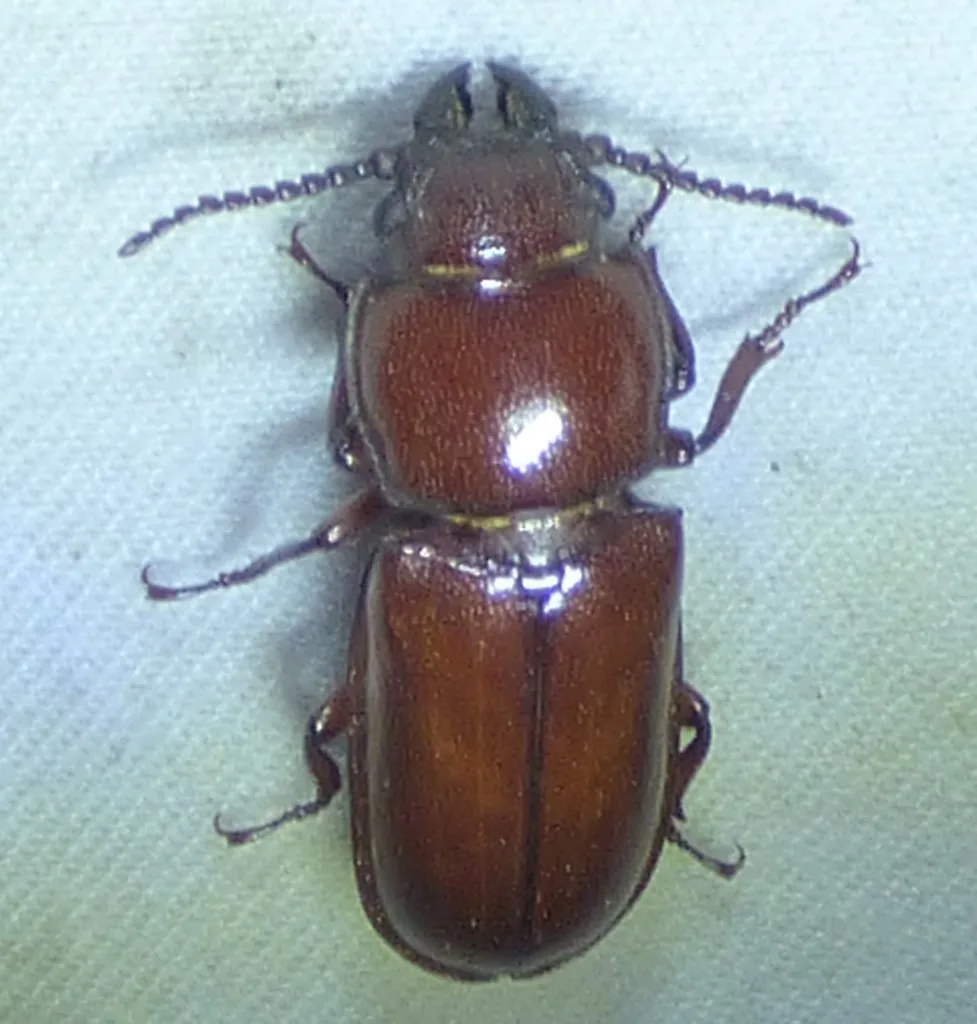
- Adults are somewhat flat, shiny, mahogany-brown longhorn beetles, 8 to 12 mm long (about 5/16 to 1/2 inch), though size, color and head parts vary.[1]
- Males have very prominent, elongate jaws with three distinct teeth along the inner edge; females are more robust and have shorter jaws.[1]
- Larvae are yellowish white with a black head and small legs on the thorax, about 30 mm (1 1/4 inches) long when mature.[1]
Look-alikes
| Look-alike | How to tell them apart |
|---|---|
| Hardwood stump borer (Mallodon dasystomus) | Another borer that enters at wounds near the base of hardwoods and attacks wood in contact with the ground, but its adults are far larger, 23 to 47 mm long, with many small teeth along the sides of the prothorax.[1] |
Where it lives
It is found through most of eastern North America. The Forest Service gives its range as the eastern United States west to Colorado and south to the upper Gulf of Mexico region.[2][1]
Biology and life cycle
It is a general feeder, recorded from black walnut, hickory, willow, beech, chestnut, oak, elm, yellow-poplar, apple, pear, plum, cherry, locust, soft maple, basswood, black ash, poplar and sweetgum, and it probably attacks all hardwoods and some conifers.[1]
Adults appear in midsummer, usually in July or August, after staying several days in their pupal chambers. Many never leave the tree, mating and laying eggs inside the cavities.[1]
Females cut small openings in exposed wood and lay one egg in each, in clusters of up to 12. The first attack on a tree comes from outside, into dead areas; later generations lay in the gallery walls or other openings inside the tree.[1]
Larvae feed along winding or zigzag paths and pack their galleries with frass; a single burrow can wander a meter or more. Because they usually feed in sound wood, each generation enlarges the damaged area.[1]
The pupal stage lasts 10 to 14 days, and a generation may take 3 or 4 years.[1]
Recorded natural enemies are two parasitic wasps and the olive-sided flycatcher.[1]
Damage and signs
- It attacks living trees almost always near the base, where sapwood has been exposed by mechanical bruises, poor pruning, sunscald, winter injury, fire blight, collar rot, storms or other borers. Trees with healthy, uninjured bark are rarely attacked.[1]
- Burrows start in exposed wood and usually run upward into the heartwood, and other borers and fungi soon follow. Within a few years the infested part of the tree can be completely honeycombed, leaving only a thin shell of sapwood, and the tree may keep living but can fall in even a light windstorm.[1]
- Entering only at dead spots and cavities, and pushing little or no frass to the surface, sets it apart from most other borers. Entry wounds sometimes heal over, hiding the injury.[1]
- It seems more common in shade and ornamental trees in towns than in forests, especially in older trees in sunny, exposed spots, and it often seriously injures orchard trees. It also damages logs, crossties, telephone and power poles, and structural timbers in contact with the ground or in moist places.[1]
Health risk
Neither source describes any risk to people; it is a pest of trees and wood.[1][2]
Control
Prevention
Preventing injury matters most. Keep trees vigorous and avoid damaging the trunk and lower branches, because attacks start in exposed dead wood.[1]
Traps and physical control
Getting rid of an established infestation means cutting out all the wood the galleries run through and cleaning out the infested, decayed wood.[1]
Pesticides
On valuable trees, treating injured and susceptible areas may help prevent infestation.[1]
Common questions
- Does the pole borer attack utility poles and lumber?
- Yes. Besides living trees, it damages logs, crossties, telephone and power line poles, and structural timbers that are in contact with the ground or in moist places.[1]
- Can the pole borer kill a tree?
- An infested tree may keep living while its heartwood is honeycombed, but once only a shell of sapwood is left it can fall in even a light windstorm.[1]
- How do I keep pole borers out of my trees?
- Prevent wounds. The beetle almost always enters through injuries that expose the wood near the base of the tree, so protecting the trunk and lower branches and keeping trees vigorous is the main defense.[1]
Sources
- USDA Forest Service, “Guide to Insect Borers in North American Broadleaf Trees and Shrubs, Agriculture Handbook AH-706 (J. D. Solomon, 1995), pole borer account (as Parandra brunnea), pp. 385-388.” research.fs.usda.gov/treesearch/22150 (accessed 2026-11-09)
- Journal of Heredity (American Genetic Association; Oxford University Press), indexed in PubMed (PMID 41045126), “Sylvester, Adams, Mitchell, Shen and McKenna. Genomic Architecture of the Pole Borer, Neandra brunnea (Cerambycidae: Parandrinae), Sheds Light on the Evolution of Wood-Feeding in Longhorn Beetles. Journal of Heredity 117: 492-501 (2026), doi:10.1093/jhered/esaf080 (abstract).” doi.org/10.1093/jhered/esaf080 (accessed 2026-11-09)
- iNaturalist, “Neandra brunnea taxon page (order and family).” www.inaturalist.org/taxa/225465 (accessed 2026-11-09)