On this page
How to identify it
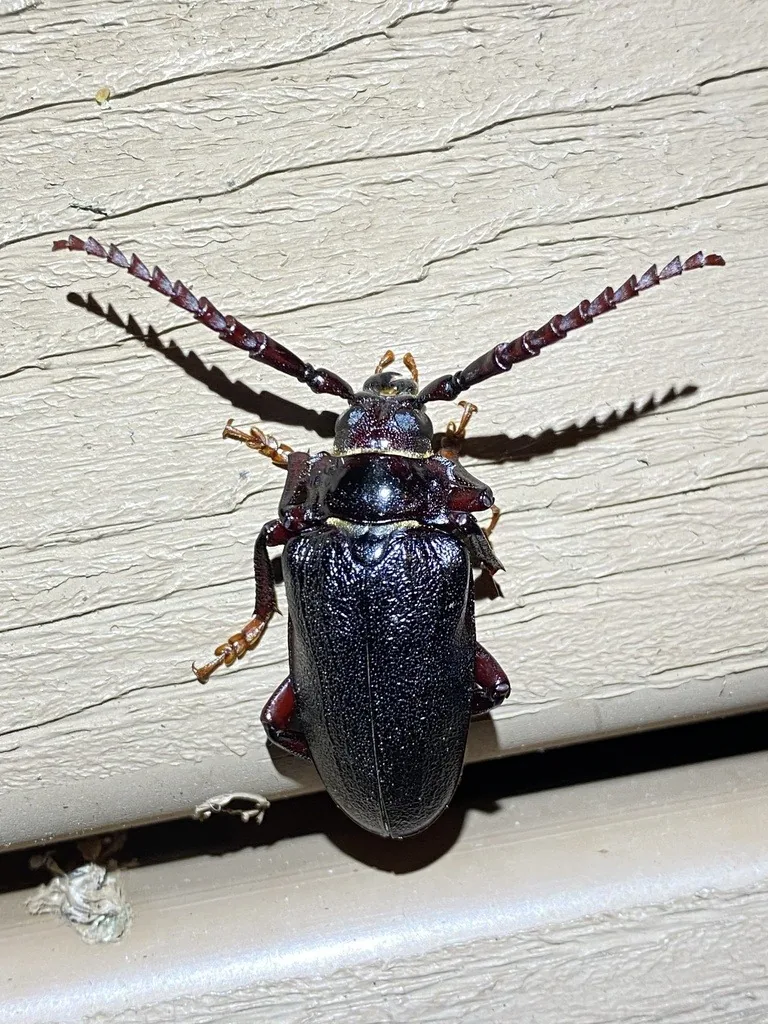
- Adults are large, robust, shiny longhorn beetles, dark brownish black to reddish brown. The Forest Service gives 22 to 32 mm for males and 31 to 44 mm for females (roughly 7/8 to 1 3/4 inches), and NC State says they grow up to 2 inches long.[1][2]
- The pronotum, the plate behind the head, is as wide as the base of the wing covers, and each of its side edges carries three broad teeth.[1]
- The antennae have 12 segments and reach just past the middle of the wing covers in males and just past their base in females. Each wing cover has three slightly raised lengthwise ridges on a rough, coarsely pitted surface.[1]
- Mature larvae are about 9 cm (3 1/2 inches) long, creamy white to yellowish, with a dark brown to black head partly sunk into a large, fleshy front segment.[1]
Look-alikes
| Look-alike | How to tell them apart |
|---|---|
| Tile-horned prionus (Prionus imbricornis) | A close relative of about the same size. Its antennae look saw-like and have many more segments, 18 to 20 in males and 16 to 18 in females, compared with 12 in the broad-necked root borer.[2][1] |
| California prionus and other Prionus root borers | The California prionus is the western member of the genus and the largest, up to 3 inches long; in the West it attacks crops such as hops and stone fruits.[2] |
Where it lives
It ranges from southern Canada through the eastern United States west to Oklahoma. NC State notes that in the East it mainly affects fruit trees such as apple and cherry.[1][2]
Biology and life cycle
Recorded hosts include oak, poplar, basswood, chestnut, apple, pecan, grape, pine, cherry, dogwood, maple and rhododendron; oak, poplar, chestnut and apple are favored.[1]
Males fly from June to August. They fly readily and are most often collected around lights, but females have never been seen flying. The adults do not feed on foliage or roots, possibly because their digestive tract shrinks as they change from pupa to adult.[1]
In North Carolina, adults of the eastern Prionus species are active from late June through the first week of August, peaking in mid-July; in the warmer Southeast they can appear as early as April or May.[2]
Females lay eggs singly or in clusters of 2 to 10 in the soil around the base of trees, 1.2 to 3.8 cm deep. In a Rhode Island study, females carried an average of 643 eggs and laid an average of 388.[1]
Young larvae move through the soil from root to root, feeding on the bark of the smaller roots. As they grow they feed deeper in the larger roots near the root crown, where roots up to 8 cm thick may be severed, honeycombed or hollowed out.[1]
Larvae molt seven times and overwinter as second- or third-stage larvae, depending on when they hatched. When mature they leave the roots and pupate in earthen cells within about 10 cm of the soil surface, mostly within 30 cm of the trunk; the pupal stage lasts about 25 days. One generation takes 3 to 4 years.[1]
Damage and signs
- Above ground, attacked trees show gradual thinning and yellowing of foliage throughout the crown and limb-by-limb dieback that ends in death. Because these symptoms look like drought stress or nutrient deficiency, they are hard to diagnose without digging.[1]
- Excavated roots show large patches of bark chewed away, girdled roots, and burrows that run into and through large roots, often honeycombing them. Larvae can cut off small trees at the root collar or just below the soil line.[1]
- Together with the tile-horned prionus it kills significant numbers of trees and cuts yields in Georgia pecan groves, and the two can destroy 75 to 90 percent of the roots of infested trees. Many bearing apple trees in Rhode Island orchards were abandoned because of this borer. It seldom does much damage in natural forests but can destroy open-grown trees in parks, pastures, orchards and along streets.[1]
- In North Carolina, Prionus grubs badly damaged the roots and crowns of 'Duke' and other highbush blueberries in reports from 2010, 2013 and 2024. Infested bushes show almost no outward sign until they weaken and wilt and can be knocked over by hand or by mechanical harvesters.[2]
Health risk
Neither source describes any risk to people. The grubs damage roots, and the adults do not feed on foliage or roots.[1][2]
Control
Prevention
Attacks are most common on stressed, weakened trees, so cultural practices that keep trees healthy come first. New plantings should be made some distance from heavily infested orchards and woodlands.[1]
Sanitation
In blueberries, NC State advises removing and destroying infested plants to keep larvae from spreading; on a small scale, digging soil away from the roots and removing the grubs by hand can work.[2]
Traps and physical control
Pheromones that attract the males have been identified for each eastern Prionus species, and pheromone lures in panel traps, along with pitfall traps, are the standard way to monitor adult flights.[2]
Biological control
Natural controls include a tachinid fly that parasitizes prepupae, five species of disease-causing bacteria, cannibalism where larval tunnels meet, and freezing of larvae that fail to move below the frost line in northern areas.[1]
Pesticides
Soil-applied insecticides and fumigants have shown some promise in tests. NC State notes that no insecticides are registered against Prionus in blueberries and that systemic insecticides do not work against the large grubs.[1][2]
Common questions
- How do I know if Prionus grubs are killing my tree?
- The above-ground symptoms, thinning and yellowing foliage and dieback limb by limb, look like drought or nutrient problems. Digging around the root crown shows chewed bark, girdled roots and burrows that honeycomb the larger roots.[1]
- Do the adult beetles damage plants?
- No. The adults do not feed on foliage or roots. All the damage is done by the grubs, which feed on roots for 3 to 4 years.[1]
- Why do these big beetles show up at my porch light?
- Males fly readily from June to August and are most often collected around lights. Females have never been seen flying.[1]
Sources
- USDA Forest Service, “Guide to Insect Borers in North American Broadleaf Trees and Shrubs, Agriculture Handbook AH-706 (J. D. Solomon, 1995), broadnecked root borer account, pp. 390-393.” research.fs.usda.gov/treesearch/22150 (accessed 2026-11-09)
- NC State Extension, “The Root of the Problem: Prionus Longhorn Beetles in Blueberries (L. Lopez, July 2024).” blueberries.ces.ncsu.edu/news/the-root-of-the-problem-prionus-longhorn-beetles-in-blueberries/ (accessed 2026-11-09)
- iNaturalist, “Prionus laticollis taxon page (order and family).” www.inaturalist.org/taxa/133029 (accessed 2026-11-09)