On this page
How to identify it
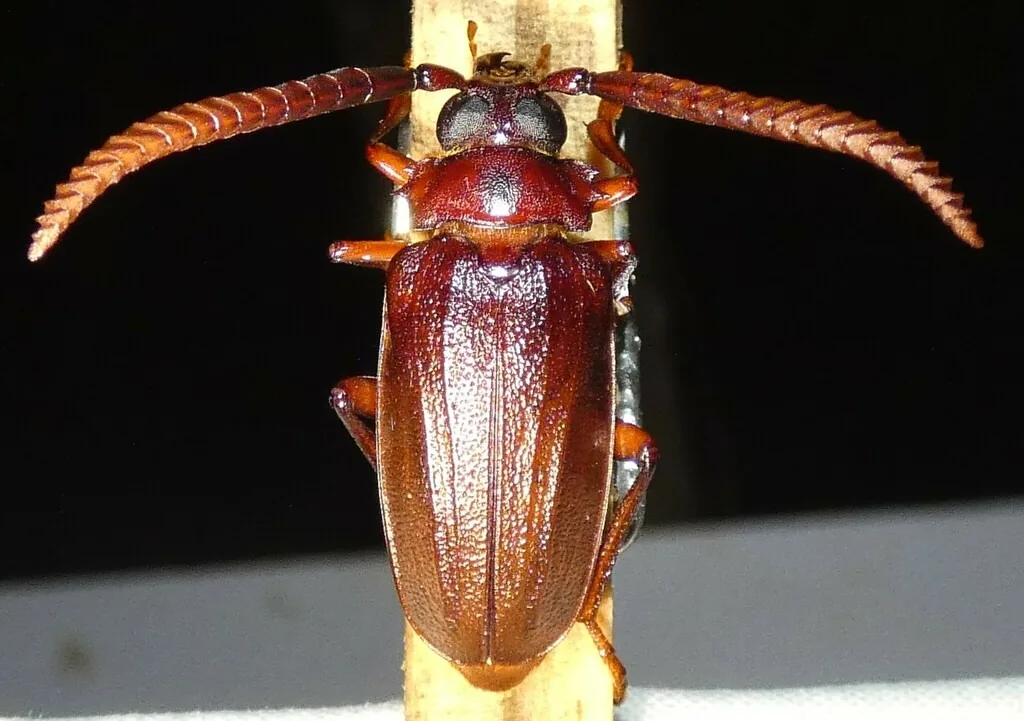
- Adults are very large, robust, shiny dark reddish-brown longhorn beetles. Males average 31 mm (about 1 1/4 inches) and females 42 mm (about 1 2/3 inches).[1]
- The antennae are the best clue: NC State describes them as segmented and saw-like, and they have 18 to 20 segments in males and 16 to 18 in females. A male's antennae reach the middle of the wing covers; a female's are slenderer and barely reach the first third.[2][1]
- The pronotum is convex and at least twice as wide as it is long, with prominent, blunt teeth at the front and middle of each side.[1]
- Mature larvae are creamy white to yellowish and up to 9 cm (about 3 1/2 inches) long, with a tough, shiny skin and a head that is widest at the back.[1]
Look-alikes
| Look-alike | How to tell them apart |
|---|---|
| Broad-necked root borer (Prionus laticollis) | A close relative of similar size. It is shiny brownish black, its antennae have only 12 segments, and each side of its pronotum carries three broad teeth.[2][1] |
| California prionus and other Prionus root borers | The California prionus is the western species of the group. It grows up to 3 inches long and damages hops and stone fruits in the western United States.[2] |
Where it lives
It occurs throughout the eastern United States from southern New England to Florida and west to Nebraska and Texas; NC State describes it as found across the eastern and central U.S.[1][2]
Biology and life cycle
Hosts include oak, chestnut, pear, apple, grape and pecan. Oak, chestnut and pecan are preferred, and fruit trees can be heavily infested in small local areas.[1]
Adults fly from June to September. They are active at night and hide by day under debris or loose bark, usually at the base of trees. NC State gives late June to early August, with a mid-July peak, as the main flight of the eastern Prionus species, with earlier emergence in the warmer Southeast.[1][2]
Each female usually lays 100 to 200 eggs in groups in the soil at the base of trees; as many as 254 eggs have been found in one female. The eggs are pale to bright yellow and 3.6 to 4.2 mm long.[1]
Young larvae feed in the bark of roots before boring into the heartwood; later, larger roots may be completely hollowed out and smaller ones eaten.[1]
To pupate, larvae leave the roots, tunnel up to 1 m through the soil, and build oval cells of soil and organic matter, about 7 by 4.5 cm, within 10 cm of the surface. Development takes 3 to 5 years.[1]
Damage and signs
- It feeds only on roots. Above ground, the only signs are gradual thinning and yellowing of the foliage and dieback limb by limb. Small trees may die quickly, but large trees usually decline slowly, and established trees are often left with one or two small roots near the surface until wind blows them over.[1]
- Young trees are sometimes chewed off just below the soil surface and their root systems eaten. Confirming an infestation means digging out or exposing the larger roots from the root crown outward for a few meters, where you find burrows, large oval holes and galleries up to 5 cm wide packed with frass and soil, usually with large yellowish-white grubs in some of them.[1]
- Mature trees in open stands and in heavily used recreation areas are especially subject to attack.[1]
- It has been a major cause of pecan decline and death across Georgia's pecan region, where 3 to 10 percent of the trees in many groves were attacked. Declining infested trees produced significantly fewer nuts and had shorter shoots and lower leaf weight. In one apple study plot, every tree was infested, with up to 67 borers per tree.[1]
- Prionus grubs have also caused severe root and crown damage to highbush blueberries in North Carolina, where growers first reported it in 2010.[2]
Health risk
Neither source describes any risk to people; the harm is to tree roots.[1][2]
Control
Prevention
Keep trees thrifty and vigorous. Disease, drought, mechanical injury and poor soil all make trees more likely to be attacked.[1]
Sanitation
For infested blueberry plantings, NC State's advice is to remove and destroy the infested plants, and on a small scale to dig away soil around the roots and pick out the grubs.[2]
Traps and physical control
Males can be monitored with traps baited with the pheromone identified for their species, using panel traps or pitfall traps.[2]
Biological control
Little has been published on natural enemies or other natural factors that regulate its populations.[1]
Pesticides
In Georgia pecan tests of several insecticides and soil fumigants, fumigants applied to the soil were the most effective against the larvae. For blueberries, NC State reports that no insecticides are registered against Prionus and that systemic products do not work on the large grubs.[1][2]
Common questions
- How can I tell a tile-horned prionus from a broad-necked root borer?
- Look at the antennae. The tile-horned prionus has saw-like antennae with 18 to 20 segments in males and 16 to 18 in females, while the broad-necked root borer has 12. The tile-horned prionus is dark reddish brown; the broad-necked root borer is brownish black.[1][2]
- Can the tile-horned prionus kill a pecan tree?
- Yes. It has been a major cause of pecan decline and death in Georgia. Small trees can die quickly, while large trees decline gradually as their roots are girdled and hollowed out.[1]
- When are the adult beetles out?
- The Forest Service gives June to September for adult flight. The beetles hide under debris or loose bark at the base of trees by day and are active at night.[1]
Sources
- USDA Forest Service, “Guide to Insect Borers in North American Broadleaf Trees and Shrubs, Agriculture Handbook AH-706 (J. D. Solomon, 1995), tilehorned prionus account, pp. 388-390.” research.fs.usda.gov/treesearch/22150 (accessed 2026-11-09)
- NC State Extension, “The Root of the Problem: Prionus Longhorn Beetles in Blueberries (L. Lopez, July 2024).” blueberries.ces.ncsu.edu/news/the-root-of-the-problem-prionus-longhorn-beetles-in-blueberries/ (accessed 2026-11-09)
- iNaturalist, “Prionus imbricornis taxon page (order and family).” www.inaturalist.org/taxa/228714 (accessed 2026-11-09)