On this page
How to identify it
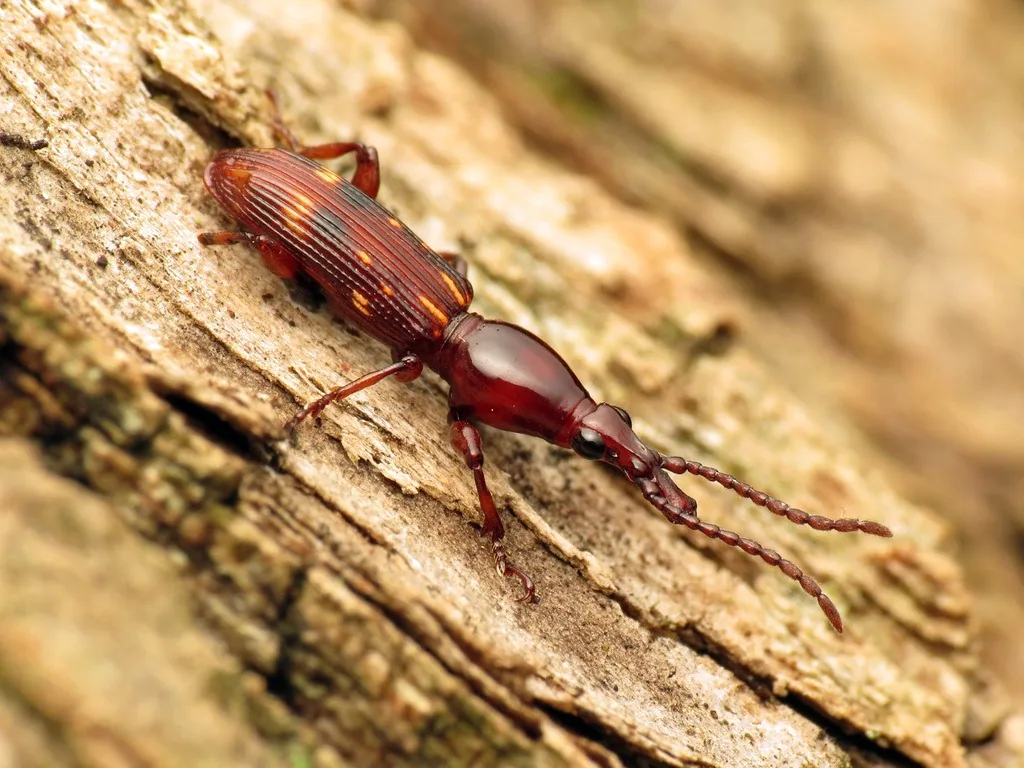
- Adults are shiny, very elongate snout beetles, 7 to 25 mm long (about 1/4 to 1 inch), reddish brown to brownish black with elongate yellowish spots on the wing covers.[1]
- The sexes differ. The female's head is drawn out into a long, slender snout, while the male's is short, broad and flat, with noticeably larger jaws.[1]
- Unlike true weevils, its snout points straight forward and its antennae are not elbowed.[1]
- Larvae are white, elongate and curved, with three pairs of small legs behind the head and one pair of prolegs at the tip of the abdomen. Full-grown larvae are 12 to 24 mm long.[1]
Look-alikes
| Look-alike | How to tell them apart |
|---|---|
| Acorn weevils and other true weevils (Curculionidae) | In true weevils the head is drawn out downward into a usually curved beak, and the antennae are usually elbowed and clubbed. The oak timberworm's snout points straight ahead and its antennae are not elbowed.[1] |
Where it lives
It occurs in southeastern Canada and through the eastern United States south to Florida and the Gulf Coast. It has not been reported from the European Union, which bans its introduction.[1][2]
Biology and life cycle
Oaks are the main hosts, in both the red and white oak groups; black and scarlet oaks on upland sites are especially susceptible. Elm, poplar, beech and aspen are also attacked, and clusters of adults found under the loose bark of boxelder and honeylocust suggest other hardwoods can serve as hosts.[1][2]
Adults are out from early May to August over most of the range. They feed on sap oozing from trees and sometimes gather under loose bark at wounds.[1][2]
Females lay their eggs at wounds that expose the sapwood. Fresh wounds are preferred, though some up to 2 years old are used. Each female chews hair-thin holes with her snout, lays one egg in each, and plugs most of them with a sticky secretion and frass. In Ontario, egg laying ran from mid-June to late July and again in early to mid-September.[1][2]
The larvae bore straight across the grain almost to the far side of the trunk, make a sharp U-turn, and tunnel back toward the entrance, pushing frass out of the hole as they go. They pupate near the tunnel opening, and the adults leave through it.[1][2]
The life cycle usually takes 3 years, though some individuals finish in 2 and a few take 4.[1][2]
Damage and signs
- Attacks usually start at earlier injuries that expose the sapwood, including wounds made by large borers, and holes are often found around large red oak borer galleries. Dying trees and freshly cut green logs are sometimes attacked too.[1]
- Signs include white, powdery frass at egg sites on exposed wood or at old borer entrances, and small round tunnels 0.2 to 4.0 mm across leading from the egg sites into the wood. In sawn lumber the tunnels run mostly across the grain, in many directions.[1][2]
- The main losses are in standing timber grown for wood products. The wormholes can make lumber unfit for uses such as tight cooperage or flooring and lower the grade of factory lumber, and fresh-cut stave bolts, unseasoned lumber and squared timbers can also be attacked.[1]
- In the Missouri Ozarks, 50 to 78 percent of blazed trees were attacked during peak larval activity. Defects are most common in upland forests of the central United States, east to Kentucky, Ohio and West Virginia.[1]
- The oak timberworm can carry the oak wilt fungus, Bretziella fagacearum, which causes a severe disease of oaks in the United States.[1][2]
Health risk
Neither the Forest Service guide nor the EFSA assessment mentions any risk to people. It is a pest of living trees and timber.[1][2]
Control
Prevention
Protect trees from wounds and injuries, including injuries caused by large borers. Where timberworm damage has been serious, take extra care during harvesting and other woods work to avoid bark injuries on the trees left standing.[1]
Sanitation
Removing dying and felled trees promptly reduces infestations.[1]
Pesticides
No natural enemies have been reported, and chemical and other direct controls have not been investigated.[1]
Common questions
- How do I recognize oak timberworm damage in wood?
- Look for small round tunnels, 0.2 to 4.0 mm across, that run mostly across the grain and often start at old wounds. White, powdery frass at egg sites or old borer holes is another sign.[1][2]
- Is the oak timberworm a weevil?
- It belongs to the Brentidae, the timber worms or primitive weevils. Unlike true weevils, its snout points straight forward and its antennae are not elbowed.[1]
- How long does an oak timberworm spend inside the tree?
- The life cycle usually takes 3 years, with some individuals finishing in 2 and a few needing 4.[1][2]
Sources
- USDA Forest Service, “Guide to Insect Borers in North American Broadleaf Trees and Shrubs, Agriculture Handbook AH-706 (J. D. Solomon, 1995), oak timberworm account and Brentidae and Curculionidae introductions, pp. 476-479.” research.fs.usda.gov/treesearch/22150 (accessed 2026-11-09)
- EFSA Journal (European Food Safety Authority; Wiley), full text in PubMed Central (PMC7009242), “EFSA Panel on Plant Health (Bragard et al.). Pest Categorisation of Arrhenodes minutus. EFSA Journal 17(2): e05617 (2019), doi:10.2903/j.efsa.2019.5617.” doi.org/10.2903/j.efsa.2019.5617 (accessed 2026-11-09)
- iNaturalist, “Arrenodes minutus taxon page (order and family).” www.inaturalist.org/taxa/1506398 (accessed 2026-11-09)