On this page
How to identify it
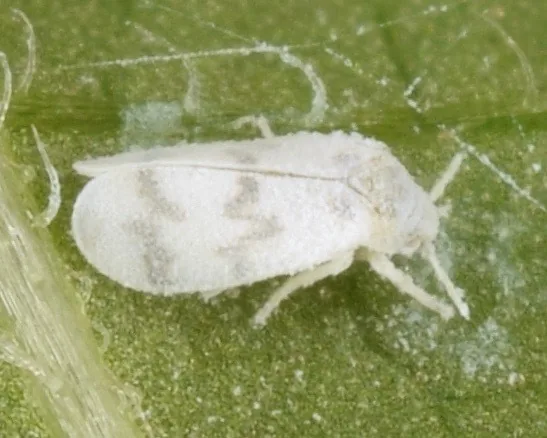
- Adults are tiny whiteflies with two distinct zigzag bands across the wings, gray in NC State's description and brownish in UC IPM's. UC IPM describes the body as gray.[1][2]
- The last immature stage, sometimes called the pupa, is oval, almost 1/16 inch long, with vertical sides and a fringe of short wax filaments around the edge. It has a dark area on top, which greenhouse whitefly pupae lack.[1][2]
- Younger nymphs are translucent white with a yellow spot on each side. Newly hatched crawlers are tiny and yellow.[1]
- Eggs are smooth, oblong and pale yellow to pink. Females push the tips into the underside of a leaf, sometimes laying them in a circle.[1]
- Its scientific name, Trialeurodes abutiloneus (also spelled abutilonea), comes from velvetleaf, Abutilon theophrasti, the plant it was first described from.[1][2]
Look-alikes
| Look-alike | How to tell them apart |
|---|---|
| Greenhouse whitefly | Greenhouse whitefly adults have plain white wings with no bands, and its last-stage nymphs carry very long waxy filaments. Its pupae also lack the dark patch on top.[2][1] |
| Silverleaf (sweetpotato) whitefly | Sweetpotato whitefly adults have white wings and a yellow body and hold their wings slightly tilted, and its last-stage nymphs have no waxy filaments or marginal fringe.[2] |
Where it lives
NC State calls it a native whitefly that can overwinter outdoors. UC IPM lists it among the common whiteflies of California gardens and landscapes, and it also occurs in Louisiana sweetpotato fields.[1][2][4]
Biology and life cycle
NC State describes it as feeding on almost any plant. It has been reported from beggarticks, cotton, geranium, hibiscus, mallows, petunia, poinsettia, ragweed and velvetleaf, and UC IPM adds cucurbits and other vegetables.[1][2]
Newly hatched crawlers wander for a while (several hours, in whiteflies generally) before pushing their long, needle-like mouthparts into the underside of a leaf to suck sap. Like other whiteflies, the immatures pass through four nymphal stages, the later ones fixed in place like tiny scales, before the winged adult emerges.[1][2]
All stages feed on sap and excrete sticky honeydew.[1][2]
North Carolina has several generations a year, and numbers can become quite high by late summer.[1]
Damage and signs
- Heavily infested plants turn yellowish and unthrifty. Honeydew and the black sooty mold that grows on it spoil the look of ornamentals, and the honeydew draws ants, which get in the way of the whitefly's natural enemies.[1][2]
- It and the B biotype of the sweetpotato whitefly are highly efficient carriers of tomato chlorosis virus, which causes yellowing between the veins and brittle leaves in tomato and can cut plant vigor and fruit yield. The virus persists in the bandedwinged whitefly for up to 5 days, compared with 1 to 2 days in the other three whitefly vectors.[3]
- In laboratory tests it also transmitted sweetpotato chlorotic stunt virus, though less often than the sweetpotato whitefly did (infecting 3.2% of test plants exposed to single whiteflies, versus 15.2%). Both whiteflies are present in Louisiana sweetpotato fields.[4]
- Low numbers of whiteflies are not usually damaging: adults alone do little harm unless they are spreading a plant pathogen, and losses generally take a large population of nymphs.[2]
Health risk
The extension sources treat it only as a plant pest; they mention no bites, stings or other risk to people or pets.[1][2]
Control
Prevention
Inspect new plants for whiteflies and nymphs before they go into a greenhouse or garden, and avoid or remove plants that keep hosting heavy whitefly populations. NC State notes this species now moves into landscapes and greenhouses from weeds.[2][1]
Traps and physical control
Use yellow sticky cards to watch for adults; they are better for monitoring than for control. Early on, removing heavily infested leaves and hosing plants with water can hold numbers down.[1][2]
Biological control
Lacewings, bigeyed bugs, minute pirate bugs, small lady beetles and parasites all attack whiteflies, and outbreaks often follow pesticide sprays or dust buildup that disrupt them. Products with carbaryl, pyrethroids or imidacloprid, especially imidacloprid sprayed on foliage, are particularly disruptive.[2]
Pesticides
Insecticidal soaps and horticultural oils give moderate control. They kill only the whiteflies they touch, so cover the undersides of leaves and repeat as needed, and don't spray drought-stressed plants or spray when it's over 90 F. NC State says other garden insecticides labeled for whiteflies should also work; UC IPM advises sticking to soaps and oils in gardens because most other products kill natural enemies and whiteflies quickly become resistant.[1][2]
Common questions
- How do I tell bandedwinged whitefly from greenhouse whitefly?
- Look at the adult's wings: the bandedwinged whitefly has two zigzag bands across them, while the greenhouse whitefly's wings are plain white. The pupae differ too: bandedwinged pupae have a dark patch on top and a short wax fringe.[1][2]
- Does the bandedwinged whitefly spread plant viruses?
- Yes. It is a highly efficient vector of tomato chlorosis virus, and lab work showed it can also transmit sweetpotato chlorotic stunt virus at a lower rate than the sweetpotato whitefly.[3][4]
- Why did it show up in my greenhouse or flower beds?
- Its recorded hosts include velvetleaf, ragweed and beggarticks, and NC State says it now moves from weeds into landscapes and greenhouses as an occasional pest.[1]
Sources
- NC State Extension, “Bandedwinged Whitefly on Ornamentals (J. Baker, PDIC factsheet).” content.ces.ncsu.edu/banded-winged-whitefly (accessed 2026-11-09)
- University of California Statewide IPM Program, “Pest Notes: Whiteflies (UC ANR Publication 7401).” ipm.ucanr.edu/home-and-landscape/whiteflies/ (accessed 2026-11-09)
- American Phytopathological Society (Plant Disease), “Wintermantel WM, Wisler GC. Vector specificity, host range, and genetic diversity of Tomato chlorosis virus. Plant Disease 90:814-819 (2006) (abstract).” doi.org/10.1094/PD-90-0814 (accessed 2026-11-09)
- American Phytopathological Society (Plant Disease), “Sim J, Valverde RA, Clark CA. Whitefly transmission of Sweetpotato chlorotic stunt virus. Plant Disease 84:1250 (2000) (abstract).” doi.org/10.1094/PDIS.2000.84.11.1250C (accessed 2026-11-09)
- iNaturalist, “Trialeurodes abutiloneus taxon page (order and family).” www.inaturalist.org/taxa/243743 (accessed 2026-11-09)