On this page
How to identify it
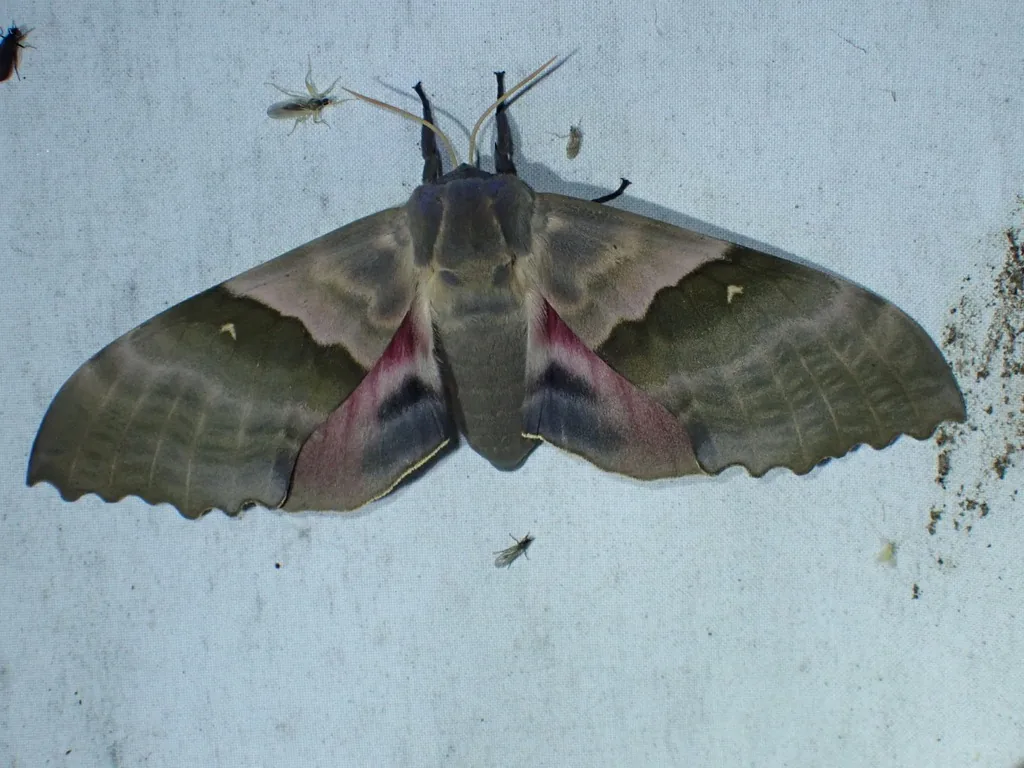
- The moth is very large, with a wingspan of 10 to 12 cm (about 4 to 4.7 inches). The long, narrow forewings are banded in light and dark gray-brown, and the hindwing is maroon with a blue-black blotch at its rear corner.[2]
- The caterpillar is pale green, rarely brown or orangish, with rings of white grainy spots around the body.[1]
- It has three to six slanting yellow stripes along the sides, clearest on the second to fourth abdominal segments, and a broader pale slanting stripe that runs from the sixth segment up to a shortened horn at the rear.[1]
- The head is flattened, with a pinkish triangle on the face bordered by a pale band running from the eyes to the top of the head.[1]
Look-alikes
| Look-alike | How to tell them apart |
|---|---|
| Paler western forms | Very pale moths from southern Alberta have been called Pachysphinx occidentalis, a lighter tan moth with more maroon on the hindwing. Alberta specimens grade from pale to dark, and the University of Alberta museum treats them all as the big poplar sphinx pending further study.[2] |
Where it lives
It occurs through much of North America, from the Gulf States north into the boreal forest across Canada. It lives in poplar woods, including open mature poplar forest, mixed forest with poplar and, in Alberta, cottonwood stands along prairie rivers.[2]
Biology and life cycle
The caterpillars feed on poplars, especially aspen. Single reports from willow and birch need confirmation.[1][2]
There is one generation a year in the North and two in the South. Caterpillars are found from July through November in the East, and from mid-July to September in Alberta.[1][2]
The pupa overwinters in the ground. In Alberta the moths fly from mid-May through mid-July.[2]
The adults are active at night and come readily to lights. In a field survey of synthetic chemical lures, big poplar sphinx moths were among the sphinx moths attracted to 10,12-hexadecadienyl compounds.[2][3]
Damage and signs
Health risk
Big as it is, neither the USDA Forest Service guide nor the University of Alberta museum page reports any danger to people from the caterpillar or the moth.[1][2]
Control
Prevention
No control is suggested in these sources; the moth is common and widespread, and its caterpillars feed on poplars.[1][2]
Common questions
- What is the huge green caterpillar on my cottonwood or aspen?
- A likely candidate is the big poplar sphinx: a pale green hornworm with white grainy spots, slanting yellow stripes and a short horn at the rear. In Alberta its larvae are reputed to be the largest insects by weight.[1][2]
- What does the moth look like?
- It is a very large gray-brown moth, 10 to 12 cm across, with banded forewings and a maroon hindwing marked with a blue-black blotch.[2]
Sources
- USDA Forest Service, Forest Health Technology Enterprise Team, “Caterpillars of Eastern Forests, FHTET-96-34 (D. L. Wagner, V. Giles, R. C. Reardon and M. L. McManus, November 1997; scanned copy).” archive.org/details/caterpillarsofea001997 (accessed 2026-11-09)
- University of Alberta Museums, “Species Details: Pachysphinx modesta (Big Poplar Sphinx), E.H. Strickland Entomological Museum.” search.museums.ualberta.ca/g/2-439 (accessed 2026-11-09)
- Journal of Chemical Ecology (via NCBI PubMed), “Attraction of sphingid moths (Lepidoptera: Sphingidae) to 10,12-hexadecadienyl aldehydes and acetates: evidence of pheromone components (D. W. Reed, E. W. Underhill and E. M. Giblin, Journal of Chemical Ecology, 1987; abstract).” pubmed.ncbi.nlm.nih.gov/24302058/ (accessed 2026-11-09)
- iNaturalist, “Pachysphinx modesta taxon page (order and family).” www.inaturalist.org/taxa/143445 (accessed 2026-11-09)