On this page
How to identify it
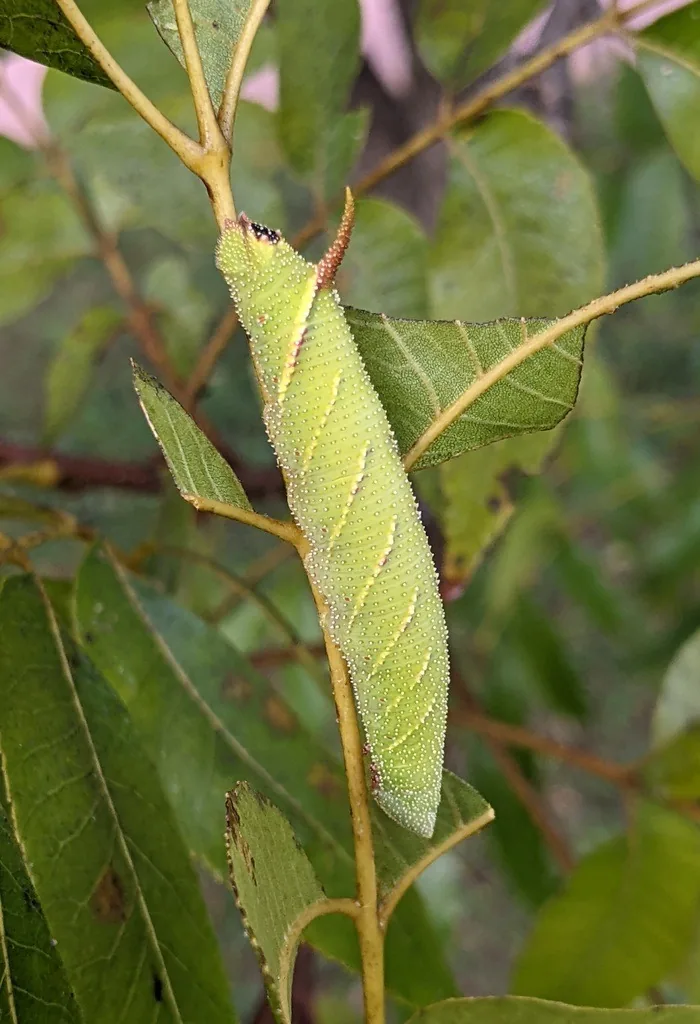
- The caterpillar is usually green, sometimes red, and covered with tiny raised white granules. Seven pairs of slanting yellow lines run along the sides, often ending in a reddish blotch at the top.[1]
- The tail horn is tinted red, and the head is pointed, with a yellow line on each side from the eyes to the crown. The markings, especially the red ones, vary a lot from one caterpillar to the next.[1]
- Like almost all hornworms, it has a horn on top of the eighth abdominal segment, and its large droppings often reveal it in a tree.[1]
- Full-grown caterpillars are about 2 inches (50 mm) long. The Forest Service's eastern forest insects guide describes them as light green to reddish and coarsely granulated with white, with two rough brownish points at the top of the head.[6]
- The moth has a wingspan of about 1 3/4 to 2 15/16 inches. Its wings are highly variable, pale to dark brown, sometimes with a white or pink tinge, and the adults do not feed.[7]
Look-alikes
| Look-alike | How to tell them apart |
|---|---|
| Blinded and small-eyed sphinxes (Paonias) | Their caterpillars are similar, but the body is less granular and the head is not as pointed.[1] |
Where it lives
The Forest Service's eastern forest insects guide gives its range as eastern Canada to Florida and west to the eastern edge of the Great Plains, while Butterflies and Moths of North America extends it from Maine to Florida, west to North Dakota and west Texas, and south to Nuevo Leon, Mexico. GBIF's public U.S. records since 1990 (about 10,900) come from 34 states on the map, most from Texas, North Carolina and Ohio.[6][7][8]
Biology and life cycle
The Forest Service caterpillar guide lists walnuts, hickories, beeches and chestnuts as preferred food plants; its forest insects guide names black walnut, butternut, hickories, beech and hop hornbeam, and Butterflies and Moths of North America adds alder and hazelnut. Caterpillars can be found from May to October.[1][6][7]
There are two generations a year in the South and one in the North. Butterflies and Moths of North America gives flights of May to August in the north and March to October in the south.[1][6][7]
The whistle comes from the caterpillar squeezing its front body segments, which forces air out through a pair of enlarged breathing pores on the eighth abdominal segment. A whistle train lasts from 44 milliseconds to about 2 seconds and holds one to eight whistles. Missouri describes the sound as a whistling hiss; Butterflies and Moths of North America calls it a squeak.[2][5][7]
In tests, 94% of caterpillars whistled when attacked with blunt forceps, often while thrashing, and showed no obvious chemical defense. Yellow warblers that attacked them hesitated, jumped back or dove away from the sound.[2]
Recorded whistles alone startled red-winged blackbirds, which flew away, flinched or hopped and took longer to come back to their food. The birds got used to the sound within an hour, but the effect returned two days later.[3]
Like other hornworms, full-grown caterpillars are often seen wandering over the ground looking for a place to pupate.[1]
Damage and signs
- The caterpillars eat the leaves of walnut, hickory, beech and chestnut. The USDA Forest Service guide doesn't describe it as a pest.[1]
Health risk
The whistle is a defense that startles birds. Hornworms in general may thrash and regurgitate when handled, but neither the USDA Forest Service, Missouri, nor the studies cited mention any bite, sting or other risk to people.[2][3][1][5]
Control
Prevention
None of the sources recommends any control. Missouri notes that small parasitoid wasps lay eggs inside sphinx caterpillars; the white oval cocoons often seen on hornworms belong to these wasps, which eventually kill the caterpillar.[1][2][5]
Common questions
- Why did a caterpillar on my walnut tree whistle?
- That is the walnut sphinx's defense. It squeezes air out through two enlarged breathing pores near its rear end, producing whistles that startle birds.[2][3]
- Do the whistles really scare birds?
- Yes, at least at first. Yellow warblers jumped back or dove away when the caterpillars whistled, and red-winged blackbirds flinched or flew off when recordings were played, though they got used to the sound within an hour.[2][3]
- What trees does the walnut sphinx feed on?
- The Forest Service lists walnuts, hickories, beeches and chestnuts as preferred, plus butternut and hop hornbeam; Butterflies and Moths of North America adds alder and hazelnut.[1][6][7]
- What does the walnut sphinx moth look like?
- A medium-sized hawk moth, about 1 3/4 to 2 15/16 inches across the wings, in pale to dark brown, sometimes tinged white or pink; colors and patterns vary a lot. The adults don't feed.[7]
Sources
- USDA Forest Service, Forest Health Technology Enterprise Team, “Caterpillars of Eastern Forests, FHTET-96-34 (D. L. Wagner, V. Giles, R. C. Reardon and M. L. McManus, November 1997; scanned copy).” archive.org/details/caterpillarsofea001997 (accessed 2026-11-11)
- Journal of Experimental Biology (via NCBI PubMed), “Whistling in caterpillars (Amorpha juglandis, Bombycoidea): sound-producing mechanism and function (V. L. Bura et al.; Journal of Experimental Biology 214(1): 30-37, 2011; abstract).” pubmed.ncbi.nlm.nih.gov/21147966/ (accessed 2026-11-11)
- Behavioural Processes (via NCBI PubMed), “Why do caterpillars whistle at birds? Insect defence sounds startle avian predators (A. L. Dookie et al.; Behavioural Processes 138: 58-66, 2017; abstract).” pubmed.ncbi.nlm.nih.gov/28232054/ (accessed 2026-11-11)
- iNaturalist, “Amorpha juglandis taxon page (order and family).” www.inaturalist.org/taxa/84023 (accessed 2026-11-11)
- Missouri Department of Conservation, “Sphinx Moths (Hawk Moths).” mdc.mo.gov/discover-nature/field-guide/sphinx-moths-hawk-moths (accessed 2026-11-11)
- USDA Forest Service, “Eastern Forest Insects (Miscellaneous Publication 1175, Baker 1972).” archive.org/details/easternforestins1175bake (accessed 2026-11-11)
- Butterflies and Moths of North America (BAMONA), “Walnut sphinx, Amorpha juglandis (species account).” www.butterfliesandmoths.org/species/Amorpha-juglandis (accessed 2026-11-11)
- Global Biodiversity Information Facility (GBIF), “Amorpha juglandis: occurrence records in the U.S., 1990-2026 (GBIF occurrence search).” api.gbif.org/v1/occurrence/search?taxonKey=5123775&country=US&hasGeospatialIssue=false&occurrenceStatus=PRESENT&year=1990%2C2026&facet=stateProvince&facetLimit=400&limit=0 (accessed 2026-11-11). State counts are records reported (iNaturalist research-grade, museum specimens, surveys), not abundance.