On this page
How to identify it
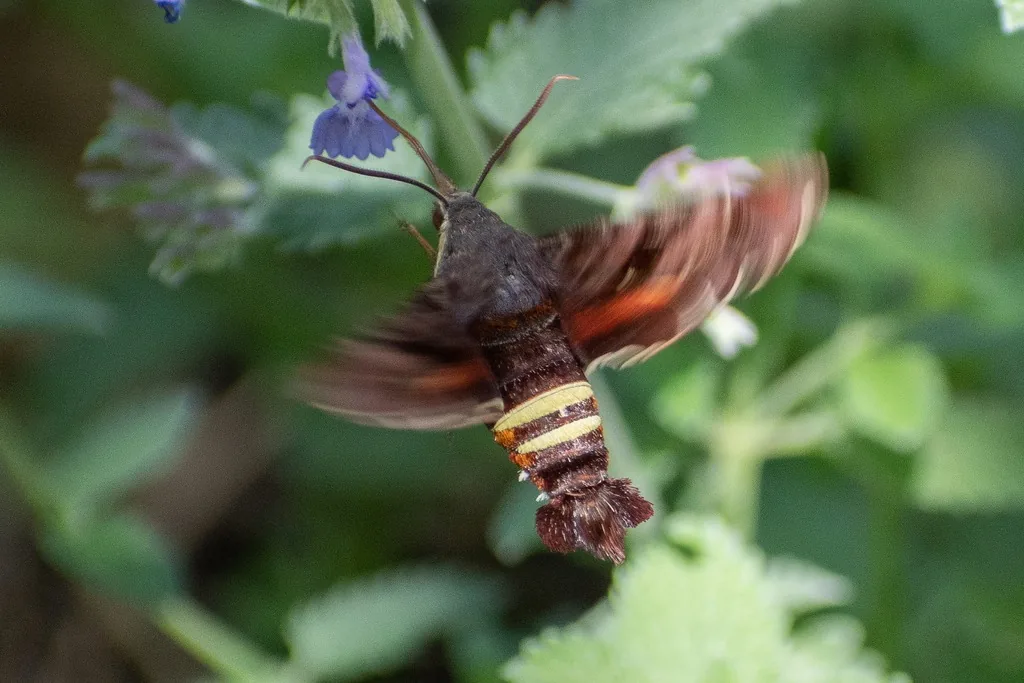
- The abdomen is dark with two whitish or pale yellow bands and ends in a fuzzy tuft.[1]
- The forewings are brown with darker bands near the base, across the middle and toward the outer edge. The hindwings have a reddish-orange band through the middle, a dark outer part and a yellowish patch on the outer front edge.[1]
- The wingspan is 1 1/2 to 2 1/4 inches.[1]
- Caterpillars change looks as they grow: the youngest are nearly transparent, middle stages are green with tiny white dots, a pale stripe along each side and a black tail horn, and the last stage is brown.[1]
Look-alikes
| Look-alike | How to tell them apart |
|---|---|
| Hummingbird clearwing and other clearwing moths | Clearwings also hover at flowers by day and mimic bumble bees, but their wings have large clear patches without scales. The Nessus sphinx's wings are fully scaled, brown with a reddish-orange band on the hindwings.[2][1] |
| Bumble bees | The black-and-yellow banded abdomen makes the Nessus sphinx look like a bumble bee, but it is a moth and has no stinger.[1] |
Where it lives
The Missouri Department of Conservation reports it statewide in Missouri, mostly in wooded areas, especially lowland and riverside woods where native grapes grow.[1]
Biology and life cycle
The caterpillars feed on members of the grape family: peppervine and raccoon grape, Virginia creeper, and grapes. They have also been reported on cayenne pepper.[1]
Adults take nectar from a variety of flowers at dusk and during the day, and are often drawn to lights at night. In lab flights, moths that had fed on sugar water burned mainly carbohydrate, while unfed moths ran almost entirely on stored fat.[1][4]
Missouri apparently has two broods a year; farther south there may be more, and farther north only one.[1]
Full-grown caterpillars dig shallow burrows and pupate underground.[1]
When disturbed, the caterpillars make hissing, crackling sounds by pushing air in and out through their mouths, past a narrow opening between two chambers of the foregut, much like a whistling kettle. The noise and thrashing apparently can startle predators such as birds, rodents and bats.[3][1]
Damage and signs
- The caterpillars eat the leaves of wild grapes, Virginia creeper and related vines. The Missouri Department of Conservation reports that the Nessus sphinx apparently is not a serious pest in commercial vineyards, perhaps because so many native grapes and Virginia creeper are available to the caterpillars.[1]
Health risk
Despite its bumble bee look, the moth has no stinger, and neither the Missouri Department of Conservation nor the research cited here mentions any risk to people.[1][3][4]
Control
Prevention
None of the sources suggests any control. The Missouri Department of Conservation reports that the Nessus sphinx apparently is not a serious pest even in commercial vineyards.[1][3]
Common questions
- Is it a hummingbird, a bee or a moth?
- A moth. The Nessus sphinx hovers at flowers like a hummingbird and its banded abdomen looks like a bumble bee's, but it is a hawk moth with no stinger.[1]
- Why does the caterpillar hiss?
- It is a defense. When pinched or disturbed, the caterpillar forces air in and out of its foregut through its mouth, making hissing, crackling sounds that, along with thrashing, apparently can startle predators.[3][1]
- Will Nessus sphinx caterpillars hurt my grapevines?
- They do eat grape leaves, but the Missouri Department of Conservation reports that the Nessus sphinx apparently is not a serious pest in commercial vineyards.[1]
Sources
- Missouri Department of Conservation, “Nessus Sphinx (Field Guide).” mdc.mo.gov/discover-nature/field-guide/nessus-sphinx (accessed 2026-11-09)
- Missouri Department of Conservation, “Hummingbird Clearwing (Field Guide).” mdc.mo.gov/discover-nature/field-guide/hummingbird-clearwing (accessed 2026-11-09)
- Journal of Experimental Biology (via NCBI PubMed), “Vocalization in caterpillars: a novel sound-producing mechanism for insects (C. A. Rosi-Denadai et al.; Journal of Experimental Biology 221(4): jeb169466, 2018; abstract).” pubmed.ncbi.nlm.nih.gov/29483140/ (accessed 2026-11-09)
- Journal of Experimental Biology (via NCBI PubMed), “Fuel use in flight and its dependence on nectar feeding in the hawkmoth Amphion floridensis (D. M. O'Brien; Journal of Experimental Biology 202(4): 441-451, 1999; abstract).” pubmed.ncbi.nlm.nih.gov/9914151/ (accessed 2026-11-09)
- iNaturalist, “Amphion floridensis taxon page (order and family).” www.inaturalist.org/taxa/126153 (accessed 2026-11-09)