On this page
How to identify it
- Full-grown caterpillars are 2.5 to 3.5 inches long, smooth and stout, and may be green, yellow-brown, pinkish brown or brown.[1][3][4]
- Along the sides are oblique white bars with notched edges, partly divided into sections, with a breathing hole in the lowest one; older caterpillars have an eyespot on top of the hind end instead of a horn.[1][5][4]
- Young caterpillars carry a long, slender horn at the tail, which is lost at the last molt.[1][2]
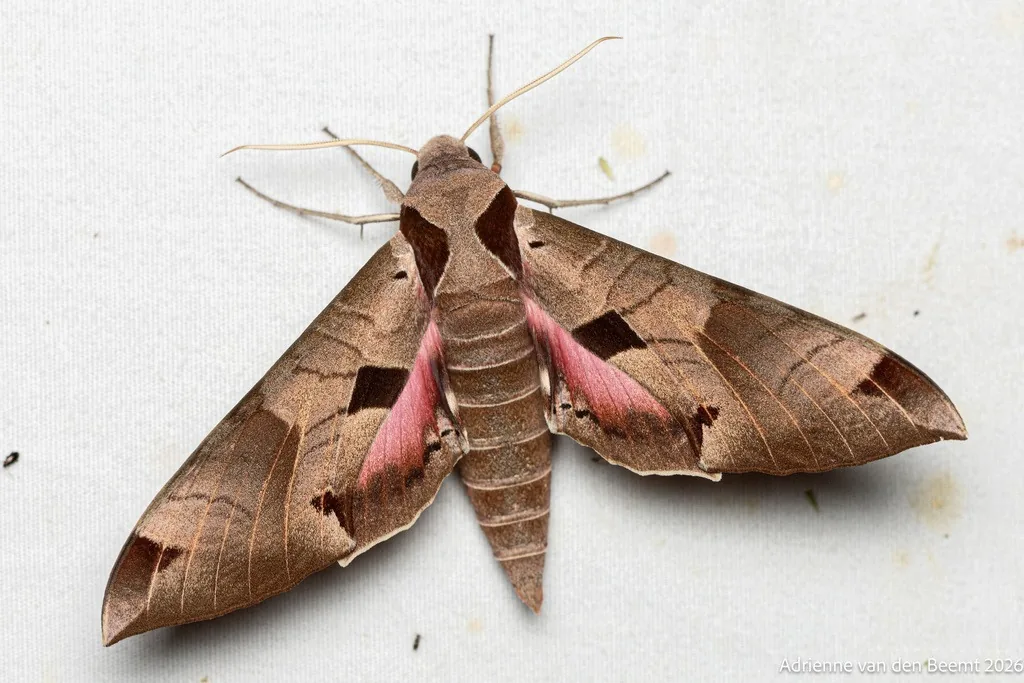
- The moth is large and heavy-bodied, with pinkish-brown forewings marked with a squarish dark spot and mostly pink hind wings; Colorado State gives a wingspan of about 3.5 inches.[3]
Look-alikes
| Look-alike | How to tell them apart |
|---|---|
| Pandorus sphinx | A related grape-feeding sphinx with a very similar life history; Michigan State finds it more common than the achemon sphinx in Michigan vineyards.[5] |
| Whitelined sphinx | Another sphinx moth whose caterpillars occasionally feed on grape.[3][2] |
Where it lives
Reported by extension services from Colorado and South Dakota to Missouri, Michigan and Virginia.[3][4][1][5][2]
Biology and life cycle
It overwinters as a pupa in a small earthen cell in the soil; in Virginia, moths emerge in early May and lay eggs on the foliage, which hatch in six to nine days.[3][2]
Caterpillars feed for about 25 days, then go into the soil to pupate; in Virginia a second generation of moths appears in early July, and its caterpillars are more numerous and do the most damage in August. Missouri reports one to two generations a year.[2][1]
Late in the season, full-grown caterpillars wander in search of a place to pupate, which is often when people notice them.[4]
Damage and signs
Health risk
It feeds only on plants; none of the sources reports any harm to people or pets.[1][4]
Control
Prevention
Check grapevines for large caterpillars and stripped leaves, especially in August, when the second generation does the most damage.[2][5]
Biological control
Parasitic wasps attack sphinx caterpillars; caterpillars carrying the wasps' small white silk cocoons are already parasitized.[2][5]
Common questions
- What is the huge caterpillar eating my grape leaves?
- A caterpillar up to about 3.5 inches long, green or pinkish brown with white bars on its sides and no horn when full grown, feeding on grape or Virginia creeper is likely an achemon sphinx.[1][4][3]
- Is the achemon sphinx harmful to my grapevine?
- In a home landscape it is usually not an important pest, although large numbers can defoliate vines.[4][5]
Sources
- University of Missouri Extension, “Caterpillars in Your Yard and Garden (IPM1019), page 2: achemon sphinx.” extension.missouri.edu/publications/ipm1019/2 (accessed 2026-10-17)
- Virginia Tech Department of Entomology, “Sphinx or hawk moths, Family Sphingidae (Virginia Fruit; after Pfeiffer and Schultz, VCE 444-567).” www.virginiafruit.ento.vt.edu/sphinx.html (accessed 2026-10-17)
- Colorado State University Extension, “Achemon Sphinx (Colorado Insects of Interest).” webdoc.agsci.colostate.edu/bspm/arthropodsofcolorado/Achemon_Sphinx.pdf (accessed 2026-10-17)
- South Dakota State University Extension, “Achemon Sphinx Moth Caterpillars (A. Bachmann, updated March 6, 2019).” extension.sdstate.edu/achemon-sphinx-moth-caterpillars (accessed 2026-10-17)
- Michigan State University Extension, “Hornworm caterpillars: The big cats of the vineyard.” www.canr.msu.edu/news/hornworm_caterpillars_the_big_cats_of_the_vineyard (accessed 2026-10-17)
- iNaturalist, “Eumorpha achemon taxon page (order and family).” www.inaturalist.org/taxa/122356 (accessed 2026-10-06)