On this page
How to identify it
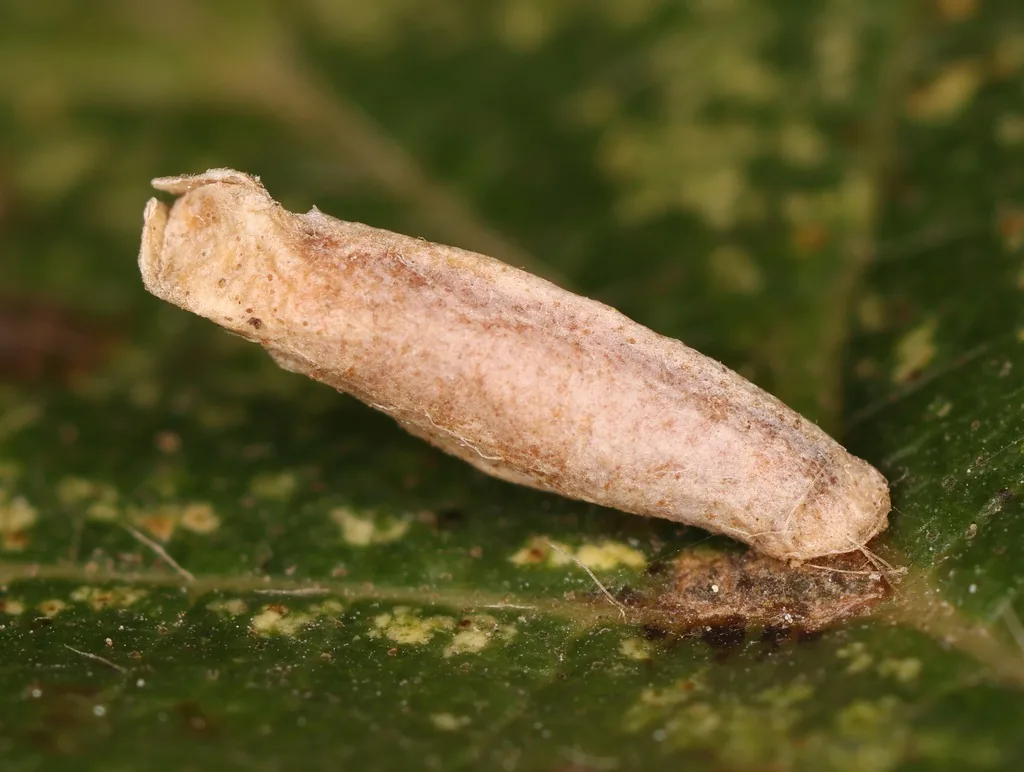
- The caterpillar is rarely seen outside its case: a small, cigar-shaped tube made from bits of the host's leaves and tied with silk. As the caterpillar grows it makes a new, larger case.[1][2]
- Cases sit attached to the leaf surface. Around each feeding spot the leaf is hollowed out from inside, as far as the caterpillar can reach without leaving its case, before it moves on and repeats.[1][2]
- The adult is a tiny brown to tan moth with a wingspan of about 12 millimeters (under 1/2 inch), flying in early July.[1][2]
Look-alikes
| Look-alike | How to tell them apart |
|---|---|
| Lesser birch casebearer (Coleophora comptoniella) | A native relative that also makes cases on birch. Ontario reports the two are commonly found feeding together.[1] |
Where it lives
It is native to Europe and was introduced to North America. Natural Resources Canada lists it in British Columbia, Manitoba and eastern Canada.[1][2]
Biology and life cycle
White birch (paper birch) is the preferred host. It also feeds on grey and yellow birch, other birches and alders.[1][2]
Moths appear in early July and lay eggs on the undersides of leaves. The eggs hatch in early to mid-August, and the young caterpillars make tiny mines in the leaves for two to three weeks before building their first case.[1]
They keep feeding from their cases into September, then move to twigs and the trunk to spend the winter. In spring, as buds swell and open, the caterpillars move in their cases onto the new leaves to feed.[1]
Feeding ends by June. The caterpillar pupates inside its case, which may be anywhere on the tree or on nearby plants and undergrowth, and masses of cases can cover birch foliage before the moths emerge.[1][2]
Many native insects have taken to parasitizing this introduced moth; researchers in Quebec identified 38 species emerging from birch casebearer pupae.[1]
Damage and signs
- Feeding hollows out the leaves, leaving the midrib and veins. Depending on how many caterpillars there are, a tree can lose part or all of its foliage.[1][2]
- Heavy feeding on opening buds in spring kills the developing leaves and shoots. After early-season defoliation a birch looks sparse, with only scattered clusters of leaves left across the crown.[1]
- Birches can grow new leaves after defoliation by forcing out the buds meant for next year, but this puts a great deal of stress on the tree.[1]
Health risk
The sources describe it only as a leaf feeder on birch and alder; they mention no harm to people.[1][2]
Control
Biological control
Native parasitic insects attack the birch casebearer; 38 species have been found emerging from its pupae in Quebec. Neither source recommends a spray.[1]
Common questions
- What are the little brown tubes stuck to my birch leaves?
- They are likely birch casebearer cases. Each small, cigar-shaped case is made from leaf pieces and holds a caterpillar that mines the leaf from inside the case.[1][2]
- Will my birch recover after casebearers strip it?
- Birches can put out a new set of leaves after defoliation, but they do it by forcing out next year's buds, which stresses the tree.[1]
Sources
- Ontario Ministry of Natural Resources, “Birch casebearer (forest health pests, diseases and severe weather conditions).” www.ontario.ca/page/birch-casebearer (accessed 2026-11-09)
- Natural Resources Canada, Canadian Forest Service, “Birch casebearer, Trees, insects and diseases of Canada's forests.” tidcf.nrcan.gc.ca/en/insects/factsheet/8229 (accessed 2026-11-09)
- iNaturalist, “Coleophora serratella taxon page (order and family).” www.inaturalist.org/taxa/217365 (accessed 2026-11-09)