On this page
How to identify it
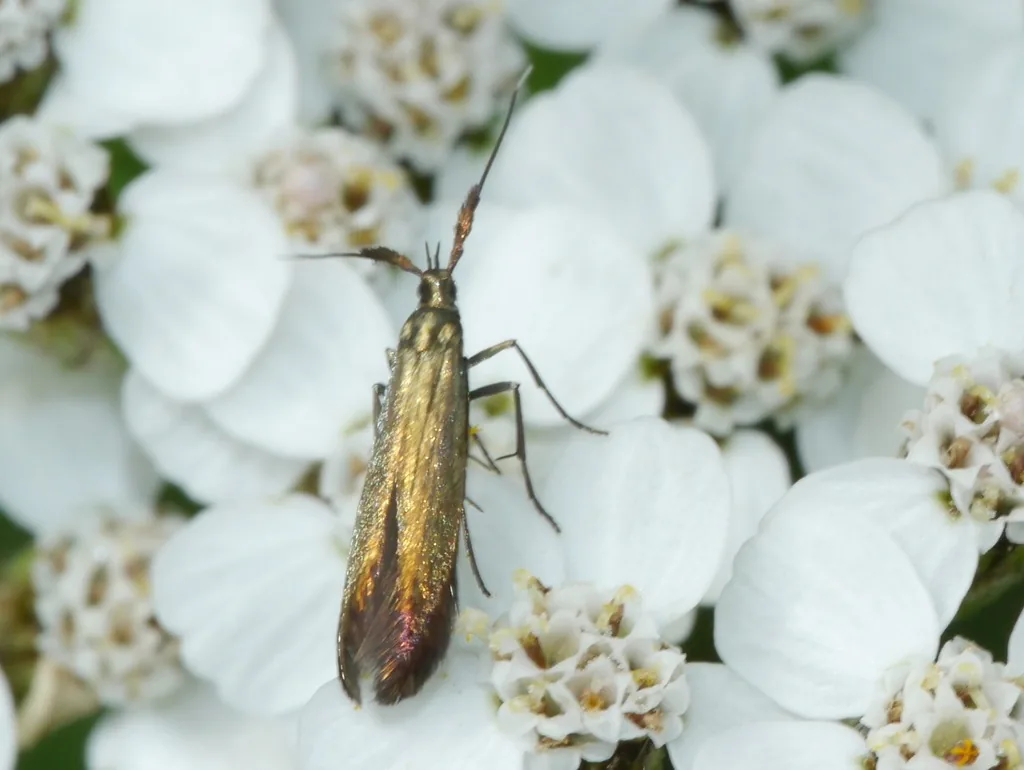
- The adult is a small, slender moth about 9 mm long with an 11 mm wingspan and shiny metallic wings with bronze and copper tones; it was only separated from the very similar Coleophora frischella in 1976.[1][2]
- Larvae live hidden inside red clover florets, and the overwintering larva sits inside a cigar-like silk case in the field residue, where it later pupates on the ground surface.[1]
- Moths fly in clover fields from June through mid-August and are most easily seen at dawn, when males respond most strongly to the female pheromone.[1][5]
Look-alikes
| Look-alike | How to tell them apart |
|---|---|
| Birch, larch and elm casebearers | Moths of the same genus; the red clover casebearer's larvae feed inside clover florets and overwinter in a cigar-like case in the field residue rather than on a tree.[1] |
| Clover seed weevil and clover seed chalcid | The Pacific Northwest handbook lists these other seed feeders of clover grown for seed; the casebearer is told by the shiny bronze adult and the cigar-shaped larval case in field residue.[1] |
Where it lives
Native to Europe, the Middle East and eastern Siberia; established across a wide area of the United States and Canada (treated as an invasive pest of red clover seed fields in Canada, including Alberta), a pest of clover grown for seed in the Pacific Northwest, and also now in New Zealand.[2][6][5][1]
Biology and life cycle
Larvae overwinter inside their cigar-like case within residue in the field and pupate inside the case on the ground surface. Adults emerge in early summer to mate, and the females lay white eggs on the calyx of the florets.[1]
Newly hatched larvae enter the florets to feed, then move from floret to floret by chewing holes through the corolla, eventually damaging the pods and developing seeds.[1][2]
Adults live only briefly, with a median longevity of 6 days in the laboratory; males emerge earlier and in larger numbers than females, and their response to the female sex pheromone, a 10:1 blend of (Z)-7-dodecenyl acetate and (Z)-5-dodecenyl acetate, peaks at sunrise.[5][4]
Damage and signs
- The larvae feed on the developing seeds of red clover (Trifolium pratense), so the loss falls on seed production fields; it is described as a significant pest in red clover seed production regions throughout the world and a major pest of red clover grown for seed in Canada and parts of Europe.[2][3][4]
- In its native European range it causes only minor damage.[2]
Health risk
None of the sources mentions any effect on people; the moth is a clover seed pest only.[1][2]
Control
Prevention
Monitor adult flights with pheromone-baited traps: green Unitraps with rubber septa lures placed 35 cm above the soil and 5 m in from the field edge caught the most males while limiting bumble bee by-catch, which was greatest in yellow and white traps. Larvae are hard to sample directly because they feed inside the florets.[6]
Traps and physical control
Cutting and removing red clover as silage in late May or early July appears to disrupt the life cycle and helps prevent damage to seed during bloom and seed fill.[1]
Biological control
Parasitoids are one of the two main approaches used against this moth, alongside pheromone mating disruption.[2]
Pesticides
No labeled insecticide is known to be effective, because the larvae feed internally. Pheromone mating disruption is the alternative: laminate flakes releasing the full pheromone blend reduced male trap catch by 94 percent in small plots and 72 percent in 5-hectare plots, lowered larval numbers and increased seed yield, whereas aerosol puffers cut trap catch but did not reduce larvae or raise yield.[1][4][3][5]
Common questions
- What are the tiny bronze moths flying over my red clover at dawn?
- Shiny metallic moths about 9 mm long on the wing from June to mid-August are red clover casebearers; the males are most active at sunrise, when they respond to the female pheromone.[1][5]
- Why don't insecticides work on the red clover casebearer?
- The larvae feed hidden inside the florets and seed pods, where sprays cannot reach them, so no labeled insecticide is known to be effective; mating disruption with pheromone flakes has reduced larvae and raised seed yield.[1][3][4]
- Does it matter for clover in a lawn or pasture?
- The sources treat it as a pest of red clover grown for seed, where the larvae eat the developing seed; forage cut as silage in late May or early July escapes most of the damage.[1][2]
Sources
- Pacific Northwest Pest Management Handbooks (Oregon State University, Washington State University and University of Idaho), “Clover seed-Red clover casebearer moth, Pacific Northwest Insect Management Handbook.” pnwhandbooks.org/insect/legume-grass-field-seed/clover-grown-seed/clover-seed-red-clover-casebearer-moth (accessed 2026-11-10)
- Wellcome Open Research (via NCBI PubMed Central), “The genome sequence of the Red-clover Case-bearer, Coleophora deauratella Zeller, 1846 (L. M. Crowley, D. C. Wawman et al., Wellcome Open Research 9:370, 2024; full text, Background section).” pmc.ncbi.nlm.nih.gov/articles/PMC11513577/ (accessed 2026-11-10)
- Pest Management Science (via NCBI PubMed), “Mating disruption of Coleophora deauratella (Lepidoptera: Coleophoridae) using laminate flakes in red clover seed production fields (B. A. Mori and M. L. Evenden, 2015) (abstract).” pubmed.ncbi.nlm.nih.gov/25180975/ (accessed 2026-11-10)
- Journal of Chemical Ecology (via NCBI PubMed), “Efficacy and mechanisms of communication disruption of the red clover casebearer moth (Coleophora deauratella) with complete and partial pheromone formulations (B. A. Mori and M. L. Evenden, 2014) (abstract).” pubmed.ncbi.nlm.nih.gov/25008969/ (accessed 2026-11-10)
- Environmental Entomology (via NCBI PubMed), “Challenges of mating disruption using aerosol-emitting pheromone puffers in red clover seed production fields to control Coleophora deauratella (B. A. Mori and M. L. Evenden, 2015) (abstract).” pubmed.ncbi.nlm.nih.gov/26308804/ (accessed 2026-11-10)
- Journal of Economic Entomology (via NCBI PubMed), “Factors affecting pheromone-baited trap capture of male Coleophora deauratella, an invasive pest of clover in Canada (B. A. Mori and M. L. Evenden, 2013) (abstract).” pubmed.ncbi.nlm.nih.gov/23786073/ (accessed 2026-11-10)
- iNaturalist, “Coleophora deauratella taxon page (order and family).” www.inaturalist.org/taxa/217331 (accessed 2026-11-10)