On this page
How to identify it
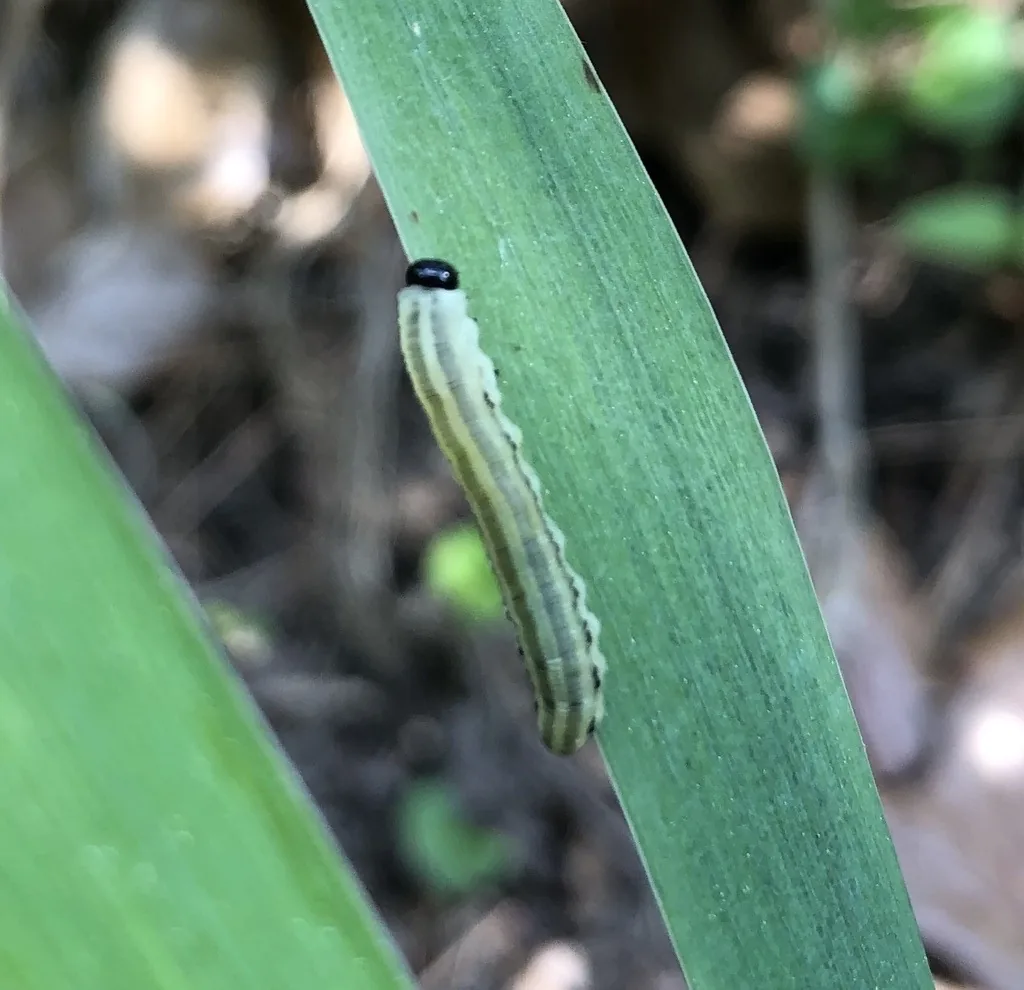
- Older larvae have glossy black heads and olive-green bodies with two black stripes down the back, a row of conspicuous black spots along each side and a large black spot on top of the last abdominal segment; the Forest Service says this pattern separates it from other sawfly larvae. Full-grown larvae are about an inch long. Alabama describes them as light greenish with four distinct stripes along the top and a shiny black head.[1][2][3]
- Newly hatched larvae are about an eighth of an inch long with dull black heads and graphite-gray bodies; once they begin feeding the head turns glossy black and the body yellow-green to green.[1]
- Young larvae feed close together, often three to five ringing a single needle and eating the outer tissue at or near the tip so a light-colored central core is left. Older larvae feed singly or in pairs on old needles, eating most of the needle to a short stub; sometimes they eat the needle bases first so green needles fall. Disturbed larvae may drop or rear head and tail into a U and bring up a droplet that repels predators.[1][2]
- The adult female is about three quarters of an inch long with a heavy brownish body, dirty-white side margins on the thorax and abdomen and thread-like antennae; the male is about a quarter inch, black, with feathery antennae. Both look fly-like with four shiny transparent wings. Cocoons are tough, light to dark brown, oval capsules, sometimes slightly curved.[1][2]
Look-alikes
| Look-alike | How to tell them apart |
|---|---|
| Redheaded pine sawfly | Often found on the same seedlings and saplings. The blackheaded pine sawfly's larvae have glossy black, not red, heads, and olive-green bodies with two black back stripes and a row of side spots.[1][2] |
| Loblolly pine sawfly | Another Alabama pine sawfly. The blackheaded pine sawfly has a shiny black head at every larval stage, breeds in overlapping generations all warm season, and peaks in late summer and fall rather than spring.[1][3] |
| Pine sawflies | Among the Neodiprion species on southern pines, the blackheaded pine sawfly is the one with four or five generations a year, all life stages present at once on a tree in late summer, and larvae marked with a black spot on the last segment and spotted sides.[1][2] |
Where it lives
The South from Virginia to Texas, with serious outbreaks in Florida and Texas. It is native to Florida and is one of the three pine sawflies the Alabama Forestry Commission lists as attacking most pines in that state.[1][2][3]
Biology and life cycle
Preferred hosts in the Southeast and Texas are loblolly and shortleaf pine; pond pine is also attacked, and Florida adds sand and spruce pine. Slash, longleaf and Sonderegger pines are attacked occasionally, but larvae survive poorly on them, possibly because of heavy resin flow from the injured needles. Eggs go mostly on medium to large trees in moderately to densely stocked stands, with seedlings and saplings attacked from time to time.[1][2]
Egg laying begins in late March and continues at irregular intervals through the warm season, peaking in July or August in east Texas and from late August to early October in the Southeast. The female cuts a slit near the base of a needle for each egg, choosing rapidly growing or just-matured needles next to a bud at the shoot tips in cool weather and shaded foliage in hot weather; a single female can carry up to 184 eggs.[1]
Eggs hatch in 10 to 21 days and the larvae feed for about five weeks before turning into paler, nonfeeding prepupae that spin cocoons, usually in the surface duff or loose topsoil under the tree but sometimes on twigs, needles or under bark scales. After a prepupal rest of a few weeks to many months and a two- to three-week pupal period, adults emerge, so that a generation can be finished in eight weeks and four to five generations occur in a year. Most overwinter in cocoons, a few as eggs or older larvae.[1]
Outbreaks come every few years and usually subside after a season. Hogs, armadillos, mice and shrews destroy cocoons, virus diseases kill larvae (dead larvae hanging from needles signal a collapse), and at least 13 insect parasites and predators attack the various stages. Cold winters do not seem to help: a 16-degree Florida night only paused feeding.[1][2]
Damage and signs
- Because the insect is most active in late summer and fall, heavily infested trees may stand without needles through the winter. Light early loss of old needles gives the crown a tufted or thinned look, and partly stripped branches look like bottle brushes; new growth usually restores the tree's appearance.[1][2]
- No tree deaths from needle loss alone had been reported and the effect on growth had not been measured, but severe defoliation weakens trees and makes them susceptible to bark beetles, especially Ips engravers, and wood borers. Florida notes that sawfly infestations can cause growth loss and mortality when bark and wood-boring beetles follow.[1][2]
- Attacks usually go unnoticed until the needles are nearly gone or the larvae are large and clustered; reddish, straw-like needle remains are the sign of young larvae. Usually single trees or small groups are hit, but under favorable conditions thousands of acres can be defoliated.[3]
Health risk
The sources mention no effect on people or pets. A disturbed larva's oral droplet is a defense against insect parasites and predators.[2][1]
Control
Prevention
In forests, chemical control is not usually recommended; outbreaks are sporadic and most subside after one season as natural enemies, weather and disease catch up. Florida advises conserving the small mammals, birds and insects that control sawflies by spraying as little as possible and keeping cypress-hardwood pond stands around pine plantations, and says fully stocked stands with early crown closure are at less risk.[3][1][2]
Traps and physical control
On ornamental pines the clustered larvae can be hand-picked.[3]
Pesticides
Insecticidal control may be justified when needles are stripped repeatedly, especially in dry weather, so that the tree is in danger of dying or of bark beetle attack, or when a forest population has not fallen by the second year. Florida reports that insecticide suppression is usually successful. The Forest Service's 1971 leaflet listed no registered product, so ask extension or the state forestry agency about current options.[1][3][2]
Common questions
- Why is my pine bare in winter?
- The blackheaded pine sawfly does most of its feeding in late summer and early fall, after the other pine sawflies have finished, so a heavily infested pine can go into winter stripped. New growth in spring usually restores it.[1]
- How many times a year does it attack?
- Egg laying runs from late March through the warm season with four or five overlapping generations, so eggs, larvae of all sizes, cocoons and adults can all be on one tree at once, especially in late summer.[1]
- Which sawfly has the black head and spotted sides?
- A glossy black head on an olive-green larva with two black back stripes, a row of black spots down each side and a big black spot on the tail segment is the blackheaded pine sawfly. The redheaded pine sawfly, which often shares young trees with it, has a red head.[1][2]
Sources
- USDA Forest Service, “Pine Sawfly, Neodiprion excitans Roh., Forest Pest Leaflet 105 (R.C. Thatcher, revised August 1971).” www.fs.usda.gov/foresthealth/docs/fidls/FIDL-105-PineSawfly.pdf (accessed 2026-11-10)
- Florida Department of Agriculture and Consumer Services, Division of Plant Industry, “Pine Sawfly Larvae, Neodiprion spp., in Florida, Entomology Circular No. 258 (W.N. Dixon, January 1984).” ccmedia.fdacs.gov/content/download/4698/file/Pine_Sawfly.pdf (accessed 2026-11-10)
- Alabama Forestry Commission, “Pine Sawfly (forest insects page).” www.forestry.alabama.gov/Pages/Informational/Insects/Pine_Sawfly.aspx (accessed 2026-11-10)
- iNaturalist, “Neodiprion excitans taxon page (order and family).” www.inaturalist.org/taxa/534933 (accessed 2026-11-10)