PestControlBasics
Menu

Cedar Tree Borer

Semanotus ligneus[3]

The cedar tree borer is a native longhorned beetle that develops in stressed, dying or dead cedar, juniper and arborvitae wood.[1][2]

Group
Insect
Order
Coleoptera
Family
Cerambycidae
Sources
3 cited
Updated
2026-10-16
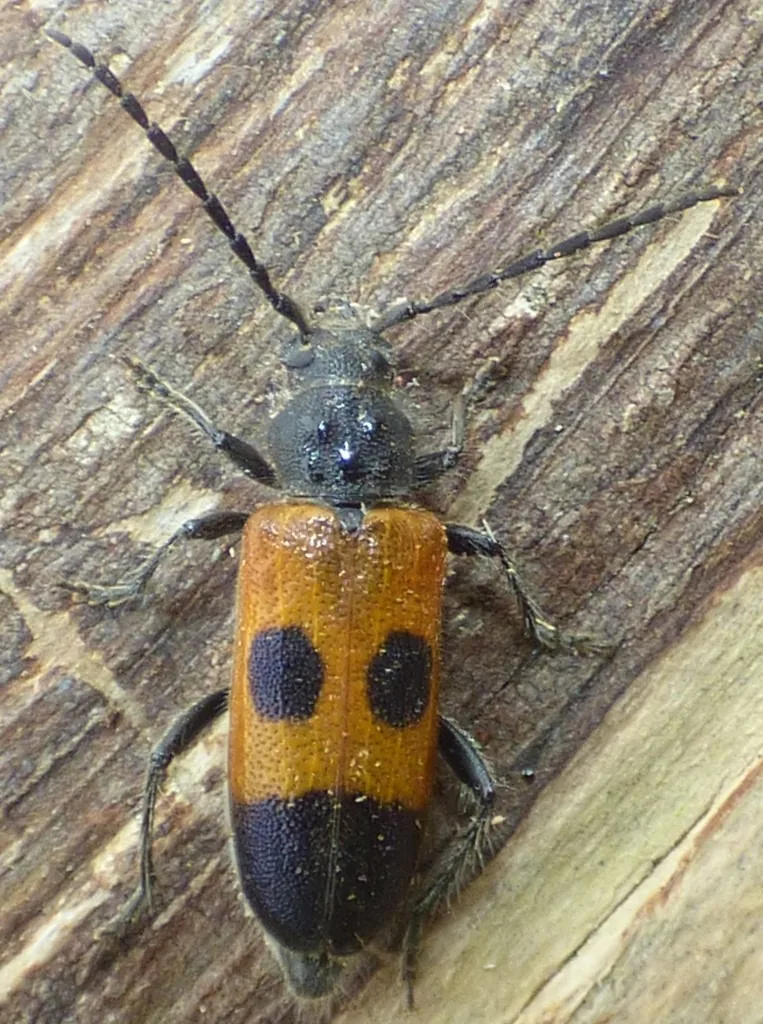
Cedar tree borer, a longhorned beetle with orange and black wing covers
Cedar tree borer, a longhorned beetle with orange and black wing covers. Photo: kcthetc1, public domain (CC0), via iNaturalist
On this page
  1. Identification
  2. Look-alikes
  3. Where it lives
  4. Biology
  5. Damage and signs
  6. Health risk
  7. Control
  8. Related profiles
  9. Common questions
  10. Sources

How to identify it

  • Adults are longhorned beetles 3/8 to 1/2 inch long.[1][2]
  • Outdoors, look for round exit holes and adult beetles on stressed or declining junipers and cedars.[1]
  • Indoors, beetles usually turn up in winter, emerging from firewood, lumber or log-cabin walls.[2]

Look-alikes

Look-alikeHow to tell them apart
Japanese cedar longhorned beetleAn invasive relative whose activity can be confused with the native cedar tree borer's.[1]

Where it lives

Found in the northern United States, including Minnesota, and southern Canada.[1][2]

Biology and life cycle

Adults are active roughly from March through August; in Connecticut they were drawn to cut eastern redcedar logs for about four weeks in April.[1]

Larvae bore galleries in the wood of stressed, dying or dead trees, and much of its life cycle is still poorly known.[1]

Damage and signs

  • It is a secondary pest that follows other problems rather than causing a tree's decline.[1]
  • Beetles emerging indoors leave only cosmetic damage in the wood and do not reinfest it.[2]

Health risk

None to people or pets.[1][2]

Control

Prevention

Keep junipers and cedars healthy with good site selection and planting.[1]

Pesticides

Chemical treatment is not recommended, because the beetle only attacks trees that are already in decline.[1]

Common questions

Why are beetles coming out of my firewood or log walls in winter?
Cedar tree borers that developed in the wood can emerge indoors; they don't reinfest it.[2]
Do cedar tree borers kill healthy trees?
No; they attack trees that are already stressed, dying or dead.[1]

Sources

  1. UMass Extension Landscape, Nursery and Urban Forestry Program (Landscape Insect & Mite Guide), “Semanotus ligneus (Cedar Longhorned Beetle, Native).” www.umass.edu/agriculture-food-environment/landscape/publications-resources/insect-mite-guide/semanotus-ligneus (accessed 2026-10-16)
  2. University of Minnesota Extension (What insect is this?), “Cedar tree borer.” apps.extension.umn.edu/garden/diagnose/insect/indoor/beetles/medium/cedartreeborer.html (accessed 2026-10-16)
  3. iNaturalist, “Semanotus ligneus taxon page (order and family).” www.inaturalist.org/taxa/230791 (accessed 2026-10-06)

Updated 2026-10-16. Built from sourced records. Spot an error? Tell us.