On this page
How to identify it
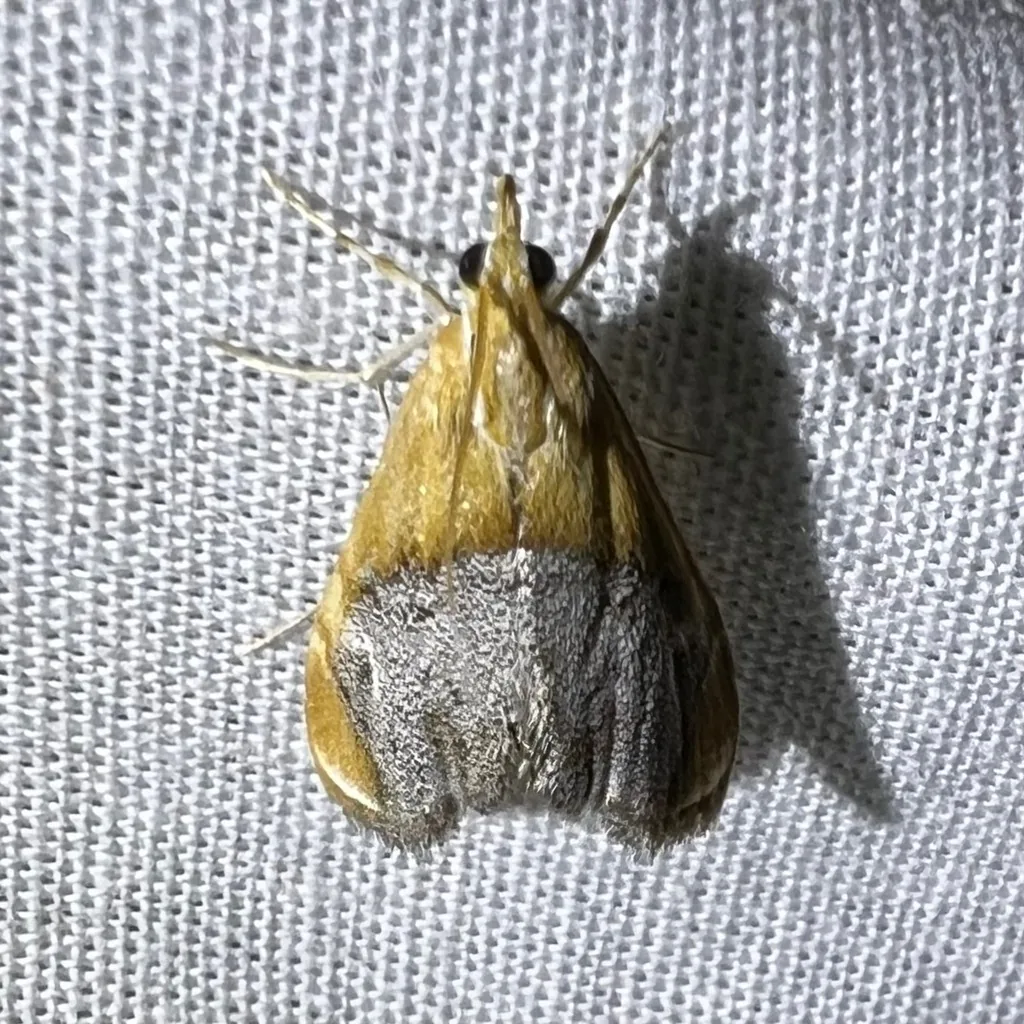
- Adults are small, with a wingspan of about 1/2 to 3/4 inch (14 to 20 mm). Males and females look alike.[1]
- Live moths hold their wings turned up, with the hindwings raised higher than the forewings. The hindwings are speckled gray with a white patch next to a metallic black strip, spots that probably mimic the eyes of small jumping spiders.[1]
- The sooty-winged chalcoela has rusty orange forewings with a lot of speckled gray. The pegasus chalcoela has reddish brown forewings crossed by two white bands, with speckled gray between them.[1]
- The caterpillars are hidden inside wasp nest cells, where they spin tough webbing. They later pupate in a tube-shaped cocoon spun inside a nest cell.[1]
Look-alikes
| Look-alike | How to tell them apart |
|---|---|
| Jumping spiders | The spots on a resting chalcoela's raised hindwings probably mimic the eyes of small jumping spiders such as Habronattus.[1] |
Where it lives
The sooty-winged chalcoela is found across most of the United States, southern Canada and Mexico, but not in peninsular Florida or Georgia, with few records from the Carolinas. The pegasus chalcoela lives in the Caribbean and across most of the eastern United States, from Florida (where it is common) west to the Texas-Louisiana border and north to southern Indiana and Delaware. The two ranges overlap widely.[1]
Biology and life cycle
Females lay eggs at night. In a laboratory study, sooty-winged chalcoela females laid only at night, prompted by contact with the nest or adult wasps, and put their eggs on the surface above or beside the nest rather than on it, so the newly hatched caterpillars have to crawl into the nest themselves.[1][2]
Each caterpillar feeds on immature wasps in the cells and destroys, on average, one wasp larva or pupa, sometimes moving into the next cell if it runs out of food. A small caterpillar has been seen feeding on a large, mature wasp larva, so the moths are better described as predators than parasites.[1]
Development from egg to adult takes about four weeks in warm weather. There can be several generations a year, the caterpillars overwinter, and adults fly from about April through October. Adults live only 7 to 14 days.[1]
The caterpillars never feed on plants. They attack many Polistes species, mostly native ones but also the invasive European paper wasp (Polistes dominulus), and females lay eggs more often on exposed nests, such as nests built on buildings, than on hidden ones. Adult wasps often show alarm and chase the moths away.[1]
Damage and signs
- The caterpillars do not feed on plants; the only damage is to paper wasp broods. Infestation rates vary widely: about 5% of nests of one Polistes species in northern Georgia, about 10% of colonies of two species in Missouri, and close to 50% of nests of another species in one field study.[1][2]
- Their effect on wasp populations is usually minor, though heavy infestations have been linked to the decline of nests, and the pegasus chalcoela has been reported wiping out paper wasp species on several Caribbean islands.[1]
Health risk
The moths feed only on paper wasp brood inside the nest; their caterpillars do not feed on plants, and the source mentions no harm to people.[1]
Control
Prevention
No control is needed; chalcoela moths are natural enemies of paper wasps. They have even been suggested for biological control of invasive paper wasps, though because they attack native Polistes too, that use is limited where native paper wasps should be protected.[1]
Common questions
- Why did moths come out of a paper wasp nest?
- Chalcoela caterpillars develop inside paper wasp nest cells, feeding on the wasp larvae and pupae, and pupate there in tube-shaped cocoons, so the adult moths emerge from the nest.[1]
- Do chalcoela moths harm plants?
- No. Their caterpillars do not feed on plants; they feed only on immature paper wasps.[1]
Sources
- University of Florida/IFAS Extension (Featured Creatures), “Chalcoela Moths: Pegasus Chalcoela, Chalcoela pegasalis Walker and Sooty-Wing Chalcoela, Chalcoela iphitalis Walker, EENY-826 (V. Miskimen and A. Sourakov; 2026).” journals.flvc.org/edis/article/view/138530 (accessed 2026-11-09)
- Insects (via NCBI PubMed), “A preliminary investigation of the interactions between the brood parasite Chalcoela iphitalis and its polistine wasp hosts (Insects, 2017; abstract).” pubmed.ncbi.nlm.nih.gov/28837069/ (accessed 2026-11-09)
- iNaturalist, “Chalcoela taxon page (order and family).” www.inaturalist.org/taxa/174382 (accessed 2026-11-09)